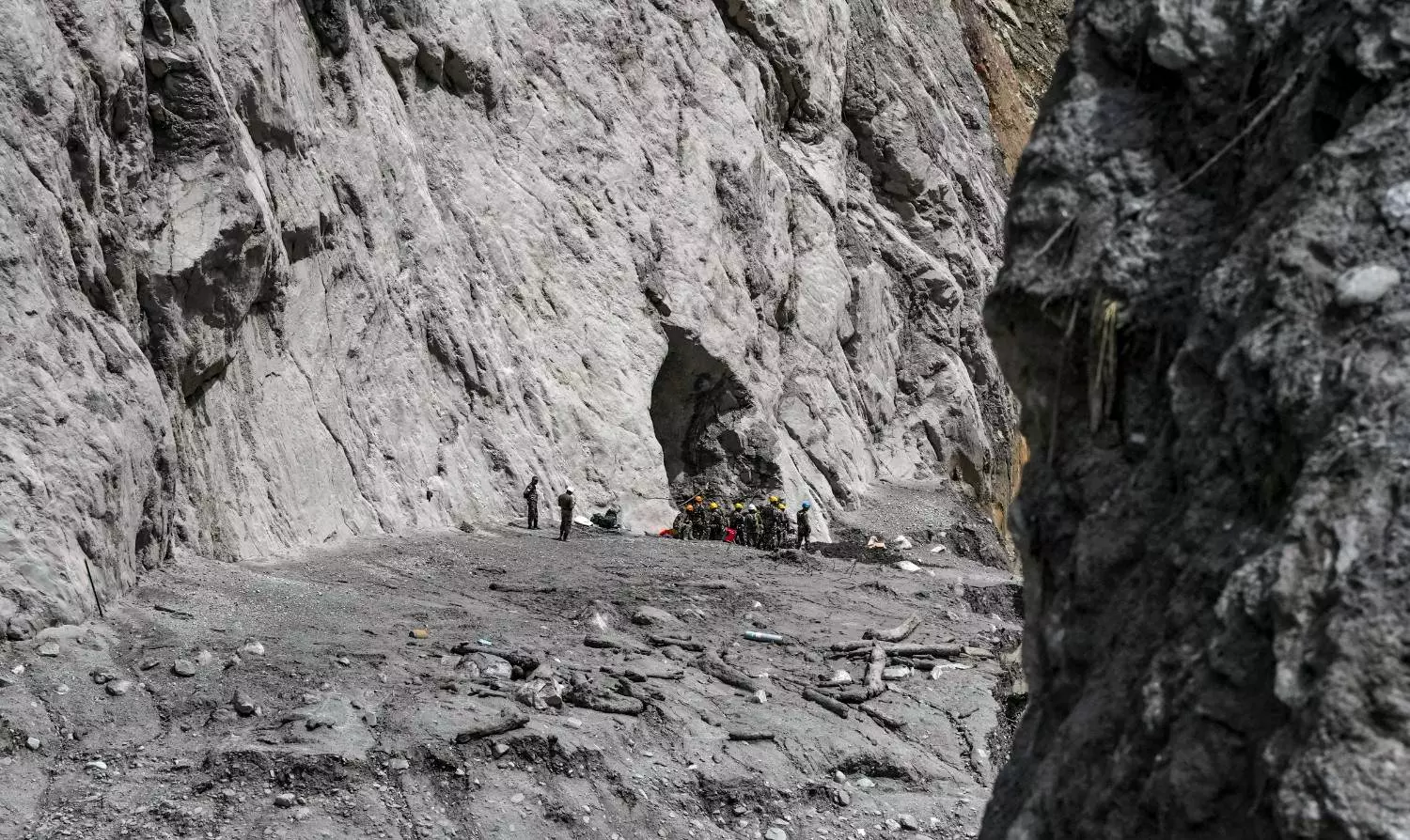
Nepalese officials recover the mortal remains of victims during a search and rescue operation after the devastating flash floods, in Rasuwa, Nepal, on Tuesday, September 1. PTI
Glaciers are collapsing, valleys are flooding, and across the Himalayas we keep building settlements, roads and dams in the path of disaster
The August flood that tore through the Nepal-Tibet border was not an act of God. It was the latest in a long line of Himalayan disasters stretching back decades – glacial lake outburst floods, sudden ice collapses, and catastrophic flash floods – each one preceded by scientific warnings that went unheeded.
The International Centre for Integrated Mountain Development (ICIMOD), a climate research organisation, reported earlier this year that glaciers across the Hindu Kush Himalayas (HKH) are melting at an accelerating rate, with ice loss doubling since the turn of the century. The region’s glaciers have thinned by nearly half a metre each year on average, and some have lost more than 27 metres of ice depth since 1975. The mountains are crumbling, and we are still building as if they are not.
Also read: From Chernobyl to Nepal floods: Why 26 is turning into a deadly date
This is not a distant crisis. The Himalayas are warming at roughly twice the global average. Glacial lake outburst flood risks may triple in the coming decades. The question is no longer whether these disasters will strike, but how we prepare for them. And on that count, we are failing spectacularly.
Construction chaos
Across the Himalayan states of India and Nepal, unregulated construction has turned river valleys and unstable slopes into death traps. The National Disaster Management Authority (NDMA), in its assessment of the 2023 Himachal Pradesh floods, found that unchecked growth of settlements around riverbanks and valleys, driven by tourism and population pressures, puts communities at direct risk during flash floods. Often, these constructions ignore essential guidelines, leading to rampant building on unstable slopes and floodplains.
The 2013 Kedarnath disaster offers a chilling preview. After the flash floods that killed thousands, scientists at the Wadia Institute of Himalayan Geology recommended a complete ban on new construction near the shrine. They suggested the entire township, which was devastated, should be shifted 2-3 km downstream. The warnings were ignored. Today, buildings and hotels have multiplied in the same vulnerable zone.
Also read: Nepal sought more glacier data from China months before deadly floods: Report
Satellite images show that infrastructure density in many Himalayan valleys has increased dramatically over the past two decades, leaving virtually no escape space for floodwaters. The 2026 flood swept through valleys where construction had continued unabated.
Hydropower’s reckoning
If construction is reckless, hydropower is outright dangerous. A 2025 study examining 257 Himalayan hydroelectric projects found that 66 per cent of sampled projects lie on potential glacial lake outburst tracks, and up to one third could experience discharges well above what they were designed to withstand. Development is pushing into higher, riskier sites closer to glacial lakes, effectively doubling the uncertainty about flood peaks.
The August flood took just 26 minutes to travel from Tibet into Nepal. But warnings still move no faster than diplomatic emails
The evidence is written in rubble. In February 2021, a massive rock and ice avalanche descended on Chamoli district in Uttarakhand. Two hydropower plants were destroyed. The 13.2 MW Rishiganga project was swept away. Power utility National Thermal Power Corporation’s (NTPC) 480 MW Tapovan-Vishnugad project suffered an estimated loss of Rs 1,500 crore. The disaster was triggered by a sudden collapse, not a lake outburst, and it proved that the threat is more varied and more unpredictable than planners had assumed.
In October 2023, a landslide of frozen sediment collapsed into South Lhonak Lake in Sikkim, generating a tsunami-like wave that breached the moraine and destroyed the Teesta-III dam, India’s second-largest, built at a cost of nearly Rs 14,000 crore. The flood claimed 55 lives, left 74 missing, and damaged infrastructure as far as 385 km downstream. It was not an anomaly. It was a warning.
Also read: Scientists saw the Himalayan disaster coming, but nobody listened
This is not just a safety crisis. It is also an energy security crisis. The Himachal Pradesh Council for Science, Technology and Environment found that glacier cover in the Sutlej basin shrank from 1,482 sq km in 2000 to 1,384 sq km in 2020. More than 80 per cent of the region’s glaciers are retreating. Most hydropower projects in Himachal rely on glacier-fed rivers. Any alteration in glacier behaviour directly affects electricity generation.
The sustainability of hydropower and long-term energy security are both under increasing threat. India’s hydropower ambitions are built on foundations that cannot withstand the new climate reality.
Cost of diplomatic indifference
The August flood took just 26 minutes to travel from Tibet into Nepal. But warnings still move no faster than diplomatic emails. ICIMOD has long called for stronger regional cooperation, expanded monitoring, standardised methods, and sustained investment.
The first meeting of the HKH Cryosphere Advisory Working Group in August 2025 brought together India, China, Nepal, Bhutan and Pakistan. But formal, binding agreements remain elusive. Himachal Pradesh’s chief minister has called for a dedicated India-China hotline for early warning. That call must be answered, and extended to Nepal.
The NDMA has rightly called for the environmental effects of hydro projects to be assessed cumulatively in river basins, and for standard operating procedures to be developed for disaster response at project sites
A disaster that ignores borders demands cooperation that matches it. The Koshi basin alone has experienced two dozen glacial lake outburst events, all with transboundary impacts. Yet there is no system for real-time data sharing between the countries most affected by the floods. Without it, every future warning will arrive too late.
What must change
The human and developmental costs of Himalayan disasters will continue to multiply unless we act. First, there is an urgent need for strictly enforced restrictions on construction in high-risk zones. Not blanket bans – those are unrealistic – but rigorous, enforceable standards backed by risk-sensitive land-use planning.
Also read: Who went to Kailash? Nepal floods expose a gap in tracking private pilgrims from India
The NDMA has already emphasised that construction practices must undergo rigorous evaluation and building regulations require updating and reinforcement. That recommendation must become law, with independent oversight and penalties for violations. The other involved nations must follow.
Second, hydropower safety standards must be redesigned for catastrophic flood scenarios, not historical averages. Independent audits of all existing and planned projects are non-negotiable. Energy security depends on resilient infrastructure, not just installed capacity.
The NDMA has rightly called for the environmental effects of hydro projects to be assessed cumulatively in river basins, and for standard operating procedures to be developed for disaster response at project sites.
Third, we must have a trilateral monitoring and early warning agreement between India, China and Nepal, with real-time data sharing and funding tied to compliance. ICIMOD has warned that we are trying to navigate a rapidly changing future with an incomplete map. That map must be completed, and it must be shared.
The Himalayan melt is inevitable, but the disasters are not. Apathy is not policy. Mountains do not recognise borders. And 2026 must not become the new normal.
(The Federal seeks to present views and opinions from all sides of the spectrum. The information, ideas, or opinions in the articles are of the author and do not necessarily reflect the views of The Federal.)