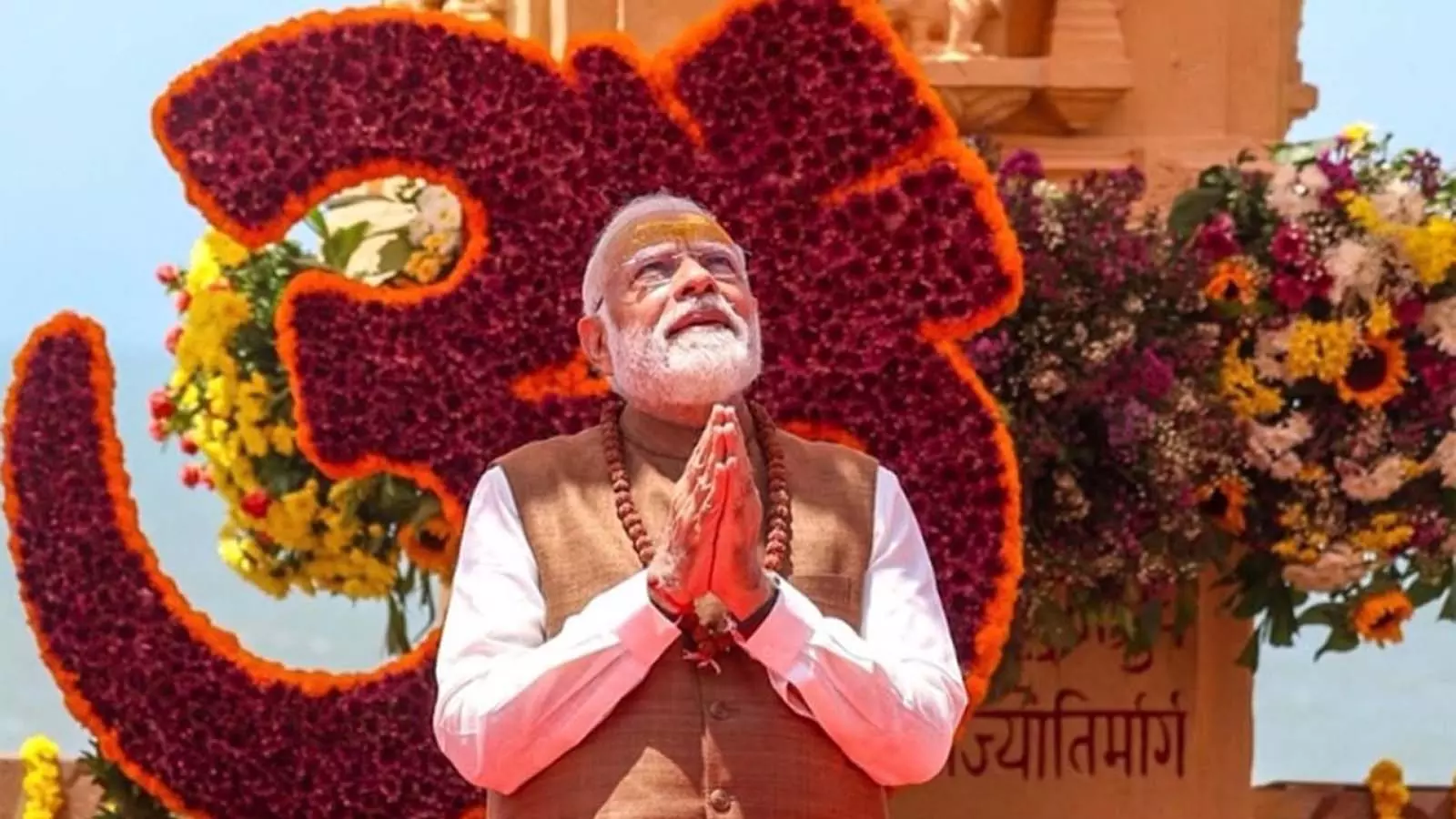
Prime Minister Narendra Modi’s appeal to people in a public meeting in Hyderabad on Sunday (May 11) to carpool, work from home, use public transport, and consume less cooking oil to tide over the crisis caused by the war in West Asia does not appear to be the speech of a leader of a major economy in the world but that of a leader of a small and vulnerable country.
It is indeed the case that India despite its claim of being the fastest growing major economy in the world is vulnerable. It’s brisk growth has not been based on a deeply strong economy. It is standing on the edge as it were, and a major global economic shock and the country would tumble. It has already slipped from the fifth largest economy in the world to sixth in 2025, and this is mainly due to the rupee weakening against the dollar, moving down from around Rs 80 to Rs 95.
For the last few months, the prime minister has been busy campaigning in the assembly elections in West Bengal, Assam, Kerala, Tamil Nadu and Puducherry. And, it is only now that he has found time to look at the impact of the US-Israel war on Iran on the national economy.
India not a Vishwaguru
Mr Modi’s claims that India is the Vishwaguru, and that it is an important player in world affairs sound empty. When the country should have thrown its weight and spoken out clearly and loudly, whether it is the Russian-Ukraine war, or it is the Israeli massacre of 70,000 civilians in Gaza, or the US-Israel attack on Iran. But India has reduced itself to a woefully passive actor on the global stage.
In the Russian-Ukraine war, all that the Indian government was concerned was the safety of the Indian students in Ukraine, or Indians fighting as mercenaries in the Russian war front, or the evacuation of Indians from Iran when the war broke out, and mild murmurs on the killing of civilians in Gaza. It is as though that India is afraid of raising its voice for fear of being rebuked, rebuffed and derided.
The only thing that Mr Modi mustered enough courage was to tell Russian President Vladimir Putin that this is not an era of wars.
India is not as helpless as its prime minister and others in the right-wing security and strategy establishment in the country believe themselves to be. It needs courage and little less of diffidence for India to tell Putin that Russia’s differences with Ukraine cannot be settled by force, or tell Israeli Prime Minister Benjamin Netanyahu that it is not right to target civilians whatever the provocation of Hamas, and that aerial attacks on Iran’s nuclear and security installations will not solve the problem of perception that Israel, the US and Iran have of each other.
Mr Modi’s claims that India is the Vishwaguru, and that it is an important player in world affairs sound empty. For India has reduced itself to a woefully passive actor on the global stage.
India should have showed initiative in pressing for a ceasefire in West Asia because the disruption in oil supplies, gas and fertilisers is affecting India directly. Despite its sharp differences with Pakistan, India should have joined hands with Islamabad in the mediatory efforts.
Blinkered vision
There is this blinkered vision among the ostensibly hard-nosed hawks in India’s strategic community that India should not ever talk of peace and harmony in the international affairs because that would make India a namby-pamby dove, and no one would respect its economic and military prowess.
India should be speaking out assertively for peace and dialogue among all the combating countries because global peace is what India needs for its economic growth. India has to learn to be hawkish about peace. The prime minister’s Hyderabad speech shows that India’s economic prowess is under huge stress and the leader is pleading with people to adopt economic austerity.
For the last few weeks, members of the Modi government had been issuing statements that India is comfortably placed with regard to oil supplies when the situation was precarious.
It is not entirely Mr Modi's fault that he dare not speak aggressively for world peace. The change in stance goes back to 1991 when India adopted economic liberalisation. The strategy wizards argued that India should stop the psychobabble about world peace, cut down on its empty preachy habit and focus on economic growth.
Mr Modi’s message of economic austerity displays a sense of helplessness, which is pathetic. India needs to be pro-active because it is an global economic player to reckon with.
The blinkered experts forgot the key factor that economic growth can happen best only in a peaceful world, and in its own national interest India should be speaking loudly about world peace.
India needs world peace so that it can become the third largest economy and clock a GDP of $7 trillion in the next decade.
India needs world peace
As one of the big economies, India’s stance carries weight. It is not any more a poor, developing country that it was in the 1950s through 1970s. It has become one of the key markets for investment and consumption, and New Delhi should be throwing its economic weight around for the sake of international peace.
Peace is not a utopian goal, it is a hard necessity. India as a matter of fact should be using the high moral pitch to serve its own economic interests. It just goes to show that the policy wonks in India are wooden in their responses. They are not able to connect the high ideal of peace with the imperative of economic growth.
There are times when the rhetoric of coercive and muscular diplomacy should give way to plain peacenik speak because that is the need of the hour.
The US-Israel war against Iran has not only disrupted the global oil supplies but it is hurting the global economic prospects. The US and Israel cannot hold the world economy to ransom because of their preconceived notions of the threat posed by Iran’s nuclear programme. There should be other ways of settling the matter. There is no doubt that the West Asia crisis is very complicated because of the stance of the Gulf Arab states, apart from that of Iran, Israel and the US.
India should be parleying with Iran, Israel, Saudi Arabia and the United Arab Emirates and openly support Pakistan playing the ‘honest broker’ between Iran and the US. Mr Modi’s message of economic austerity displays a sense of helplessness, which is pathetic. India needs to be pro-active because it is an global economic player to reckon with.
(The Federal seeks to present views and opinions from all sides of the spectrum. The information, ideas or opinions in the articles are of the author and do not necessarily reflect the views of The Federal)