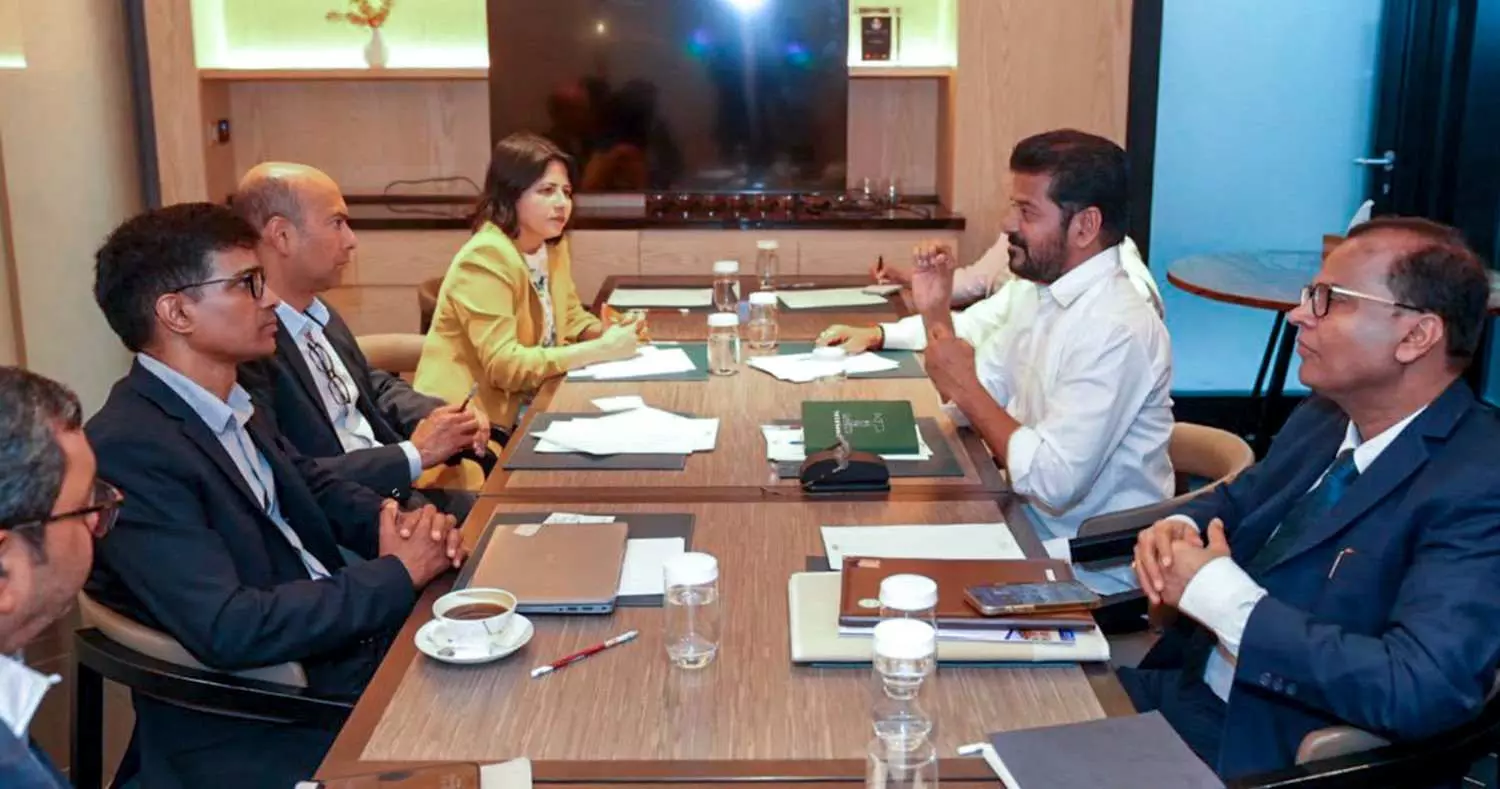
Telangana Chief Minister Revanth Reddy (right) and others during a meeting with an academic team from the University of Cambridge, in London, during his recent overseas trip. Photo: PTI
While Reddy has alleged discrimination, citing clearance given for similar visit to Gujarat CM, MEA must put on record Telangana CM’s proposed itinerary, and explain why Delhi found it objectionable
Telangana Chief Minister A Revanth Reddy, who was denied political clearance by Delhi to visit the United States, lashed out at the Centre after returning from the UK. Accusing Delhi of discrimination, Reddy said the Centre prevented him from travelling to the US, meant to attract educational institutions to Telangana, even though it had no issues with Gujarat Chief Minister Bhupendra Patel’s visit to America to promote the state’s Vibrant Gujarat conference.
On reports that said he was scheduled to meet New York Mayor Zohran Mamdani and US Vice President JD Vance, Reddy said “I did not have any permission to meet Vance and Mamdani, and I had not applied for this permission also”. Besides, he said, “Mamdani is not an anti-social element. He is an elected mayor”. Thus, all in all, Reddy, backed by the Congress, has sought to make the denial of political clearance to him an issue of discrimination against an opposition-ruled state.
Reddy went by book; did govt falter?
In adhering to Delhi’s decision not to visit the US, Reddy did the right thing because political clearance is necessary for officials, political office holders, members of legislatures, and constitutional authorities before they go abroad, whether on official or even private visits.
When asked about the denial of permission to Reddy to travel to the US, the Ministry of External Affairs (MEA) spokesperson on July 21 said “...the visits of chief ministers, as indeed of other dignitaries, are assessed by the MEA in order to accord political clearance. The programme proposed in such cases should be appropriate to the office held, and the purpose of the visit. In this particular case, that was not so in respect of the United States, and therefore, the clearance was denied, not given”.
Also Read: Revanth Reddy’s US visit cancelled: Will Telangana’s investment push take a hit?
In the light of Reddy’s charges against the Centre, the MEA spokesperson would now do well to place on record the purposes, programme and meetings that Reddy had given for his US visit. Among these, what did Delhi find objectionable? Reddy could have been asked to modify the programme if some of his meetings, likely or fixed, were found to be undesirable. Surely, a chief minister deserved such courtesy. The MEA spokesperson could also clarify Reddy’s response if such advice was given.
Meeting with Mamdani not a wise call
Naturally, the Congress has protested the denial of clearance to Reddy for the US visit. It has asserted that the purpose of Reddy’s visit was to “make Telangana a global hub for education, innovation, skills and investment”. For this purpose, Reddy was slated to visit leading US educational institutions to encourage them to look to Telangana for setting up centres in the state. The party has therefore charged the government that by preventing Reddy’s visit, it has acted against the interests of the youth. The government has not responded to this charge as yet.
Regarding Reddy’s comment on Mamdani, it can be said that it is true that he is an elected mayor, but he has been very critical of India’s West Asia policy. Foreign policy is within the purview of the central government and therefore it would be hardly proper for a chief minister of any state in India to meet an elected official in a foreign country who is so opposed to Indian policies on any issue.
Also Read: Centre denies political clearance to Telangana CM Revanth Reddy for US visit
It is also a fact that Mamdani is opposed to the Narendra Modi government’s domestic policies, especially against the minorities. But it is wise for Indian political leaders not to take the country’s domestic politics abroad. Hence, if a person like Mamdani takes a partisan view of Indian politics, any chief minister should avoid meeting him. However, Delhi could have found no credible basis for objecting to a Vance-Reddy meeting if the US vice president was willing to meet the Telangana chief minister.
How Centre approves foreign visits
Given the present controversy, it may be useful for readers to learn how political clearances are sought and given by the central government.
The MEA is responsible for political clearances. Those seeking clearances approach the MEA, where a specific ‘division’ of the ministry processes them. In doing so, it seeks the views of Indian Missions/Posts on different aspects concerning the visit, including those relating to security. The views of the concerned territorial division are also taken into account.
Also Read: Is Revanth’s delimitation formula for fair South representation reasonable?
Clearances for officials are given at the level of the secretary overseeing political clearances. In other cases, the file is forwarded to the Union External Affairs Minister with the recommendation of the secretary. Naturally, the secretary takes into account the views of the concerned Mission/Post and MEA division. While it is examined whether the visit is for participation in an event, the nature and suitability of the event for the applicant is also taken into account. If the visit is for other reasons, then overall diplomatic considerations, including relations with the country to be visited, are taken into account.
MEA reasons, CJI accepts
An overwhelming number of applications for political clearance are approved. However, in some, they are refused, not because of domestic political considerations – at least that was so in the past—but because of objective considerations. A few cases where clearances were not given are within the personal knowledge of this writer. Some are worth recalling.
Also Read: Revanth vs Pinarayi in ‘letter war’ over Mohanlal punchline
In one case, a serving chief justice of India (CJI), the attorney general (AG) and other senior members of the official legal fraternity wanted clearance to attend a legal seminar hosted by a group in a US university. The concerned Indian Consulate in the US reported that the event was going to be small, the hosts were an obscure group, and that the audience would be very limited. It opined that the event was not going to be important enough for the participation of the CJI, AG and others.
As the matter involved the CJI, the MEA decided to send the Consulate’s report to the CJI through the Union law ministry. The MEA took the view that because of the Consulate’s report, it did not find it possible to recommend that the CJI and others attend this conference. However, it prudently left the decision to the CJI. Taking the MEA's hint, the CJI and others cancelled their visit. In this case, the MEA’s action was not obstructive, but objective, and the CJI wisely did not press the issue.
Sensitive visits always a no-no
There were cases of governors who wanted to accept the invitations of little-known Indian community organisations and in these cases political clearances were denied too. Those days, the MEA’s view at the professional level, upheld by the then external affairs minister, SM Krishna, was that governors should devote themselves to their constitutional duties and not look for opportunities to travel overseas on what were nothing but junkets.
In one instance, two Lok Aayuktas wanted to go to a conference where representatives of Pakistan-occupied Jammu and Kashmir (PoJK) were invited. They were advised not to go. In response, they wanted to know the law and rules that had led to MEA’s advice. They were informed that the MEA was responsible for the conduct of India’s external relations and that it had made a judgment that Indian constitutional authorities could not take part in an event where a PoJK representative would be present, for it would be against the national interest. The Lok Aayuktas finally saw reason.
These cases show that sometimes the MEA denies political clearance for good reasons. This, however, cannot be said of MEA denial of clearance for Reddy’s US visit unless it gives a full and credible account for doing so.
(The Federal seeks to present views and opinions from all sides of the spectrum. The information, ideas or opinions in the articles are of the author and do not necessarily reflect the views of The Federal)