From Republic Day sermons to Kartavya Path naming, Sangh Parivar’s emphasis on duty reveals deeper reordering of ruling dispensation's constitutional priorities
It operated for its first 25 years without a written constitution. It is now is its centenary year. And yet, the Rashtriya Swayamsevak Sangh (RSS) has no formal existence on paper.
Given this, it was an oddity that one of its most important office bearers had one essential sermon to deliver to the people on the occasion of the Republic Day.
Before delving into that, a quick recap is in order to set the context. It is an unvarnished truth that the RSS, ideological fountainhead of the BJP, would not have adopted its Charter had it not been for the insistence of Sardar Vallabhbhai Patel, India’s first Deputy Prime Minister and Union Home Minister, and the accusation of having been part of the conspiracy to assassinate Mahatma Gandhi.
BJP and RSS are completely in sync insofar as ideological matters are concerned, regarding statecraft, as well as which constitutional notions have to be prioritised over others.
Even thereafter, the RSS had a very tenuous relationship with the Indian Constitution, as well as the National Flag. It is only in recent years that important national commemorative celebrations started being held within its offices in different parts of the country.
With their scale being inconsequential, especially when compared to the official programmes, these celebrations and speeches made at RSS functions on Republic Day or Independence Day have been largely overlooked. They are for internal consumption, even though messages radiating from these are significant and are portents of a reality they would wish.
Duties over rights
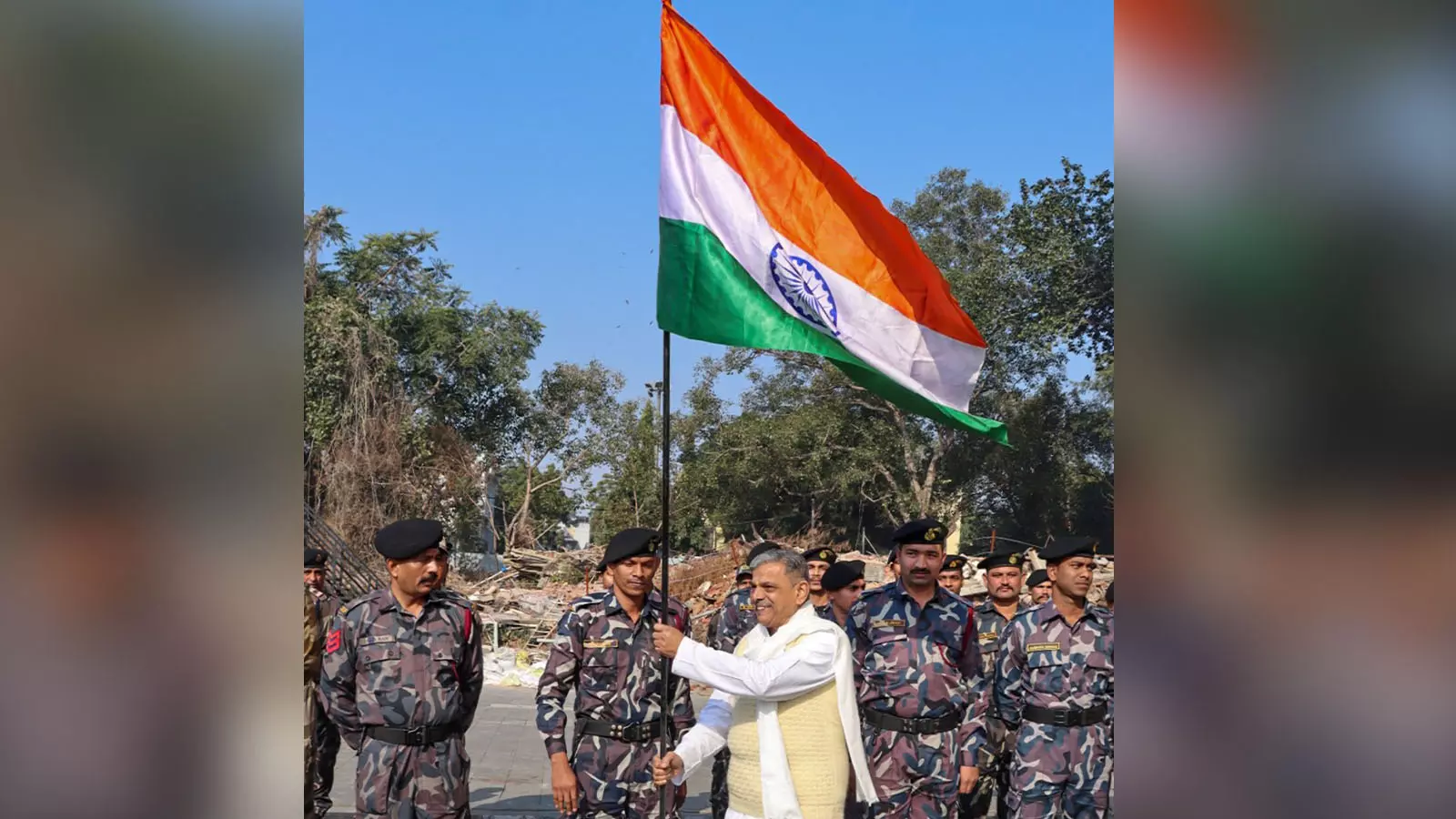
It is only because of this trend that a series of staccato assertions by Dattatreya Hosabale, the Sarkaryavah (general secretary) of the RSS, this Republic Day, after unfurling the national flag at the plush and renovated office in New Delhi, went virtually unnoticed.
Also read: Move over, Sanatana, what RSS truly cares about is political power
In these, he made one fundamental point: In the belief system of the RSS, fundamental duties of citizens are more important than their Rights enshrined in the Constitution.
This was evident in the simplest of ways – although there were several references to the duties of citizens from contemporary life, to sermons from mythology in Hosabale’s speech, there was not a single mention of the constitutional rights that are guaranteed to the citizens and which the government is expected to never violate.
It is worth recalling that the RSS and all its affiliates, including the BJP, remain among the most vociferous critics of Indira Gandhi’s decision to impose Emergency in the country in June 1975, when the suspension of the Fundamental Rights of citizens were among the most draconian of measures.
In sync with govt
Hosabale’s statements further underscored complete synergy between the organisation’s leaders and those in the party and government, especially Prime Minister Narendra Modi, on the singularly important issue of how the Constitution is to be interpreted and which Articles are to be prioritised.
In the belief system of the RSS, fundamental duties of citizens are more important than their Rights enshrined in the Constitution.
It is important to recall that such politically-driven comprehension is unwaveringly spoken about a text that Modi has repeatedly referred to as “India’s only Holy Book.”
These statements underscore that while these leaders may disagree on matters related to running the BJP and the process of choosing its office bearers, they are completely in sync insofar as ideological matters are concerned, regarding statecraft, as well as which notions laid out in the Constitution have to be prioritised over others.
Fulfilling fundamental duties
In the relatively short speech after unfurling the tricolour, Hosabale said citizens must pledge to “uphold the eternal spiritual values of India in their lives, fulfil their civic duties and abide by national duty”.
Without elaborating on how citizens, with limited constitutional powers in their hands, can perform Herculean tasks, he exhorted them to safeguard “India’s unity, and securing India’s borders.”
Also read: RSS centenary: Historian explains why distorting the past is deeply problematic
Referring to the character of Bhishma Pitamah from the epic, Mahabharat, Hosabale stated that the patriarch coined the concepts of Praja Dharma and Praja Kartavya (citizens’ dharma or principle and citizens’ duties).
While elaborating these ideas, the mythological character detailed the duties of citizens towards the state and society, and called on them to follow these. The RSS leader urged Indians to do the same, as if there is little difference between the times these mythical tales purportedly depict and the contemporary period.
Paradoxically, Hosabale asserted that citizens must defend the Republic. He wanted them to have empathy for society, sensitivity for the downtrodden, and to dedicate themselves to work ceaselessly for the betterment of life and the nation.
The RSS leader, while foisting the above-mentioned set of duties, made no mention of the fact that the majority of these situation-altering actions can be best taken by the state and leaders in government and ruling parties. He, however, had no advice for those manning the positions of power and instead directed all his counsel to the lowest common denominators in society.
Delhi's Kartavya Bhavans
The Sangh Parivar’s inclination towards ensuring that people fulfil their Fundamental Duties is most evident in the government’s decision to name all new Central Secretariat buildings coming up in New Delhi as part of the Central Vista Project, as Kartavya Bhavans, 1, 2, 3... and so on. (Kartavya means 'duty'.)
In September 2022, the renovated Central Avenue that connects the Rashtrapati Bhavan with India Gate was ‘re-inaugurated’ (after all, the road was part of New Delhi, built by the British) by Prime Minister Narendra Modi and renamed Kartavya Path.
In his speech on the occasion, Modi declared that its then name, Rajpath, was being “erased forever” because that name was a “symbol of slavery”. He thereafter, announced the road’s new name, which underscores that the principal ethos of this part of the city – that citadel of the government – shall be duties to the nation.
It is important to remind those working from ministerial and other government offices about their duties and oaths they are bound with, but where does the citizen fit in?
It is important to remind those working from ministerial and other government offices about their duties and oaths they are bound with, but where does the citizen fit in? After all, the majority of occasions when they approach those in these offices or their ilk throughout the country, are about seeking their various entitlements and to ensure their enshrined right are not violated, and seek recourse if they are.
Why then did the government not conceptualise an Adhikar Bhavan, where lesser mortals can go and seek redress? Without such a space for citizens in an ideal democracy, is it possible for people to stop being slavish to the government of the day?
Also read: RSS at 100 stands tall but is shadowed by a fraught past and fractious present
Despite the absence of such a platform, Modi on the day in 2022 stated that Rajpath, the name given to King’s Way after Independence, represented “slave mentality” and, by renaming the road as Kartavya Path, this had been rejected by the Republic under his charge.
'When the king is lazy...'
Importantly, while ministerial officers are called Kartavya Bhavans, the new Prime Minister’s Office has been bestowed with the pretentious name of Sewa Teerth or Service Pilgrimage.
Given the choice of the name, would it be inappropriate to contend that Modi defines his work as Prime Minister as a pilgrimage and eschews duties of the office?
When Modi inaugurated the Central Avenue in September 2022, the noted mythologist, Devdutt Pattanaik, also master of sarcasm, tweeted: "When the king is lazy, he focuses less on his raj-marga and puts spotlight on your kartavya-patha."
It might be fit to recall a certain predecessor of Modi, Atal Bihari Vajpayee, reminded Modi of his Rajdharma in 2002, when Gujarat was still simmering in the aftermath of the riots that radically altered the nature of politics in the state and India.
The betrayal
As against the primary principles of Hindutva, it is pertinent to emphasise that the fundamental duties list in the Constitution includes upholding India’s unity and to “promote harmony and the spirit of common brotherhood amongst all the people of India, transcending religious, linguistic and regional or sectional diversities.”
All Indians, including holders of constitutional offices, are duty bound to “value and preserve the rich heritage of our composite culture.” Besides this, everyone is committed “to develop scientific temper, humanism, and the spirit of reform”.
Also read | Architecture as Modi's political assertion in remaking of Lutyens' Delhi
All these above-mentioned duties, listed in the Constitution, are anathema to the entire lot committed to majoritarian autocracy.
No one requires spoon-feeding and be told about occasions when this regime, including its topmost leaders, were found to have betrayed these duties. Significantly, the Fundamental Duties of citizens were not considered essential or important enough by the architects and founding fathers of the Indian Constitution and the Republic.
This section was introduced by Indira Gandhi contentiously during the Emergency as part of the 42nd Amendment, and exists as Article 51 (A), during the Emergency when Fundamental Rights were suspended.
While several sections of this Amendment were repealed, the one on Fundamental Duties was never repealed possibly because of ‘righteousness’ of the idea.
Evading rights
Almost from the time Modi assumed office, he spoke regularly regarding Fundamental Duties and almost demeaned civil society and even Opposition parties, for drawing attention on violation of constitutional rights of the people.
Also read: RSS chief Mohan Bhagwat says nationalism is not an issue in India
Such tactics were not surprising for populist leaders, and they continue to use similar rhetoric and demagoguery as tactics to demand the loyalty of citizens.
They follow the footsteps of the President of the United States John F Kennedy, who rephrased Khalil Gibran’s ever-popular line to his advantage in his 1961 inaugural address: “Ask not what your country can do for you – ask what you can do for your country.”
It is a greatly inspiring line in the moment of national crisis, but it cannot be a constant call to citizens, the country must also ‘do’ sufficiently for its people.
'Wasting our time'
In a speech in 2019, Modi charged that people had “turned away from our duties and did not give them primacy” and described this as a “malaise (that) has afflicted our society, our nation and all of us”.
In a direct assault on rights-driven organisations and people’s movements, the PM had contentiously stated that since Independence, “we only kept talking about rights, fighting for rights and wasting our time. The issue of rights may be right to some extent in certain circumstances, but neglecting one’s duties completely has played a huge role in keeping India vulnerable.”
A few days later, the then President of India, Ram Nath Kovind, in his address to the nation on the eve of Republic Day, virtually copied-pasted Modi’s speech and read it out.
The most problematic aspect of the Sangh Parivar’s consistent campaign to play up fundamental duties and run down constitutional rights and the demand for them when these are undermined, is that it divides citizens into two categories: One, the ‘good’ citizens who do not demand rights and perform the so-called duties with servility. Two, ‘bad’ citizens who initiate or join protest movements for fundamental rights whenever these are treaded usurped by the State and its agents.
Quite clearly, the Sangh Parivar wants people to perform duties with one hand and only after that, that too not always, extend the other hand for rights.
Hosabale did not state this explicitly, but the message was there loud and clear. The strategy is simple: Talk only about duties and people will eventually get brainwashed and forget the matter of their basic rights.
(The Federal seeks to present views and opinions from all sides of the spectrum. The information, ideas or opinions in the articles are of the author and do not necessarily reflect the views of The Federal.)