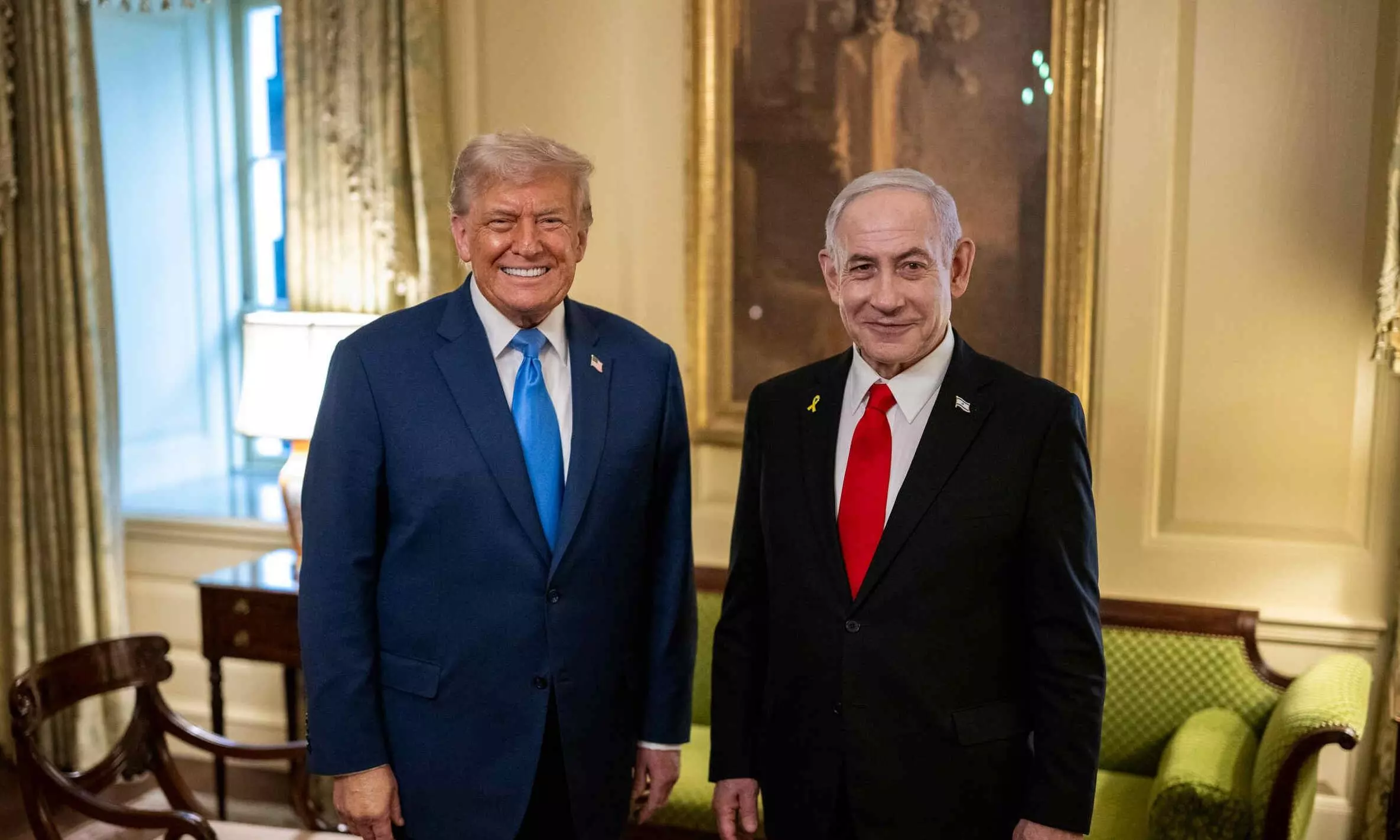
The US and Israel claim to uphold humanistic values, yet commit war crimes against Iran, a nation that, despite internal flaws, has acted peacefully globally
The war in Iran, initiated by Israel and the US, has drawn widespread global condemnation, yet it continues unabated, with no end in sight. Public opinion appears to matter little, as the leaders of two democratic countries seek, by their own stated goals, to push an ancient civilisation back to the Stone Age.
Also read: Israel isn’t just responding to threats – it’s reshaping Middle East
The US and Israel are both democratic countries given to humanistic rhetoric in public, often emphasising the value of every human life, but that hardly deters them from what they are doing, despite the ill-defined goals they claim to be pursuing. One may condemn what they are doing, but that merely adds to a plethora of gestures that serve as little deterrence.
Contradictions of Western morality
Israel and the US are both Western military powers, regardless of Israel being nominally in Asia, as they embody Western interests more than any others. The West looks askance at countries like India, which are still grappling with societies where there is admittedly more structural violence than in their own, but such humanistic concerns desert them when they embark on projects like the ongoing one in Iran. How they deploy humanistic rhetoric while being engaged in war crimes against a country that, despite its internal problems, has conducted itself peacefully with the rest of the world remains difficult to understand, and this is primarily an effort in that direction.
The US is no longer constituted by one religion and has embraced multiculturalism but it implicitly sees the Western nations and those of the white race as the only authentic representatives of ‘humanity’, though its political rhetoric proclaims otherwise. This justified the ruthlessness of colonialism and the extermination of Native Americans by the settlers
‘Structural violence’, unlike physical violence, is indirect, often invisible, and embedded in unequal systems such as racism, poverty, and sexism, leading to preventable health disparities, mortality, and limited life quality. Broadly speaking, structural violence in India was shaped by the caste system, which arguably stems from a Brahminical struggle for hegemony and dominance set in motion several millennia ago and remains very much alive. Measures instituted after 1947, such as reservation in public employment and education, have not achieved their intended impact.
Hinduism, a by-product of the same process, did not have a single point of origin like the Judaeo-Christian religions but evolved from aboriginal faiths brought under the authority of the Brahmins. This helps explain the vast number of gods and belief systems incorporated into it over millennia. The struggle in India was largely internal — with one group establishing control over others — rather than directed outward, which may explain why Indians are also not known to have attempted to conquer foreign lands outside the sub-continent.
Hierarchy of human lives
When we examine the Judaeo-Christian religions, they are seen to have originated from a single point. While Judaism rests on the notion that the Jews are chosen by God and therefore does not emphasise proselytisation, Christianity has expanded its reach through conversion. Christian communities, such as those in the US, gradually evolved into national communities, and the same sanctity accorded to the religious community came to be extended to the nation. Those outside the religious community had been called pagans and excluded from consideration as humans and evidence even exists in the products of popular culture today.
In the American TV series The House of David, the captured Amalekite king Agag, an enemy of the Israelites, is cut to pieces even while he is in chains. He is depicted as physically ugly and growling like an animal, denying him the humanity typically accorded to prisoners. This is God’s instruction – as the Prophet Samuel says – but that is to deny the enemies their humanity since God (by definition) should protect every human being; still, this is from an ancient religious text addressing only a chosen group while the US is using the same logic today while claiming to speak for democratic values and egalitarianism. Agag is described as “evil,” the same term used by US President Donald Trump against the Iranian leadership.
Also read: Trump’s Iran profanity: Desperation or dangerous escalation? | AI With Sanket
The US is no longer constituted by one religion and has embraced multiculturalism but it implicitly sees the Western nations and those of the white race as the only authentic representatives of ‘humanity’, though its political rhetoric proclaims otherwise. This justified the ruthlessness of colonialism and the extermination of Native Americans by the settlers.
The American liberal is vocal about issues involving ‘political correctness’, including putting restrictions on certain kinds of speech, being outraged by child abuse, and advocating gay rights, but these remain within the same circle of exclusivity. While ‘Black Lives Matter’ can inflame the US, there is no parallel ‘Iranian lives matter’
In films like Black Hawk Down (2001), the death of every American is meticulously counted and mourned while the Somali deaths go uncounted. An anti-war satire like M*A*S*H (1970) does not even show you the enemy (North Korea) when the US had bombed it virtually to rubble in the Korean War. What seems to matter are only the casualties on one’s own side even if they are few. There are few things more obscene than the desperate search for one missing American airman after another country has been incessantly bombed and even its schoolchildren have not been spared.
Silence of American liberals
The US has intellectuals who see things for what they are, but they find it difficult to be published in the liberal American press. Apart from Noam Chomsky, John Mearsheimer, a political scientist from Chicago and arguably one of the most prominent American commentators today, has said that, by the standards of Nuremberg, both Trump and Netanyahu are culpable of war crimes and deserve to be hanged. But this leads to the silence of American liberals over the war — when their elected government goes on a destructive spree like the present one, all they protest is authoritarianism through movements such as ‘No Kings’; the Democrats object only to the war being ‘unconstitutional’.
The fact is that American liberals also draw an exclusive circle around their own people, in the manner of a religious community whose God has told them that they are the chosen. The most striking case here is perhaps New York mayor Zohran Mamdani, proud of his Shi’ite birth, who, after speaking out fearlessly at every political opportunity, says nothing about the genocide. The American liberal is vocal about issues involving ‘political correctness’, including putting restrictions on certain kinds of speech, being outraged by child abuse, and advocating gay rights, but these remain within the same circle of exclusivity. While ‘Black Lives Matter’ can inflame the US, there is no parallel ‘Iranian lives matter’.
Regime change remains unlikely
This leaves us with the issue of the brutally repressive Iranian regime — about whose actions there can be little doubt. But can one really believe that bombing a country “back to the Stone Age” will remove a regime that, regardless of its oppression, emerged from what was once a popular movement? It would normally be expected that when a people are killed indiscriminately, as the US and Israel have been doing, whatever resistance is offered by the nation-state to such unprovoked external aggression would be regarded as heroic. If Iranians in the US (like the son of the former Shah, Reza Pahlavi) hope for regime change and cheer Trump on, it is hardly the Iranians speaking.
Also read: Trump claims ‘victory’ but no regime change in Iran; so who’s winning this war?
In fact, the chances are that the attack on Iran has weakened whatever opposition existed within the country. There were enough indications that regime change was unlikely, since the Opposition was not strong enough, but those indications were never heeded. But if one places such a low value on the lives of others, how does anyone go about preventing the war? As it stands, only high fuel prices stand in the way of the destruction of Iran.
(The Federal seeks to present views and opinions from all sides of the spectrum. The information, ideas or opinions in the articles are of the author and do not necessarily reflect the views of The Federal.)