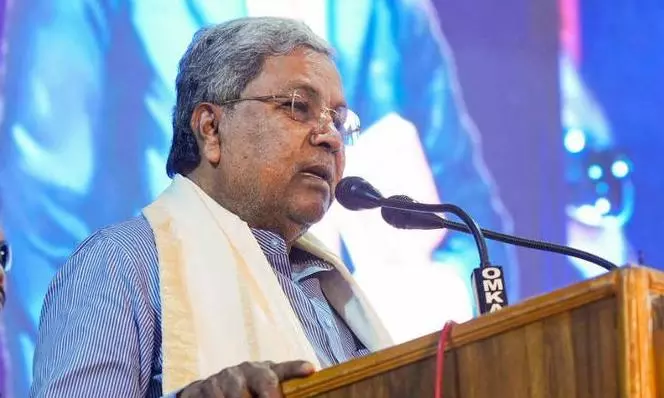
The key question now is whether Siddaramaiah will be allowed to complete his full term, and notch another record – that of completing two full terms. File photo: X/@siddaramaiah
Unlike Devaraj Urs who deserted Indira Gandhi and lost his way, Siddaramaiah followed Sonia Gandhi and prospered
If cricket can become political, why can’t politics be turned into a game? Karnataka Chief Minister Siddaramaiah has just become the state’s longest-serving chief minister, breaking the record of the iconic Devaraj Urs.
One can almost visualise Siddaramaiah breaking into a sword dance, like cricketer Ravindra Jadeja with his bat after a century. And, why not? To break a record of longevity, with his deputy DK Shivakumar snapping at his heels among others, is no small feat.
What is of significance, incidentally, is the length of Siddaramaiah’s service as chief minister, which runs into seven years 240 days (as of Wednesday), a day more than Devaraj Urs. It’s literally nothing compared to several other states.
In a nation where individuals have regularly governed for over 20 years like Sikkim’s Pavan Kumar Chamling who holds the record of the longest-serving chief minister (24 years, 165 days) followed by Odisha’s Naveen Patnaik, who fell short of Chamling by 66 days, followed by Bengal’s Jyoti Basu who crossed 23 years, Siddaramaiah’s meek “record” is a story in itself, which we will return to a little later.
Achieved record despite tremendous pressure
In fact, Karnataka is among five states that has never seen any chief minister cross 10 years in office. As everyone has seen in the last few months, the tremendous pressure Siddaramaiah has faced to hold on to his chair in the face of sustained challenge from Shivakumar – this is just a passing peek into the historical instability of the chief minister’s chair in the state.
Also Read: Siddaramaiah becomes Karnataka's longest-serving CM, breaks Devaraj Urs’ record
In the last two months, when it looked like the game was up for Siddaramaiah, some were of the view that the Congress leadership would “allow” him to break Urs’s record, with his deputy’s cooperation – much like Sachin Tendulkar being given the maximum opportunity to break a record before the end of play.
Another record on the way
Now that Siddaramaiah has completed his achievement, there looms one more record – linked to the state’s budget presentation. The chief minister, who holds the finance portfolio, is expected to score there as well – which would be another record for the maximum number of budgets presented by an individual minister in Karnataka.
Also Read: Shivakumar congratulates Siddaramaiah as he nears record tenure as Karnataka CM
If and when he does present the budget next month, it will be his 17th budget, no less. Former chief minister Ramakrishna Hegde comes some way behind with 13 budgets.
Congress dominance during Devaraj Urs’ period
If “seven years and 240 days” is considered a record for Karnataka, the reason can be traced to the nature of the state’s socially-fractured electorate. When Devaraj Urs was the chief minister in the 1970s, the context was different. He governed from 1972-77 and 78-80 (two terms, with the second one incomplete)
That was the period when the Congress was dominant in the state. His rule coincided with Indira Gandhi’s Emergency from June 1975-March 1977. Devaraj Urs was an Indira loyalist and remained with her when the Congress first split after the Emergency.
Also Read: Siddaramaiah set for record Karnataka CM tenure, uses Tendulkar-Kohli analogy
But then, in his second term, he developed differences with Indira Gandhi in 1979 and broke away from her along with other colleagues. However, the return of Ms Gandhi as prime minister in 1980 saw several of Urs’ supporters return to Indira Gandhi’s fold. He had to resign. Politically, that was the beginning of the end for Urs.
Siddaramaiah’s move to Congress
It worked out differently for Siddaramaiah, who was essentially a socialist and a member of the Janata Dal. He moved to the Congress in 2006, following a falling out with his mentor HD Deve Gowda and his son HD Kumaraswamy.
The Devaraj Urs period was marked by the then-chief minister’s master stroke in slicing through the dominant Vokkaliga and Lingayat castes, and reducing their political clout
Siddaramaiah was among a group of bright and purportedly committed individuals in the Janata Party, and then the Janata Dal who besides Ramakrishna Hegde and Deve Gowda were leaders in their own right – like Abdul Nazir Sab, Lakshmisagar, JH Patel, and SR Bommai. This was unlike the Congress which relied heavily on the charisma of one or two leaders while the rank and file was not particularly noteworthy.
Also Read: Siddaramaiah says Congress high command to decide on Karnataka leadership issue
When Siddaramaiah quit the Janata Dal and joined the Congress, he had to face widespread resentment within the party. But, his reputation as an able administrator including handling the finance portfolio protected him from the wave of opposition within the Congress. The new entrant quickly struck a chord with the then-powerful team in 10, Janpath, and specifically with the party supremo Sonia Gandhi.
Unlike Devaraj Urs who deserted the Indira Gandhi-led Congress and lost his way, Siddaramaiah came into the Congress then led by Sonia Gandhi and prospered.
Urs was game-changer for Karnataka
But, there can be no point-to-point comparison between the two chief ministers. Urs was a game-changer for Karnataka, a chief minister who is considered peerless in the state’s contemporary history since 1956. Siddaramaiah himself modestly conceded that he could not be compared to Urs, except that both hailed from Mysore district.
The Devaraj Urs period was marked by the then-chief minister’s master stroke in slicing through the dominant Vokkaliga and Lingayat castes, and reducing their political clout. Urs socially broke the hold of the Vokkaliga and Lingayat communities by implementing the land reforms in Karnataka and in a calculated move created openings for the backward class members in politics and governance. He set up the state’s first backward classes commission.
Also Read: Will serve full five-year term, says CM Siddaramaiah, rejects power-sharing talk
Urs’s fillip to the backward classes laid the foundation for future political changes in the state. The emergence of the Janata Party (and later the Janata Dal) in 1983 on an anti-Congress plank, brought forth individuals from the backward classes like Siddaramaiah to the forefront. And, similar to Urs, Siddaramaiah too has promoted the coalition of backward classes, Dalits, and minorities (AHINDA).
The other record they share is that they are the only two chief ministers to have completed a full term each – Urs from 1972-77 and Siddaramaiah from 2013-18. SM Krishna of the Congress too could have completed his term from 1999-2004, but before his term technically ended, he suo motu called for elections.
State’s political instability
The loss of the Congress’s political dominance, followed by the emergence of the backward caste-oriented Janata Dal which later split enabling the emergence of the BJP, have all contributed to the state’s political instability as none of the three parties has managed to conclusively score over the other two.
Siddaramaiah, though somewhat disconnected from the dominant Vokkaliga and Lingayat communities, has managed to keep his flock together to reach where he has, using his political acumen
In the ensuing politico-electoral arithmetic, only that party which has the cross-section of support from across all communities in Karnataka has managed to get a majority on its own. The Congress, in that sense, was helped by the entry of Siddaramaiah who brought along with him the support of the OBCs.
Also Read: Siddaramaiah: ‘I will remain CM for five years, we will return to power in 2028'
The BJP, though in power on and off since 2008, has never managed a simple majority on its own in the 224-member Assembly as it has so far not managed to get the support of the Dalits and minorities. Its topmost leader BS Yediyurappa who showed promise of carrying on for a full term when the BJP came to power in 2008 failed to achieve this as he was unable to manage the contradictory power centres within the party along with his personal failures.
Will he complete two full terms?
Siddaramaiah, though somewhat disconnected from the dominant Vokkaliga and Lingayat communities, has managed to keep his flock together to reach where he has, using his political acumen. Among other things, he will be remembered for conceiving the five guarantee schemes for the poor, minorities, and women that, many believe, played a major role in the resounding success of the Congress in 2023.
The key question now is whether he will be allowed to complete his full term, and notch another record – that of completing two full terms. But that is a story for another day.