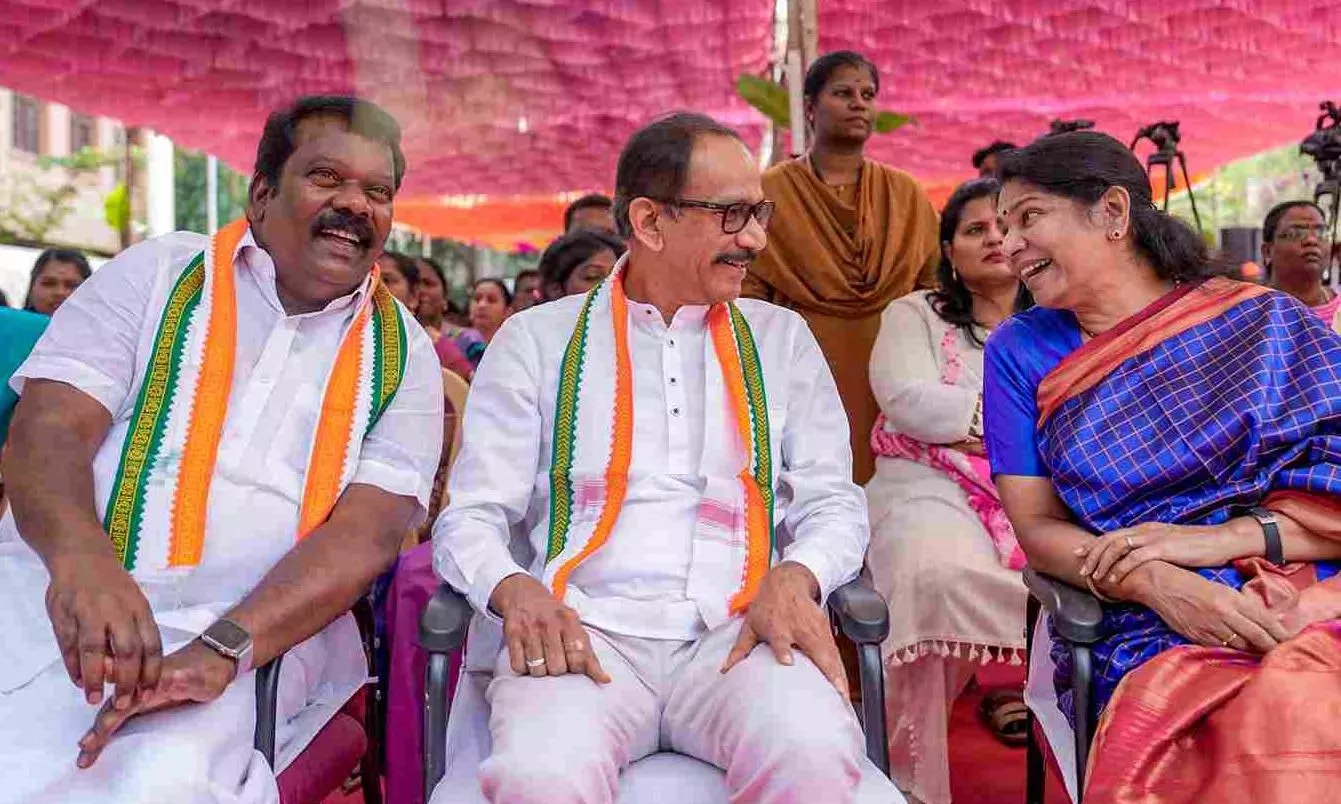
If Congress wants to rebuild its TN base, it should go for patient reorganisation, local leadership and consistent messaging, and not flirt with untested allies
The political signals coming from Tamil Nadu Congress and actor-politician Vijay’s Tamilaga Vettri Kazhagam (TVK) convey distinctly different messages.
On the one hand, the All India Congress Committee (AICC) in-charge Girish Chodankar has reaffirmed that the party continues to stand with the DMK-led alliance. On the other hand, the TVK has called the Congress a “natural ally”, hinting at friendship and future alignment.
Somewhere between these two cues lies a risk the Congress cannot afford to ignore. In a state where the party lacks an independent base, any move away from the DMK would be a strategic misstep.
Alliance dilemma
The Congress in Tamil Nadu is facing a classic coalition dilemma that political scientists would describe as a problem of “asymmetric dependence”.
A public controversy over Congress strategist Praveen Chakravarty’s recent remarks on Tamil Nadu’s debt sharpened this tension. Though Chakravarty’s point is disputable, more economic than political, it was seen as a veiled criticism of the DMK government. The DMK’s quick rebuke, followed by mixed signals from senior Congress leaders such as Manickam Tagore and P Chidambaram, revealed a party unsure of its own footing.
Also read: Why internal bickering in Tamil Nadu Congress may hurt ties with DMK
Tagore’s latest comment that seat-sharing and “power-sharing” should be discussed further has complicated matters. Whether this was intended as a bargaining tactic or a serious statement, it raised questions about the actual leverage Congress has in the alliance. In reality, its leverage is slender.
The DMK can contest and win most seats on its own. The Congress, meanwhile, relies on the DMK’s vote transfer to retain relevance in the state.
Limited leverage
This imbalance is not new. Tamil Nadu’s Dravidian political landscape has reduced national parties to peripheral roles for over five decades. The Congress’s 2019 Lok Sabha success in the state came largely due to the DMK’s coalition arithmetic, rather than its own organisational muscle. On its own, the Congress lacks a coherent ideology that resonates with Tamil voters, a strong cadre structure, or local leadership rooted in mass mobilisation.
Today, mixed signals about alliances or power-sharing risk reopening old divisions just as the Congress is beginning to find limited stability through its DMK partnership
Political analysts often describe such smaller partners as “satellite parties”— groups that depend on dominant regional forces to remain visible in the political system. The comparison with the BJP may be uncomfortable for the Congress, but accurate: both parties have mindshare but little vote share.
There’s a cautionary historical parallel here. When GK Moopanar broke away to form the Tamil Maanila Congress in 1996, the split crippled the Congress’s grassroots presence. The party has never fully recovered from that wound.
Also read: Amit Shah's 'Chanakya Neeti' struggling in Tamil Nadu? | Talking Sense With Srini
Today, mixed signals about alliances or power-sharing risk reopening old divisions just as the Congress is beginning to find limited stability through its DMK partnership.
Allure of the new
Enter Vijay, a superstar with undeniable fan power. His party, the TVK, carries promise and curiosity in equal measure. However, Tamil Nadu’s history of film star politics is more complex than it appears.
For every MG Ramachandran or Jayalalithaa who successfully bridged the gap between screen and state, there is a Sivaji Ganesan, a Kamal Haasan, or a Vijayakanth whose forays never quite translated into enduring political capital. The reason is structural.
Also read: Vijay’s political entry 'highly beneficial' to INDIA Bloc: Congress
Tamil Nadu’s political culture is rooted in organisation, ideology, and long-term mobilisation. Political identity, not popularity, drives voting behaviour here. The TVK, which has not yet contested an election, is still testing whether Vijay’s appeal can translate into votes on the ground.
The Congress might be tempted by the possibility of contesting more seats with the TVK’s help. But contesting more without an organisational base only increases the scale of risk. In simple terms, it could lose more, not gain more.
Unpacking TN’s political grammar
There is also a larger political grammar to Tamil Nadu’s coalition politics that national parties often misread.
Dravidian movements have always asserted autonomy within the state, even when they align with national coalitions in Delhi. Leaders like Annadurai, Karunanidhi, and now MK Stalin have preserved this model of centralised state leadership while bargaining at the Centre.
The idea of “power-sharing” within Tamil Nadu’s government structure goes against this well-established pattern.
The Congress might be tempted by the possibility of contesting more seats with TVK’s help. But contesting more without an organisational base only increases the scale of risk. In simple terms, it could lose more, not gain more
For the DMK, the electoral logic is clear: it can do better consolidating small regional allies than managing the demands of a national party seeking parity. This doesn’t mean the Congress is entirely dispensable, but it does mean that the DMK can afford to call the shots. Of course, this is not to say the Congress should remain perpetually subordinate.
A national party must, eventually, rediscover its character at the state level. But rebuilding should happen through patient organisation, local leadership, and consistent messaging and not by flirting with untested allies or making headline-grabbing statements about “power-sharing”.
The only way out is through long-term investment in party building, not short-term tactical manoeuvres.
Strategic moment of truth
Seen in this light, Chodankar’s confirmation that the Congress remains firmly with the DMK is not a matter of routine damage control; it’s an act of strategic realism. Holding onto this alliance, even as a junior partner, gives the Congress its only route to relevance in Tamil Nadu for now.
Abandoning it for an uncertain partnership with a fledgling party would amount to political adventurism—biting off far more than it can chew.
Tamil Nadu’s voters have always rewarded clarity, commitment, and continuity. The Congress’s path to revival in the state, however long and hard it may be, must run through internal discipline and patient reconstruction, not through the mirage of instant expansion.
Real politics, like serious cinema, takes better to slow-building stories than to experiments in spectacle.
(The Federal seeks to present views and opinions from all sides of the spectrum. The information, ideas or opinions in the articles are of the author and do not reflect the views of The Federal.)