There is a useful distinction in political science between governments that win power and governments that can exercise it.
Tamil Nadu’s new administration, sworn in under Chief Minister C Joseph Vijay, after days of back-channel negotiations and arithmetical anxiety, appears to have accomplished the former while remaining deeply uncertain about the latter.
The swearing-in ceremony projected closure. What it could not conceal was the structural fragility underneath; a coalition assembled from tactical necessity rather than ideological conviction, led by a political newcomer attempting to govern like an established hegemon.
Polarised pluralism
Political scientists have long distinguished between what Giovanni Sartori called “polarised pluralism”, where ideological distance between coalition partners produces centrifugal pressures, and more workable coalitions built on genuine programmatic overlap. Tamil Nadu’s new arrangement is closer to the polarised kind.
The Left parties and the VCK bring with them organised, ideologically conscious bases that demand accountability. Their support for the new government is, by their own admission, tactical. They are not converts. They are temporary fellow travellers. And temporary fellow travellers, as coalition theory consistently demonstrates, become the most destabilising internal actors once governance begins to impose hard choices.
The Congress, of course, is unlikely to be a source of such friction. Its early and enthusiastic support, coupled with an interest in ministerial accommodation, signals a transactional rather than ideological stake in the arrangement. It is the ideological partners, not the transactional ones, who ultimately pose the greater governance challenge.
Ideological fault lines
The ideological fault lines are not trivial. The Communist parties derive their political legitimacy from uncompromising positions on labour rights, federalism, and resistance to corporate-driven economic policy. The VCK’s entire political identity is built on Dalit assertion, anti-caste mobilisation, and minority rights — causes that cannot be quietly subordinated to coalition management without political cost.
This creates what might be termed the coalition’s central paradox: the supporting parties must simultaneously sustain the government and differentiate from it. They cannot afford full absorption as their voter base expects resistance.
What the present moment offers is charisma without organisation, popularity without party depth, and coalition without cohesion. This is a qualitatively different and far more precarious form of political power.
At the same time, they cannot afford open rupture either, at least not yet. The result is a permanent balancing act that generates a particular kind of slow instability: not dramatic collapse, but chronic friction. The signs were visible from day one. When the ThamilThai Vazhthu, the state song, was allegedly sidelined during the swearing-in ceremony itself, the Left parties immediately expressed displeasure — a seemingly symbolic dispute that was, in political terms, anything but.
Every major policy decision becomes a potential site of contestation. Every compromise becomes evidence of betrayal. Every bureaucratic delay becomes an occasion for distance-signalling. Over time, such friction compounds.
Leadership style
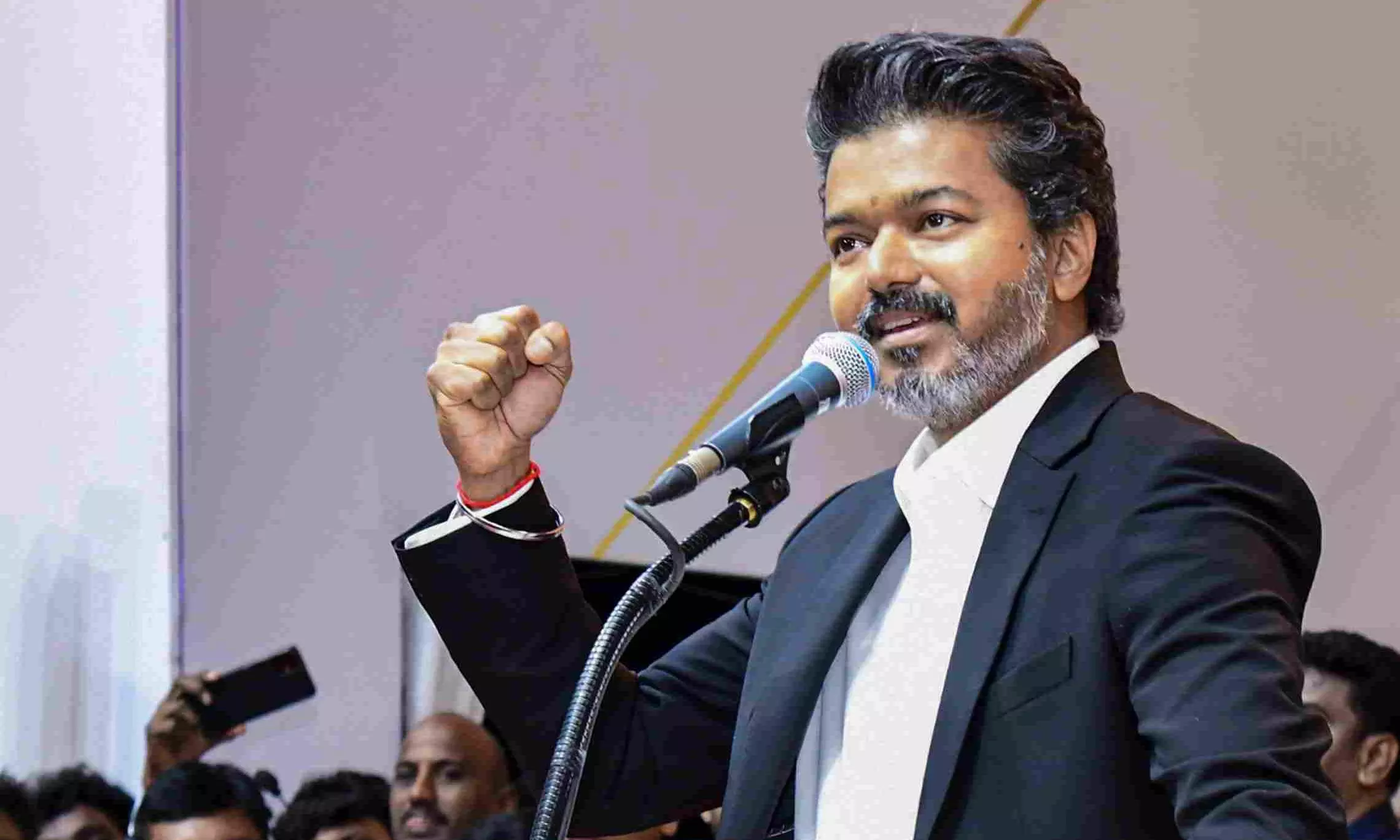
Compounding this is a problem of leadership style, and here one must be candid. Tamil Nadu’s new Chief Minister rose through a model of political mobilisation built on mass visibility, personality projection, and the affective loyalties of a media-era public.
This is a recognisable phenomenon in contemporary democracies; a style of leadership where authority is derived not from institutional position or party organisation but from direct emotional connection with a mass following. Such leaders can be enormously effective at winning elections. They are ill-suited to coalition governance, which demands precisely the opposite virtues: patience, consultation, accommodation of competing egos, and the painstaking management of ideological anxieties.
Tamil Nadu voted for disruption. It may be getting something more complicated.
Tamil Nadu’s political history adds yet another layer of complexity. The state was shaped for decades by leaders like Annadurai, Karunanidhi, MGR, and Jayalalithaa, whose charisma was inseparable from deep organisational infrastructure. Their authority rested on disciplined cadres, institutional networks, and decades of accumulated political capital.
What the present moment offers is charisma without organisation, popularity without party depth, and coalition without cohesion. This is a qualitatively different and far more precarious form of political power.
There is also the governance question, which is often underweighted in the drama of coalition formation. Administrative effectiveness in a coalition government requires not just political survival but the ability to make decisions consistently and credibly. When the coalition’s internal tensions prevent clear policymaking, when industrial decisions are held hostage to Left party concerns, when law-and-order responses must be calibrated against activist expectations, when welfare commitments collide with fiscal constraints, the bureaucracy receives contradictory signals. Bureaucratic indecision follows. Public confidence erodes.
Survival vs governance
The government survives, but it ceases to govern effectively.
The difference, therefore, is between survival and governance. A floor test can confirm numbers. It cannot resolve contradictions. And it is the contradictions: ideological, structural, and temperamental, that will determine whether this government becomes a transformative administration or a cautionary case study in the limits of charismatic politics without institutional depth.
Tamil Nadu voted for disruption. It may be getting something more complicated. A government perpetually negotiating with itself, caught between the politics of personality and the demands of coalition arithmetic, between the ambitions of its leadership and the anxieties of its allies.
The question is not whether the government will survive the floor test. Most likely, it will. The more important question is whether it can govern itself before it governs the state.