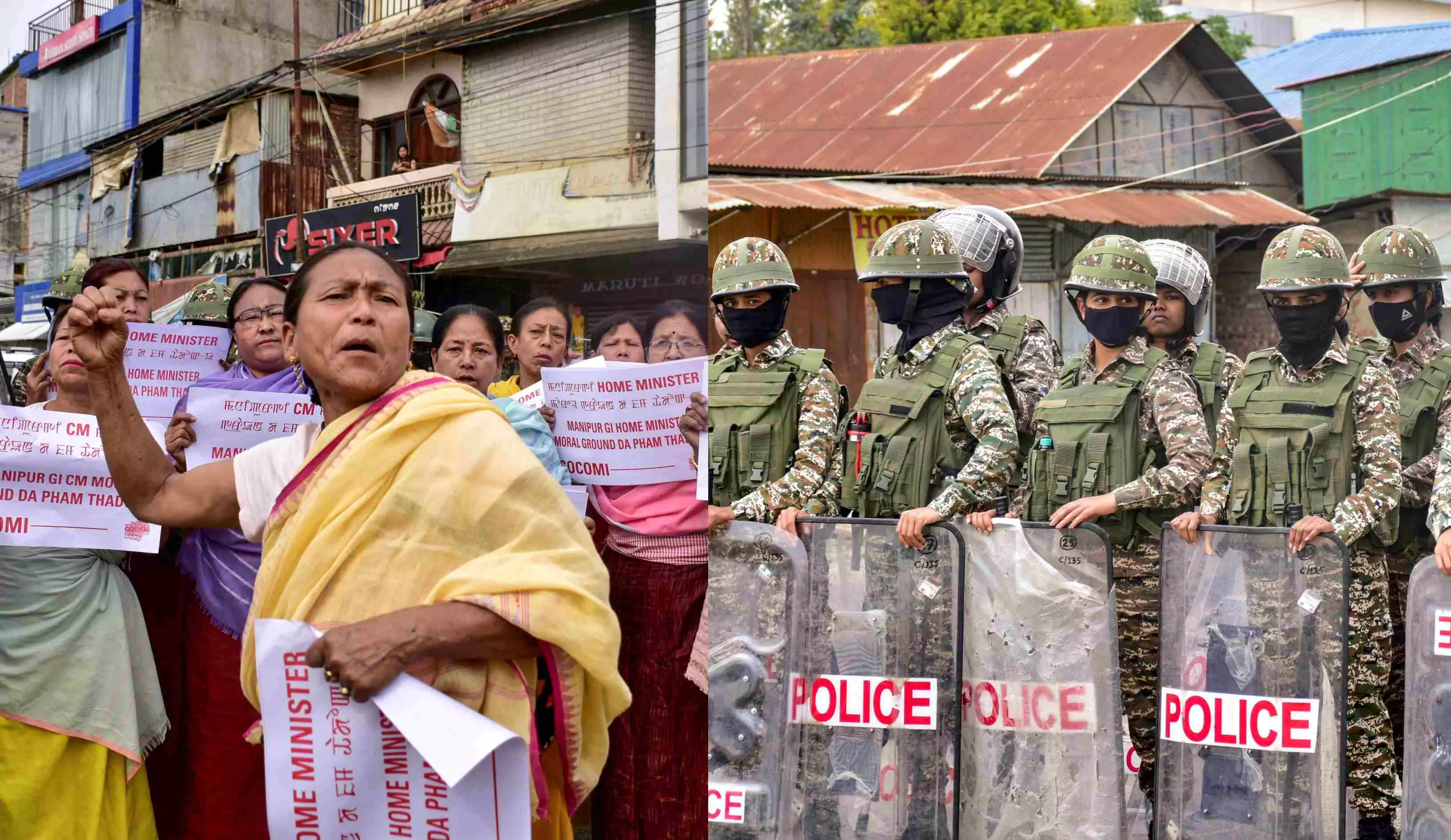
The journey for peace must continue, with the understanding that peace is a war of position. The blood of the two children in Tronglaobi demands more than grief and protest
On April 29, just days before the third anniversary of the ethnic conflagration that tore Manipur apart, Chief Minister Yumnam Khemchand Singh stood before a gathering in Langthabal constituency and made a startling accusation.
The horrific rocket attack on April 7 in Tronglaobi village that killed two young siblings—a five-year-old boy and his five-month-old sister—was not random violence. It was, he said, "the handiwork of groups attempting to destabilise the state and obstruct ongoing peace efforts." The chief minister declared, “We believe that the incident must have been triggered by those who did not want the formation of a popular government or those who want to create a volatile atmosphere.”
Also read | New Delhi’s Manipur script: Is administrative trifurcation the endgame?
This statement—from a leader who took office just months earlier on February 4, 2026, after a year of President’s rule—encapsulates the tragic paradox of Manipur today. Just as political normalcy returns and a “journey for peace” begins, armed actors seem determined to shatter it. Over the past three years, much has been said about the nature of violence and tensions in the state. However, with the raw human horror of the Tronglaobi attack that killed two minor siblings, Manipur’s crisis seems to have entered its most dangerous phase, as the chief minister describes it as “a deliberate campaign to sabotage peace efforts through militarised terror.”
Peace framed as provocation
The chief minister’s framing is significant because it shifts the understanding of violence from spontaneous ethnic rage to calculated political sabotage. He placed the Tronglaobi killings in a specific political timeline: Manipur had been under President’s Rule since February 13, 2025, following the resignation of former Chief Minister N Biren Singh. The revocation of central rule on February 4, 2026, and the installation of a popular government—“through the voices of the public,” as he emphasised—was meant to restore democratic normalcy.
Yumnam Khemchand said he had not lobbied for the post and did not expect to be chosen. He added that his government’s focus has been on a “journey for peace,” involving extensive engagement with MLAs and civil society, along with visits to hill districts including Jiribam, Senapati, Kangpokpi, and Ukhrul. The Tronglaobi blast occurred “shortly after his visit to Jiribam,” which he called an “unfortunate” attempt to derail the fragile peace process.
This is not merely political rhetoric. It aligns with a deeper analysis provided months earlier by the Federation of Civil Societies (FOCS) in a memorandum to the Ministry of Home Affairs. On May 27, 2025, FOCS had warned that the conflict was no longer civil unrest but an organised military campaign employing “grey-zone warfare” tactics. The chief minister’s statement suggests that this organised violence now has a strategic objective: to prevent the consolidation of a popular, democratically accountable government that might succeed in brokering inter-community reconciliation.
The evolution of violence
To understand what has been happening over the past three years and what well-intentioned authorities are up against, one must revisit the trajectory documented by FOCS. The federation had outlined a chilling evolution:
May 2023: Civil unrest spirals into riots and arson.
May 22, 2023 onwards: The conflict “transformed from mob violence to more organized and militarized engagements,” marked by “standard conventional warfare of marking territory, developing infrastructure, construction of makeshift bunkers and fortifications.”
September 2024: Drone bombings in Koutruk and Kadangband—later confirmed by the NIA—mark a “turning point.”
September 6, 2024: A 70-year-old killed in a rocket strike in Moirang.
The April 7, 2026, attack on Tronglaobi is the bloody culmination of this arc. On the day of the incident, “suspected armed men launched a projectile—believed to be a rocket—targeting a civilian residence.” The missile struck through a window, killing two children and severely injuring their mother.
There were adequate warnings that any move to restore peace and normalcy should not reflect a “miscalculated restraint” that fails to dismantle “arm-manufacturing units” and disarm armed rogue elements. The Tronglaobi bomb/rocket—a manufactured explosive, not a makeshift weapon—proves that those units remain operational and that militants possess the range and intent to strike anywhere in the state despite the presence of Central security forces.
Narrative as a weapon
Why has the government been so slow to act? Why does the “outdated moral lens” persist? A groundbreaking 2024 study, ‘National Media and the Manipur Mayhem: The Fourth Estate as a Site of Information War’, published by MAPAAL (Media and Policy Analysis Loisang), Imphal, succinctly offered a damning explanation. The study argued that the “national” media has perpetuated “structural violence through underreporting and decontextualization.”
Also read | How Manipur unrest is flaring up again after deaths of children, Naga civilians
The study’s findings indicated that there had been a distorted moral landscape where one community’s violence is systematically underplayed all in the name of clichéd binary of the oppressor and the oppressed. Linked to this, the national media disproportionately framed one community as the victim and the other as the perpetrator, ignoring reciprocal violence. The study also critiques the infamous Editors Guild of India (EGI) report, calling the guild “complicit in misinformation” and “aligned with New Delhi’s ambivalence.”
This is not a side issue. When national media frames one community as perpetual victims and the other as perpetual aggressors, it creates political pressure on the government to adopt the very “outdated moral lens” that needs condemnation. It becomes nearly impossible to conduct aggressive counter-insurgency operations against armed groups within a community that has been sanctified as “victims” by the country’s most powerful newspapers and news channels.
Failure of operational strategy
Chief Minister Yumnam Khemchand’s call for unity and his promise that “we will apprehend those responsible; they have no place to run” are noble, but a growing critique suggests they may be insufficient without a strategic overhaul. It has already been warned that “fragmented coordination among agencies” and “reactive rather than proactive strategies” are key gaps.
The immediate aftermath of the Tronglaobi attack illustrates this. Even after reports that security had been significantly tightened across the valley, an action many considered too late, fury spilled onto the streets, with irate mobs holding rallies that led to violence and tension. For over a week, the valley turned into a battleground due to confrontations between civilians and combined central and state forces. However, the public outrage failed to provide a clear sense of Manipur’s priorities. The pattern remains evident: armed men strike, civilians die, public rage follows, and security responses remain reactive.
The chief minister acknowledged this challenge indirectly when he noted that “people across communities have expressed a strong desire for peace and stability.” He urged citizens “to remain united and vigilant against elements seeking to create division.” But the government must move from a “risk-averse approach” to “unified, intelligence-driven operations to dismantle militant networks and secure border zones”. Peace cannot be protected by vigilance alone; it requires the aggressive, pre-emptive neutralisation of those who wield rockets and projectiles against five-month-old infants.
A state at a crossroads
Three years after May 3, 2023, Manipur stands at an abyss. The chief minister seemed to have some understanding of those who could sabotage his moves. He has identified that there are “elements” who benefit from chaos and who see a popular government’s peace initiative as a threat. But, make no mistake, “naming” anyone is not neutralising. It may further complicate his own path.
Also read | Modi's Manipur visit is a missed opportunity to heal a fractured state
The way forward requires a strategic overhaul, replacing reactive restraint with pre-emptive, unified action to dismantle armed capabilities. The Central government must reject an “outdated victimhood frame” that has paralysed its ability to adopt realistic approaches. The state and civil society must actively counter the “epistemic injustice” perpetuated by spin doctors of conflicting thoughts disguised as collective ideologies or the never-ending narratives and counter-narratives.
The “journey for peace” must continue, but with the understanding that peace is a war of position. The blood of the two children in Tronglaobi demands more than grief and protest. It demands that Manipur’s government and India’s central leadership finally recognise that this is no longer an ethnic riot or civil unrest. It is an armed campaign to prevent peace. And it must be met with the full, unapologetic, and pre-emptive force of a state that has finally understood what it is fighting for: the right of every citizen in the state.
(The Federal seeks to present views and opinions from all sides of the spectrum. The information, ideas or opinions in the articles are of the author and do not necessarily reflect the views of The Federal.)