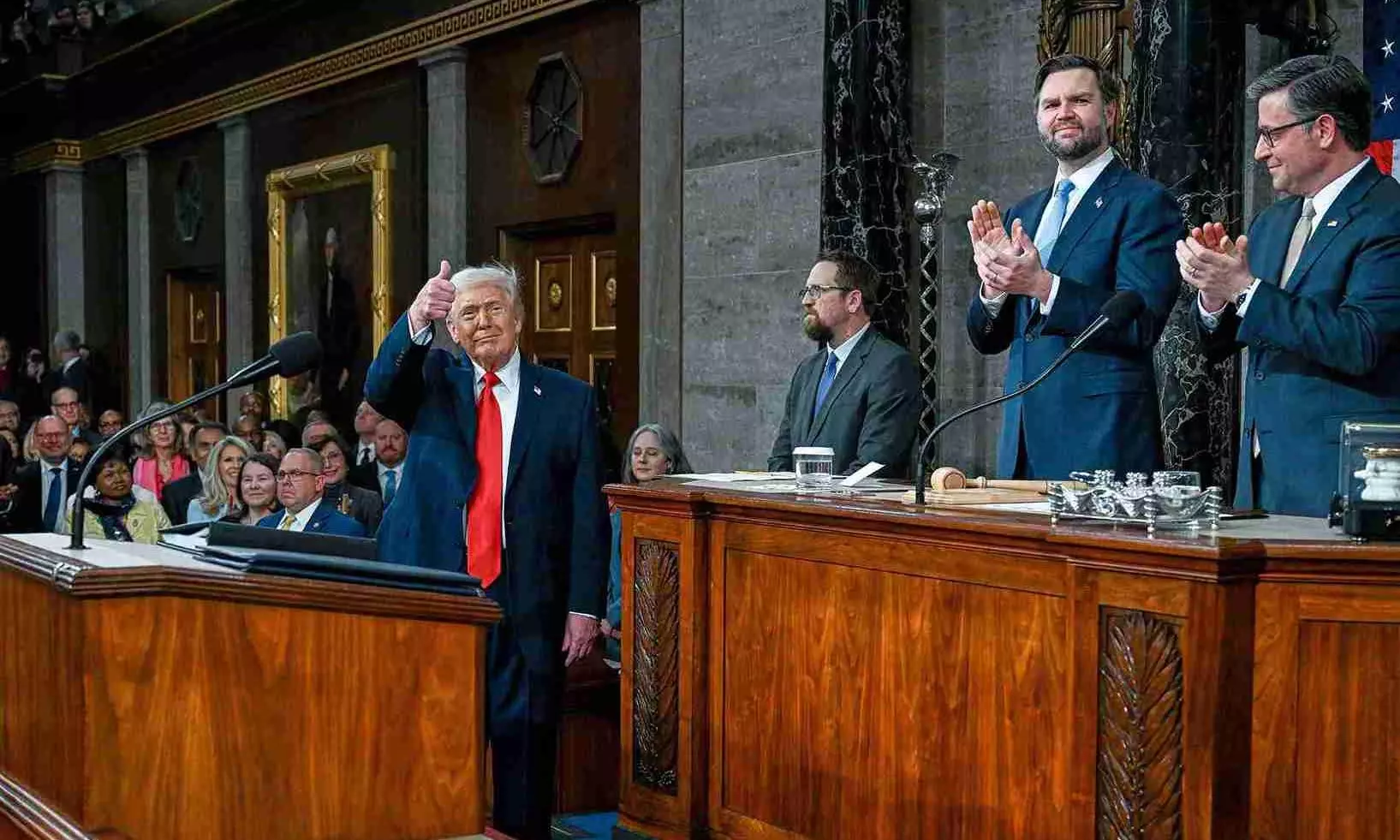
Trump lied about everything—inflation, jobs, economic growth, tariffs, immigration, and Democrats’ disposition towards the US—in his State of the Union speech
At a campaign speech, Prime Minister Narendra Modi once said that King Purushottam (Porus, the Greeks called him), defeated Alexander the Great in Bihar. If someone cringed at the sight of India’s prime minister laying himself open to ridicule, that person would have to grow a shell like a turtle and withdraw into it upon hearing US President Donald J Trump’s “State of the Union” speech on Tuesday (February 24).
Trump lied, repeatedly, confidently, grandiloquently. He lied about inflation, jobs, economic growth, who pays for his tariffs, crime statistics, the cost of healthcare, his predecessors’ record in office, immigration, corruption and swindles by immigrants, and the Democrats’ disposition towards the United States. He lied about ending wars and making peace.
Congress colluded in his lies, applauding his false claims, cheering revanchism and failing altogether to provide the check or balance the legislative branch of government is expected to provide, even as the Supreme Court has done that service by overruling Trump’s tariff overreach.
Uncertainty reigns
Indians would be concerned by his refusal to clarify his plans for Iran, and irritated by his claim on averting nuclear war between India and Pakistan. He claimed to have avoided the killing of 35 million people in such a war, a figure that he attributed to the Prime Minister of Pakistan, who is unlikely to rush to clarify the veracity of this claim.
Also read: I will make peace wherever I can, confront threats to America: Trump
Uncertainty over Iran needlessly raises oil prices, raises concern over the safety of millions of people living in the region, including Indian migrant workers. A certain temporary Indian migrant to Israel would have to beat a hasty retreat, in case regional war breaks out following a US attack on Iran.
Nothing to Bragg about
Trump implied, without actually saying it, that he restored a Confederate (meaning slavery-defending) military leader’s name to Fort Bragg, which, in 2023, had been renamed Fort Liberty. The Secretary for War, Pete Hegseth, had changed it back to Fort Bragg, naming it after a military hero of World War II, Private First Class Roland A Bragg, who fought in the Battle of the Bulge, a Bragg altogether different from General Braxton Bragg, who led Confederate troops to defend the right of Southern states to carry on with slavery.
Trump’s White Supremacist base had been unhappy with the removal of symbols that memorialized Confederate war heroes, in the aftermath of the killing of George Floyd in 2020 and the Black Lives Matter protests that swept across America and Britain. By justifying the restoration of the name Bragg to the Fort in North Carolina, saying that Bragg had been the name of the military base when the US won World War I and when the US won World War II, Trump was ignoring the sleight of hand through which the Bragg name had been restored, and rejoicing with the White Supremacists at the still-cherished celebrity of Confederate war heroes.
The tariff lie
Right now, FedEx, Costco, Revlon and a thousand other companies are suing the Trump administration, demanding refunds for the tariffs they have paid on goods. Still, the US president has no shame in repeating his barefaced lie that foreign countries paid the tariffs that have enriched the US exchequer, and now could leave a big fiscal deficit, if refunds are shelled out.
Also read: Tariffs will eventually replace Income Tax, says Trump, slams SC ruling
Trump claims to have secured USD 18 trillion of investment flows into the US in his very first year. The White House has a helpful tracker for major investment announcements, and the figure there is only USD 9.7 trillion. From that figure to the State of the Union speech’s USD 18 trillion is but a short flight of fancy.
The White House figure itself is a mishmash of vague promises to invest and buy US goods. Promises by the UAE to invest USD 1.4 trillion, and by Qatar, to invest USD 1.2 trillion look impressive, but are unrealistic. The UAE’s sovereign wealth funds and pension funds have a cumulative worth of USD 2.4 trillion, but to expect the Sheikhs to dump whatever they hold in order to generate funds to make fresh investments in the US is to confuse “lunar”, a term compatible with religious practices and the calendar of the region, with “lunatic”, a term that transcends geographic limitations, and is linked to the term lunar only by their shared semantic root, luna, meaning the moon.
Service saviour
But the US economy has continued to grow faster than most other rich countries, despite Trump’s tariff tantrums and resulting uncertainty. How do we explain this? A tentative explanation lies in the structural lightness of goods in the US economy. Manufacturing accounts for 11-13 per cent of GDP. Trump’s tariffs are on goods, not services. Services account for more than 80 per cent of US economic output, and farm output, less than 1 per cent, although all agri-related sectors together add up to some 6 per cent of GDP.
Artificial intelligence is the Great White Hope for the US, and massive investments are being made by a number of tech giants competing to be better than the rest and to become the first to produce artificial general intelligence (AGI). They invest in giant data centres and in power plants to run the data centres. The Biden-era industrial policy to produce advanced chips in the US has fructified, and Taiwan’s leading chipmaker, TSMC, has been investing in three plants in Arizona, has plans lined up for three more plants, as well as a research and development centre.
An affordability crisis
While manufacturing investment might be disrupted by tariff uncertainty, service sector investments, and investment in housing, a red-hot sector, continue.
Also read: The world waits with apprehension as Trump decides on attacking Iran
Tariffs have not reduced the US trade deficit or added appreciably to manufacturing capacity in the US. The tariffs’ chief contribution has been to create an affordability crisis for ordinary folk in the US, and hand the Democrats their mid-term campaign platform. That, of course, is something that Trump would find difficult to admit.
(The Federal seeks to present views and opinions from all sides of the spectrum. The information, ideas or opinions in the articles are of the author and do not necessarily reflect the views of The Federal.)