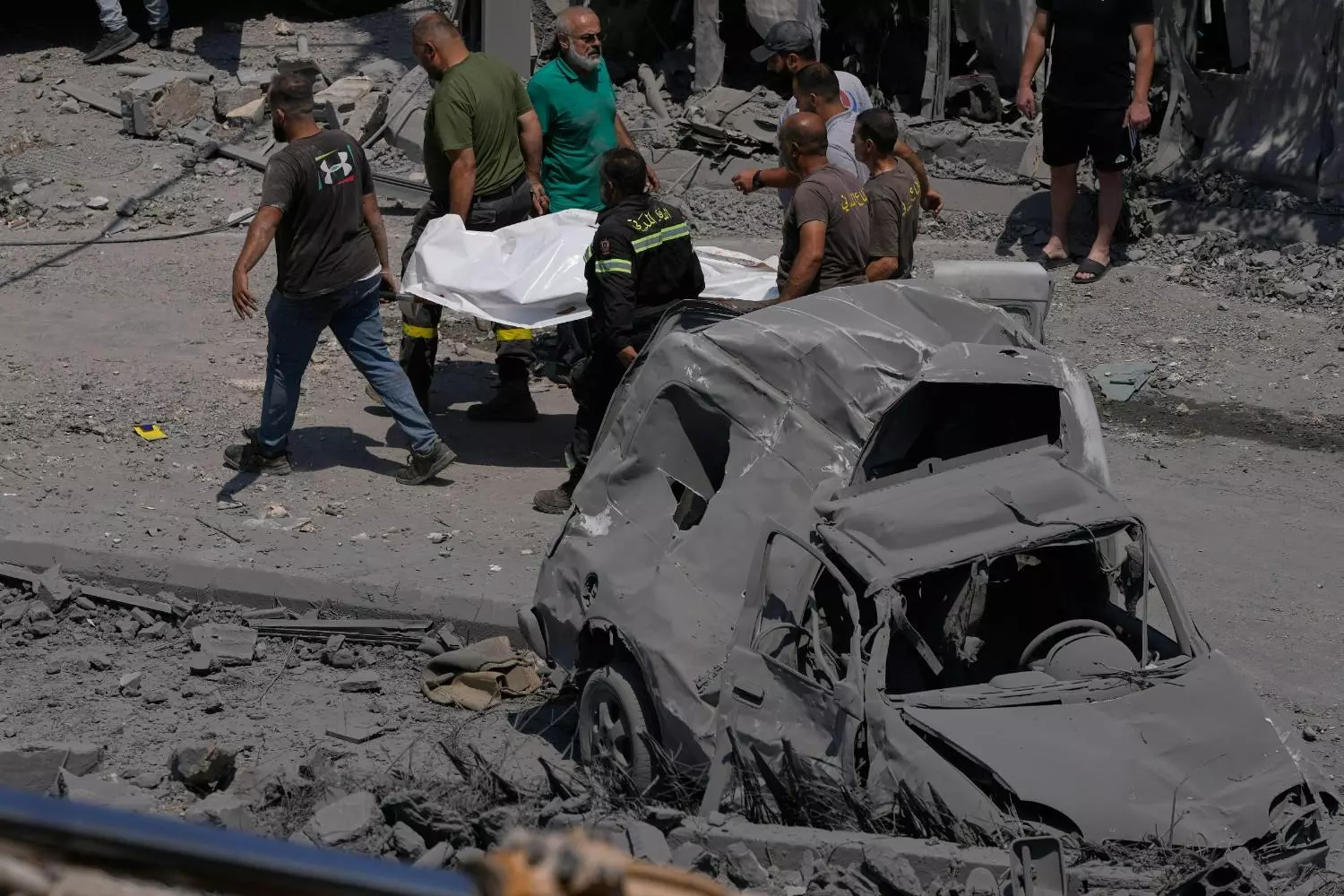
Rescue workers carry a plastic bag, containing the body of a person who was killed at a house that was hit by an Israeli airstrike in Deir al-Zahrani village, southern Lebanon, Saturday, August 15. AP/PTI
Iran will continue to be on tenterhooks at least until mid-term polls in the US and general elections in Israel, later this year
Has the Iran war come to an end? Not formally, and not in a way that is easily recognisable. Yet the reality is that the fighting has paused, if not stopped, for several days now.
The 60-day deadline to find a diplomatic resolution, set by the MoU between the US and Iran, ended today (Monday, August 17) rather quietly. All this tempts one to assume that the fighting is well and truly over. But the ground reality does not allow the luxury of such assumptions.
Also read: Ukraine in Iran-like military tactics strikes Russia where it hurts
The status of the Strait of Hormuz remains cloudy. US President Donald Trump insists it is under his country’s control. Iran laughs off such claims while negotiating with its neighbour Oman on the modalities of reopening the crucial shipping route, with conditions attached.
Iran’s biggest trump card
Ultimately, few will contest the conclusion that the entire exercise has been one of frustration for Trump and his ally, Israel’s Prime Minister Benjamin Netanyahu. No wonder Trump was forced to claim he would declare the Hormuz Strait a US territory. If nothing, it was his fantasy working overtime. Trump’s administration quickly jumped in to confirm it was said in jest.
Funnily enough, Trump’s claim reflects the big picture of his military adventure which started off as a serious, lethal attempt to dislodge Iran’s Islamic dispensation only to end as a joke. How else can one categorise the Strait of Hormuz siege — an issue that did not exist before February 28 became the biggest trump card for Tehran, and as of today, remains unresolvable.
Also read: Israeli airstrike kills 7 in southern Lebanon amid fragile truce
Leaving aside the core issue of Iran’s nuclear programme, which the US and Israel were determined to “decimate”, it is not clear to what extent they even managed to discuss the issue – though there were reports that “technical teams” of mediators were looking at it.
With mid-term elections later this year, the ruling Republicans also fear the worst, with the Iran fiasco topping the reasons for the potentially negative performance.
The adverse consequences of Iran's Hormuz blockade hit the world so hard that the Trump-Netanyahu strategy was blown away unceremoniously. It left Trump, in particular, to deal with an economic crisis and face accusations even from US allies in Europe, while also triggering a worldwide slump.
With Hormuz hogging the limelight, an outraged Trump attempted to resume bombing Iran after declaring the ceasefire dead. But it turned out to be a futile attempt, and the US president eventually had to back off and declare that negotiations would be the way forward.
Trump faces opposition
But now that the 60-day deadline has passed, where does this leave the conflict? For Trump, who was planning to emerge from the fighting appearing victorious, his already-maligned reputation is at further risk of ridicule. And, his Iranian adversaries are not making it any easier for him.
Also read: ‘Big, bold step’: Trump hails Saudi-Turkey-Pakistan defence deal
The US president is also haunted by the widespread opposition to his war, even from among his Republican party and MAGA loyalists. His calculation that the crude oil shortage would not affect domestic US prices went awry, leaving him to deal with millions of citizens outraged over the sharp rise in fuel prices and its cascading impact on the American economy.
With mid-term elections later this year, the ruling Republicans also fear the worst, with the Iran fiasco topping the reasons for the potentially negative performance. If they lose majority in the House of Representatives and the Senate, Trump will be hamstrung from doing anything during the rest of his term – in short, a lame duck president.
The possibility of the US resuming military strikes against Iran also appears remote, given that nothing substantial has been achieved in the fighting so far. Crucially, the US has reportedly used virtually all of its high-precision long-range missiles, to a point where further usage will hamper it in the event of an unexpected conflagration elsewhere. Already, Trump has reduced the US military supplies to Ukraine in its war with Russia. Furthermore, he has pressured his European Nato allies to spend more on that war – another indication that US has used up a significant portion of its armoury.
US spends $40 billion for Iran war
Monetarily too, Trump, who had promised to cut back on military spending during the presidential campaign, needs to assuage voters and show that his administration is walking the talk. He has reportedly spent around $40 billion so far in the war against Iran. In an attempt to re-ingratiate himself with voters, he has cut spending on the Ukraine war.
Also read: Trump says he secretly switched planes in Turkey after security threat
And, on Monday, he instructed his officials to sharply cut down the scale of routine military exercises with South Korea on the ground that it was expensive and unwarranted given his good relationship with North Korean dictator Kim Jong Un.
Technically, until a peace agreement is signed, the fighting cannot be considered finished. Chances are that at this stage a peace deal looks remote.
Trump, after the MoU with Iran was signed two months ago, pressured Netanyahu to stop attacks on Iran which the Israeli prime minister complied with. Under Iranian pressure, Trump also forced his Jewish ally to pause his bombing of Lebanon. Though there have been sporadic bombings, Israel has largely reduced its military strikes on south Lebanon.
Iran de facto emerges ‘victorious’
Iran, which was attacked without provocation, is sitting pretty as far as the world’s perception of the war is concerned. Of course it has suffered enormous damage to its nuclear facilities, civilian infrastructure including bridges, power plants and the death of around 5,000 citizens, including 170 children at a school in Minab, on the day the strikes commenced.
And, the most crucial of them all – the assassination of Supreme Leader Ayotollah Khameini in a US missile strike besides the killings of several of its top military commanders, government officials and bureaucrats in US-Israeli attacks.
But, Iran on its own is not likely to initiate fighting as it has no reason to. It has de facto emerged “victorious” by not losing and all indications are that it will not give up its hold over the Strait of Hormuz, considering how key this has been in resisting Trump-Netanyahu’s attack.
Technically, until a peace agreement is signed, the fighting cannot be considered finished. Chances are that at this stage a peace deal looks remote. Which means that the region will continue to be on tenterhooks at least until the political scene changes in the US mainly, but also in Israel where general elections are due in October.