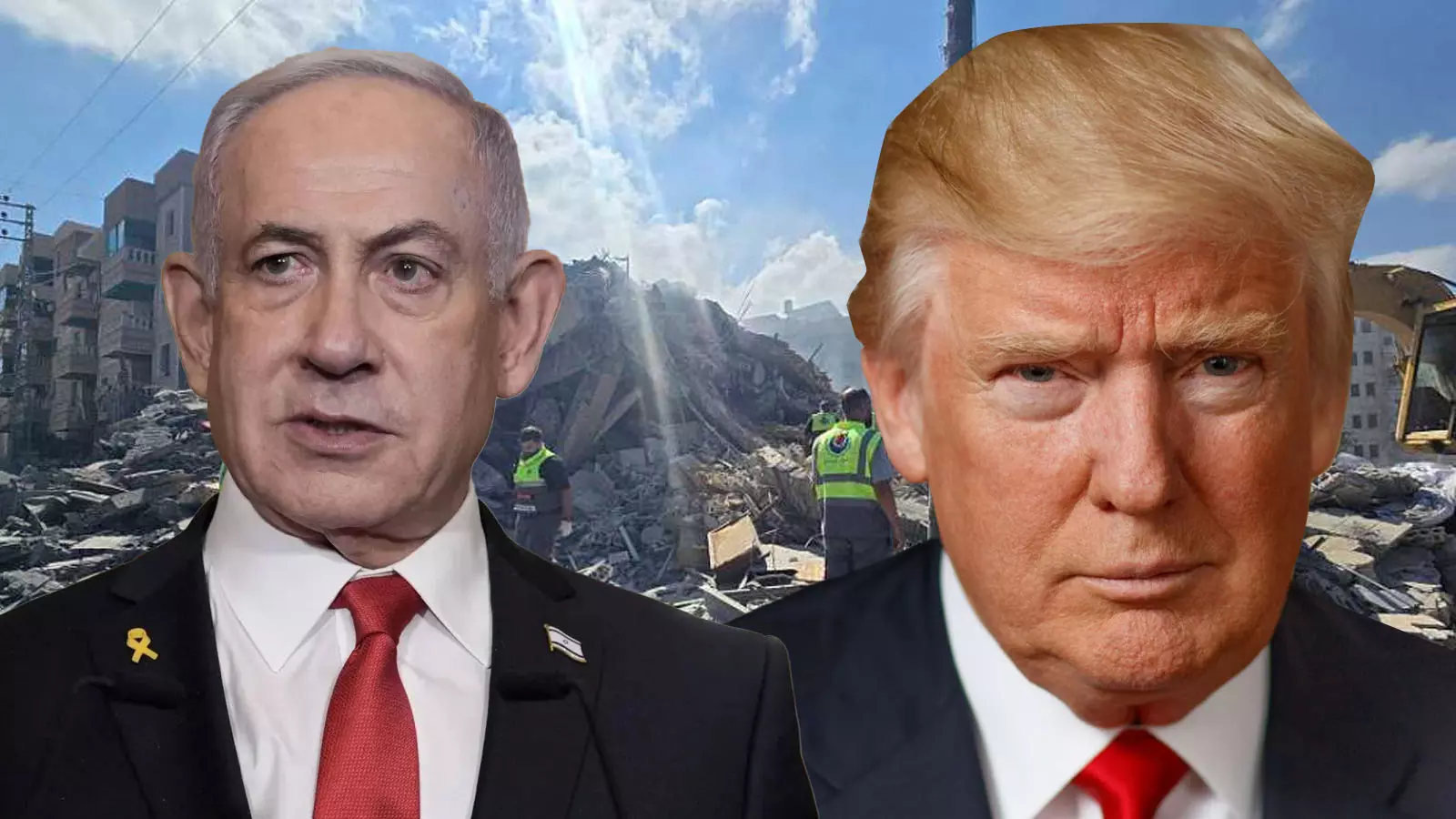
As Washington quietly negotiates a retreat with Tehran, the destruction in Gaza leaves Israel alone and exposes the deep moral evasiveness of powers like India
It is a rare moment in modern geopolitics when a superpower accustomed to dictating terms is forced instead to negotiate its retreat. Yet that is precisely the spectacle unfolding in the Gulf, where the United States — after weeks of military escalation alongside Israel — appears compelled to seek an understanding with Iran on terms far removed from the triumphalist rhetoric that launched the conflict.
Also read: The duplicity behind Trump's push to disarm Iran
President Donald Trump would stay “patient” on an Iran deal, per his war secretary—potentially buying Israel time to finish its genocidal campaigns in Lebanon and Gaza, since a ceasefire there is a precondition for any immediate memorandum of understanding.
Iran's endurance against relentless attacks
For all the bluster emanating from Washington, the emerging reality is unmistakable: Iran has demonstrated the strategic endurance of an ancient civilization confronting two heavily armed modern powers determined to bend the region to their will.
Trump’s latest Truth Social outbursts inadvertently revealed more than they concealed. His insistence that “Iran must agree that they will never have a Nuclear Weapon, that the Strait of Hormuz be reopened without restrictions, and that sea mines be removed immediately”, read less like the declarations of a victor than the demands of an administration searching desperately for an exit from a costly and dangerous confrontation.
The lesson is an old one, but Washington refuses to learn it. Not in Vietnam. Not in Iraq. Not in Afghanistan. And not against a regional power capable of absorbing bombardment while exploiting the vulnerabilities of a globalised economy.
The war itself — launched jointly by the US and Israel on February 28 under the familiar banners of “security” and “stability” — failed to achieve its central political objective: coercing Tehran into strategic submission. Instead, the confrontation elevated Iran’s leverage, particularly in the Strait of Hormuz, through which a substantial portion of the world’s energy supply passes.
Vietnam, Iraq, Afghanistan: US refuses to learn
The lesson is an old one, but Washington refuses to learn it. Military superiority does not automatically translate into political victory. Not in Vietnam. Not in Iraq. Not in Afghanistan. And not against a regional power capable of absorbing bombardment while exploiting the vulnerabilities of a globalised economy.
Reports now suggest that sanctions relief and the unfreezing of Iranian assets, to start with USD 12 billion, are part of ongoing negotiations — concessions Washington would never publicly acknowledge as such, but concessions, nonetheless. Trump’s administration may attempt to package any agreement as a triumph of “maximum pressure,” yet history is unlikely to remember it that way.
The real story is the collapse of the illusion that the US and Israel can indefinitely reorder the Middle East through force alone.
Israel’s deepening global isolation
Behind the broader regional escalation stands the unmistakable hand of Israeli Prime Minister Benjamin Netanyahu, whose government has fused military maximalism with political desperation.
Netanyahu recently boasted that India remains one of the few countries where support for Israel is still “crazy”. The remark was revealing not because it demonstrated confidence, but because it betrayed anxiety. Israel today faces a crisis of legitimacy unprecedented in its history.
Also read: How US diktat has kept apart natural allies India and Iran
That crisis is not the product of some abstract “media bias”, as Israeli officials routinely claim. It stems from the devastating images emerging daily from Gaza: flattened neighbourhoods, bombed hospitals, starving civilians, and thousands of dead children buried beneath rubble. It stems from the growing perception across much of the world that Israel’s war has crossed the line from retaliation into collective punishment.
Even within Jewish intellectual and political circles internationally, dissent has become impossible to ignore. Holocaust scholars, human rights advocates, and younger Jewish voices have increasingly condemned the destruction in Gaza and rejected attempts to silence criticism through accusations of antisemitism.
Netanyahu's 'India support' is misleading
Netanyahu’s invocation of unwavering Indian support is equally misleading. India’s political establishment may have deepened strategic and military ties with Tel Aviv, but public sentiment is far more complex. India possesses a long anti-colonial tradition that has historically identified with the Palestinian struggle.
Mahatma Gandhi himself warned in 1938 that “it is wrong and inhuman to impose the Jews on the Arabs.” Whatever one’s interpretation of history, his words resonate powerfully amid the current catastrophe.
Netanyahu’s invocation of unwavering Indian support is equally misleading. India’s political establishment may have deepened strategic and military ties with Tel Aviv, but public sentiment is far more complex.
The tragedy is that New Delhi — once an advocate of Palestinian self-determination — now appears willing to subordinate moral consistency to geopolitical calculation. Prime Minister Narendra Modi swiftly condemns attacks on Israeli civilians, yet remains conspicuously silent about the mass killing of Palestinian civilians, including women, doctors, aid workers, and children.
Also read: 12-hour drive through Iran shows defiant nation balancing daily life with destruction
India is not alone in this moral evasiveness. Much of the West, except Spain and Ireland, has effectively granted Israel extraordinary impunity while demanding restraint from everyone else in the region.
But impunity carries consequences.
The longer the destruction of Gaza continues, the more Israel risks transforming tactical military victories into a strategic disaster. No state can indefinitely sustain international legitimacy while entire civilian populations are subjected to siege, displacement, and annihilation before a global audience connected in real time.
Middle East cataclysm
Meanwhile, the broader Middle East edges closer to a regional conflagration. Israeli escalation in Lebanon, the unresolved catastrophe in Gaza, and mounting tensions with Iran all threaten to ignite a conflict whose economic and political consequences would extend far beyond the region.
What is collapsing before our eyes is not merely another ceasefire. It is the credibility of a global order that speaks endlessly of rules, human rights, and international law, yet selectively suspends them whenever geopolitical allies are involved.
Also read: Iran war tests India’s strategic autonomy as it walks a diplomatic tightrope
The US may still possess overwhelming military power. Israel may still dominate the battlefield. But both are discovering an uncomfortable truth: coercion without legitimacy breeds resistance, not submission. Against this backdrop, why would any Middle East country join the Abraham Accords?
And resistance, however costly, has once again altered the balance of power.
(The Federal seeks to present views and opinions from all sides of the spectrum. The information, ideas or opinions in the articles are of the author and do not necessarily reflect the views of The Federal.)