The government should have referred the Bill to a parliamentary committee to iron out differences, instead of using its legislative majority to pass it as introduced
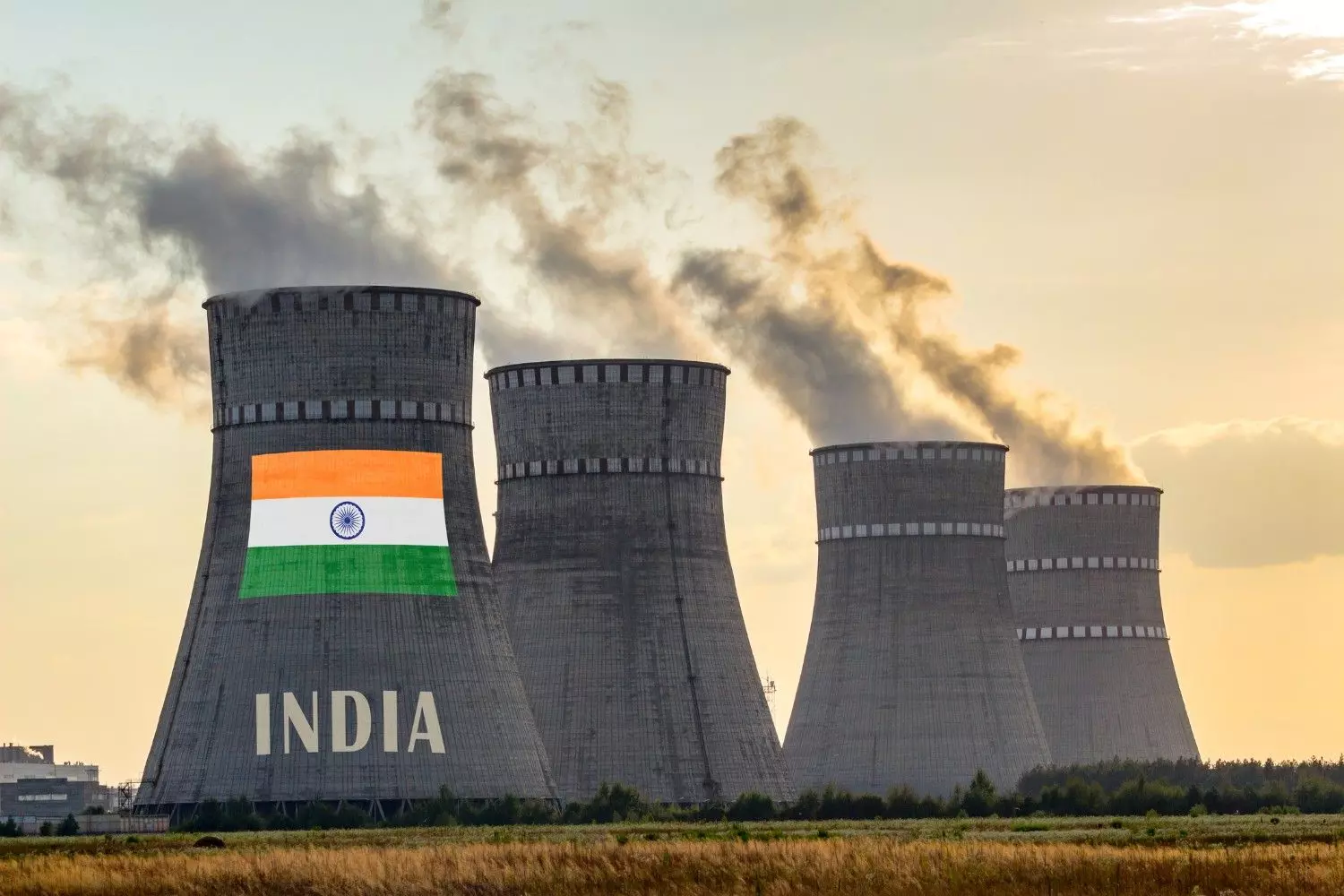
The Sustainable Harnessing of Nuclear Energy for Transforming India (SHANTI) Act, 2025, paves the way for India to expand nuclear power generation by allowing greater participation of companies in the sector. There is a certain irony in the present government introducing the Bill to amend provisions that the BJP and the Left had together foisted on the Congress-led United Progressive Alliance (UPA) government when it enacted the Civil Liability for Nuclear Damage Act in 2010.
Also read | LS passes SHANTI Bill 2025 to target 100 GW by 2047; Opposition seeks JPC debate
There has been considerable anxiety over certain provisions of the new law, particularly regarding the likelihood of accidents, compensation for victims, who would bear the burden of such compensation and how, and the robustness of the regulatory apparatus governing nuclear safety. Ideally, the government should have referred the Bill to a parliamentary committee to iron out differences, instead of using its legislative majority to pass it as introduced — after all, generating sufficient green energy to fuel India’s prosperity is not a partisan concern.
Let us examine some of the concerns.
Regulatory architecture under scrutiny
Should private companies be allowed in nuclear power generation, where the security of the fuel and of the spent fuel, the integrity of the plant operation in full compliance with the established protocol are vital? Chernobyl was a state-owned plant. It is not the nature of ownership but the quality of operational management, including maintenance and regulatory supervision, that would determine safety at nuclear power plants.
That being the case, regulatory capacity, autonomy and accountability are of paramount importance. The regulatory structure proposed by the new law is not fit for purpose. The regulator is the Atomic Energy Regulatory Board (AERB). There is a two-tier body to arbitrate disputes over decisions of the AERB, an Atomic Energy Redressal Advisory Council, and, to hear appeals against the findings of the Council, the Appellate Tribunal for Electricity.
The Redressal Advisory Council comprises members of the nuclear and power establishment. The chairperson of the Atomic Energy Commission (AEC) heads the Council, and its members are the director of the Bhabha Atomic Research Centre (BARC), the chairperson of the Atomic Energy Regulatory Board (AERB), and the chairperson of the Central Electricity Authority (CEA).
This is idiotic. The AERB should comprise experts who are on a first-name basis with the assorted protons, neutrons and electrons to be found in a nuclear reactor and its supply chains. However, the advisory council should consist of people who bring to the table sociological, psychological, medical, human-rights and other such expertise, along with ad-hoc members to be chosen in accordance with the nature of the grievance on which advice is generated. This body should not be a place to store spent babus or other species beholden to the powers that be.
The appellate tribunal for electricity does not measure up to the task of evaluating the advice of such a council. Appeals against the Advisory Council’s decisions should be heard by a bench of the Supreme Court.
The AERB should be made accountable, by law, to a committee of Parliament, before which it should testify at least once a quarter.
Compensation beyond operators
Should compensation be capped at 3,000 million SDR, the International Monetary Fund’s unit of account, computed as a weighted average of the dollar, euro, yen, pound and renminbi? This figure is derived from the Revised 1997 version of the Vienna Convention on Civil Liability for Nuclear Damage, originally formulated in 1963. Several countries have pegged their liability cap much higher, and India could do the same. However, it should be noted that pegging the cap arbitrarily high is not particularly helpful. If the liability that a private operator is obliged to pay exceeds its net worth, it would simply go insolvent and not pay more than that.
The Fukushima cleanup is estimated to cost upward of $150 billion, a figure that Shashi Tharoor brought up in his speech in Parliament, in which he demonstrated that he is capable of a little more than entertaining wordplay and mischievous swipes at Congress royalty.
It is worth exploring who is footing the bill for the Fukushima cleanup. The government of Japan nationalised the power utility, Tokyo Electric Power Company, as it would have gone bankrupt if asked to bear the cost, and gave it soft loans to finance the cleanup. Other power companies in Japan are chipping in, as well. The government will recover the loans as special electricity cesses. Normal taxes would cover a part of the cost. In other words, the people of Japan, as electricity consumers and taxpayers, foot the bill.
Should liability stop at the operator, or should it extend to the supplier of equipment? India did not sign up to the Vienna Convention because it placed statutory liability on the operator and explicitly excluded the supplier from statutory liability, but not from contractual liability. The logic behind this is straightforward. If an accident happens and people suffer harm, they should get damages from the operator without having to establish whose fault caused the accident. The operator is free to enter into contracts with the supplier to stipulate supplier liability, but that should be between the operator and the supplier. The victims of a mishap should not have to wait for their dispute to be settled to receive their claims. SHANTI now accepts the Vienna Convention logic, and there is nothing wrong with it. India should now sign up to the Vienna Convention.
Rethinking nuclear risk financing
India joined the Convention on Supplementary Compensation for Nuclear Damage in 2010. This obliges signatories to form a pool, once a mishap has happened in any signatory party, to meet a part of the damages over and above the SDR 3,000 million that is expected to be covered at the national level. There is a complicated formula to determine how much each party would contribute to the pool, involving its nuclear power generation capacity and its contribution to the UN.
Also read | SHANTI Bill 2025: Who pays in case of a nuclear disaster?
Innovations have taken place in risk transfer mechanisms since the time of the Vienna Convention and the Convention on Supplementary Compensation. These are Catastrophe bonds or Cat bonds. Re-insurance companies issue such bonds, which have short tenures and abate, in full or in part, in case a catastrophe occurs requiring damages to be paid that exceed the amount that can be recouped from the aggregate premiums charged for insurance against that calamity. The bond proceeds are held in a special account and used to repay the bonds if no calamity occurs during their tenure, or to pay compensation, if calamity does strike.
Why should there be any takers for such a bond, whose interest payments and principal repayments are all iffy? The bonds offer higher yields than normal bonds of the same tenure. They are totally delinked from business cycles. Very large funds that optimise risk and reward by investing in different asset classes with different risk and reward profiles could well find that it is worthwhile to invest in such Cat bonds and obtain superior returns on a thin slice of their overall portfolio.
Instead of relying solely on the exchequer to pay damages, the Government of India should institute insurance cover backed by Nuclear Cat bonds (NuCat Bonds?) for nuclear damage.
Regulator must be independent
There are good reasons for the Indian public to distrust regulatory fairness. The whole experience with IndiGo shows that regulators are pliant handmaidens to dominant market players. Nor does it make sense to place our bets on AERB always being manned by someone like TN Seshan, tame poodle as a civil servant, who turned into an Alsatian who heeded only one master, the Constitution, when put in charge as regulator of elections.
AERB must be made a regulator like TRAI for telecom and SEBI for the markets, under a special statute, and made answerable to a Committee of Parliament, and to that committee alone.
It is silly to announce targets such as 100 GW of nuclear power by 2047. Over the next few years, the world might see the death of a longstanding joke: nuclear fusion is the power source of the future, and will forever remain the power source of the future.
The essential challenge in nuclear fusion has always been how to contain the superhot plasma, the mass of ionized gas, in which hydrogen atoms fuse to produce a helium atom, destroying some mass that converts to energy in the process. The plasma is too hot to be contained in metal or ceramic, or any other material. It can only be contained in a magnetic field. Depending on the direction and intensity of the plasma in flux, the position and strength of the magnetic field must adapt. Till now, this has been difficult. The arrival of artificial intelligence changes this altogether. It can forecast the likely movement of the plasma and recalibrate the magnetic field accordingly. Many experts believe we are on the threshold of producing power from nuclear fusion.
Reform SHANTI for growth
If that happens, all worries about spent fuel and radioactive waste would become history. We would switch all power production to nuclear fusion.
Also read | Why SHANTI Bill is a big risk: Yashwant Sinha speaks out
Till then, we should make use of fusion reactors, incorporating the advances made in design and safety of operations, and the cost efficiency to be derived from producing standardised modules of nuclear power plants in factories, and assembling them at the site as so many Lego bricks. Small modular reactors have much to commend them.
But that is no reason to abandon our home-grown fast-breeder reactors that use domestically available Thorium as the starting material. The pilot we already have must be scaled up to commercial size at the earliest.
SHANTI must be amended to make nuclear power generation take off in India. Such changes are imperative. People get a second chance at life only in Om Shanti Om. For the real world, SHANTI, poor thing, is just not good enough.
(The Federal seeks to present views and opinions from all sides of the spectrum. The information, ideas or opinions in the articles are of the author and do not necessarily reflect the views of The Federal.)