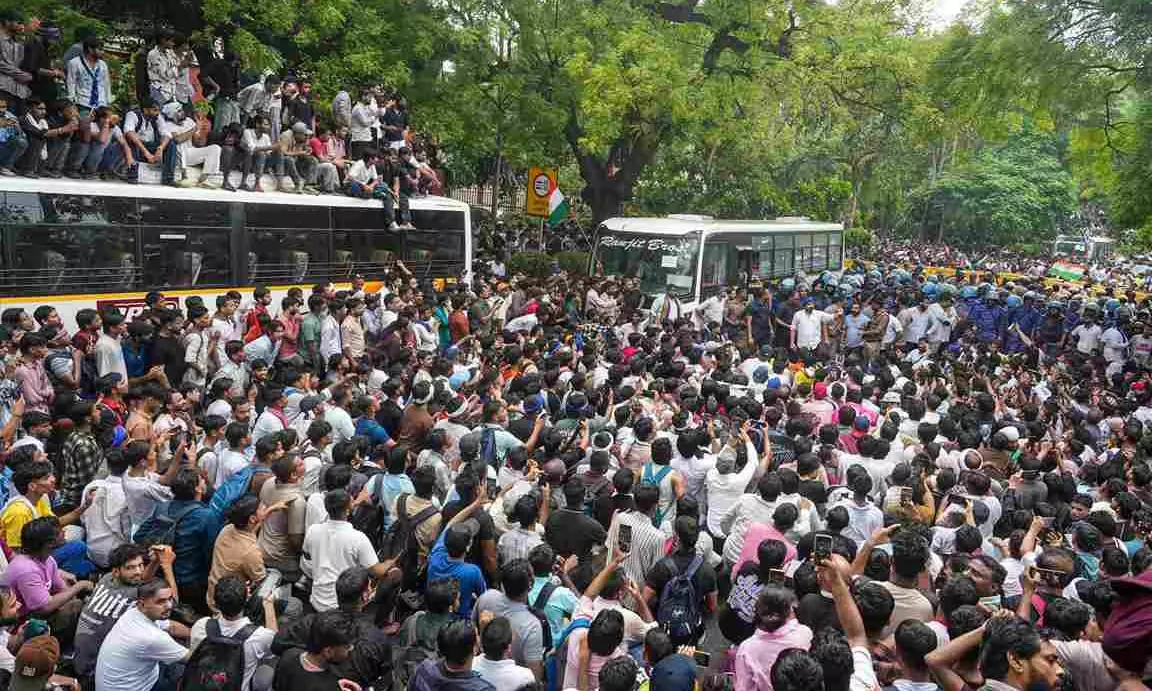
The march to Parliament over NEET paper leak suggests that sustained public mobilisation can emerge even without Opposition leadership or mainstream media amplification
What unfolded on Delhi’s streets on Monday (July 20) was not just another protest. It was a spontaneous eruption that exposed the limits of state power and the strength of public anger. Thousands of students and young people gathered at Jantar Mantar, many arriving from coaching hubs outside the capital.
Also read | ‘Is this not our country’: What CJP protesters said as they defied police crackdown
Their target was clear: paper leaks that have wrecked careers, NEET irregularities, and a broken education system. They wanted to march to Parliament. Delhi police responded with lathicharge and tear gas. Security forces sealed the Parliament complex with iron gates, fire tenders, and layered barricades. The crowd did not disperse.
The difference this time
This protest is bigger than the Nirbhaya movement of 2012 and the Anna Hazare agitation of 2011-12 precisely because it happened under a far more powerful and organised regime.
In 2012, the UPA government was already weakened by corruption scandals and faced a resurgent Opposition. In 2011, Anna’s fast drew massive support partly because the political atmosphere allowed civil society and Opposition voices to amplify it. Both movements operated in a relatively enabling environment where dissent could gather momentum without immediate, heavy-handed containment.
It should be noted that the administration back then was accused of forcefully attempting to end the protests. The difference lies in the scale of the crackdown.
Today’s reality is different. The current government has demonstrated repeatedly that it can anticipate, manage, and neutralise large-scale protests through administrative efficiency, legal tools, and narrative control. Yet on July 20, despite advance intelligence, despite a month of prior agitation, and despite visible police aggression, the numbers swelled. Youth from outside Delhi kept arriving. The protest persisted. That persistence under conditions designed to deter it is what separates this moment from the earlier ones.
Beyond Opposition politics
It is also bigger than anything the organised political opposition has managed to achieve on the same issues. For years, opposition parties have raised paper leaks, NEET scams, and education minister’s accountability in Parliament, in press conferences, and on social media. These interventions remained largely symbolic. They produced headlines but rarely translated into sustained street mobilisation of the scale seen today.
The Opposition has struggled to connect with Gen Z and young aspirants on bread-and-butter education failures. Internal divisions, shifting political priorities, and the difficulty of sustaining ground presence under current conditions have limited its reach. The result: powerful speeches, but thin crowds and even less impact.
Also read | CJP’s Parliament march: From clashes to talks with ministers, key developments
What changed on July 20 was the absence of that political scaffolding. This was not an Opposition-called protest. It grew from months of accumulated frustration among students whose futures were directly damaged by leaks and systemic rot. When a month-old agitation, led primarily by student-youth networks rather than any major party, finally forced the streets of the capital to fill, it revealed something the Opposition has been unable to deliver: organic, persistent mobilisation that does not depend on electoral calendars or high-command directives.
The contrast with Nirbhaya and Anna is instructive on another level. During both those movements, the BJP — then in Opposition — extended tacit or open support. It amplified the narrative in media and political spaces, giving protestors additional oxygen. That external political backing helped turn public anger into sustained pressure. No comparable backing from any major political formation exists for today’s education protest. The fact that it still grew, still reached Parliament’s gates, and still extracted the first high-level dialogue after weeks of stonewalling, makes it structurally different and, in many ways, more significant.
Limits of state power
The government’s handling exposed four clear failures.
It failed to anticipate the scale of public anger despite weeks of prior signals. It failed to manage the protest without resorting to force against largely peaceful participants. It failed to initiate dialogue early, waiting nearly a month before any meaningful engagement. And it failed by continuing to defend an education minister whose tenure has been defined by recurring crises rather than solutions.
Only after the streets filled did a delegation finally meet senior leadership and submit demands. Only then did the hunger strike end following external appeals for talks.
What makes this moment unprecedented in the current political cycle is the lack of mainstream media amplification. Nirbhaya and Anna agitation was covered 24/7 on mainstream news channels and newspapers. In contrast, the CJP protest was completely blacked out on these big platforms and it largely survived on social media amplification.
The protest also forces a larger question about democratic space. When a powerful government can contain most organised dissent but still faces spontaneous youth mobilisation on an issue that touches their future directly, it signals that administrative strength has limits. Education failures are not abstract policy disputes; they destroy individual lives and collective trust. When those failures accumulate without redress, anger finds its own channels.
The real test ahead
The coming days will test whether the state responds with further containment or with substantive correction. The three demands submitted by the CJP delegation — Sonam Wangchuk’s immediate release from the hospital, Dharmendra Pradhan’s removal and Rs 1 crore compensation for the families of NEET aspirants who died by suicide — are modest.
Also read | CJP protests in pictures: The day ‘Chalo Sansad’ march turned Delhi into a battlefield
Meeting them would not weaken authority; ignoring them would confirm that the only language the system understands is numbers on the street.
Delhi witnessed something rarer than large crowds. It witnessed sustained public pressure that did not require political permission to exist.
That is why this protest stands taller than Nirbhaya, taller than Anna, and taller than the Opposition’s own record on the same issue. The regime’s strength met its first real test from a constituency it has long taken for granted. The outcome of that test will shape far more than one minister’s future. It will reveal how much space remains for citizens to force accountability when institutions fail them.
(The Federal seeks to present views and opinions from all sides of the spectrum. The information, ideas or opinions in the articles are of the author and do not necessarily reflect the views of The Federal.)