


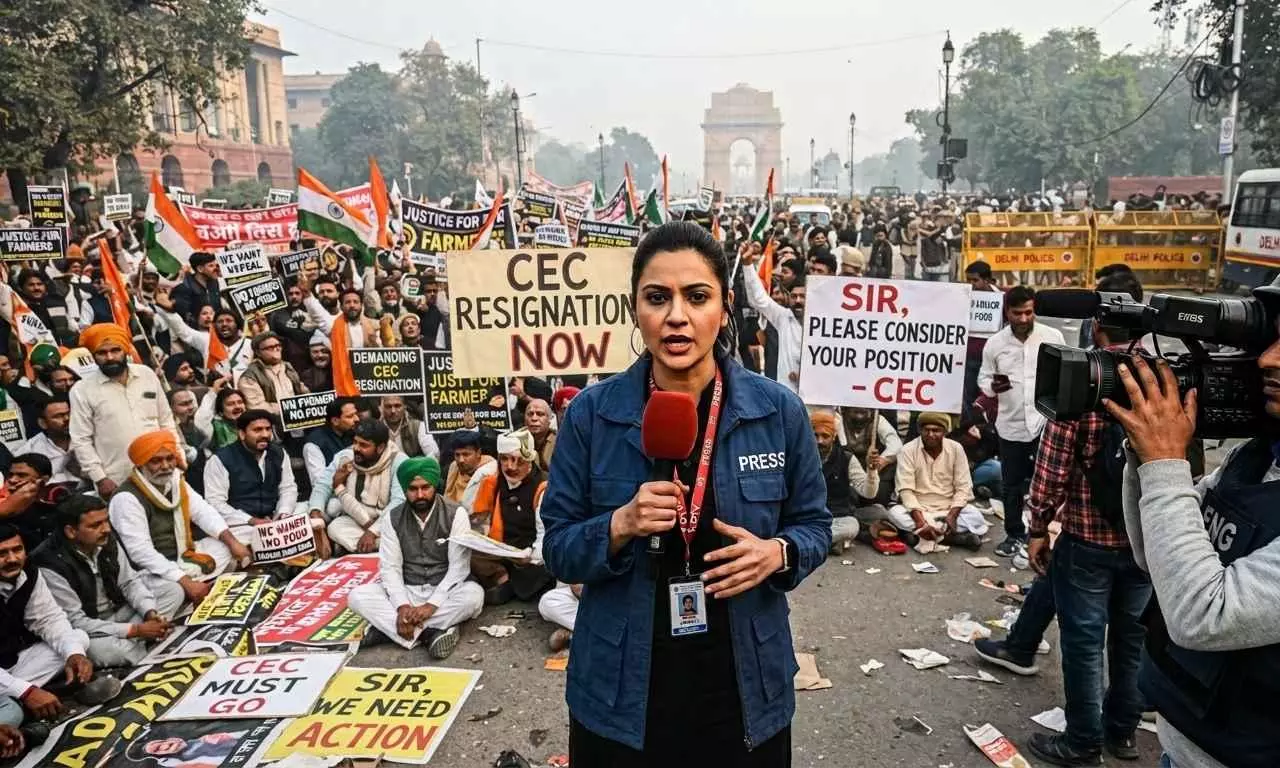
Independent journalists report about grassroots movements and marginalised groups which large media outlets normally ignore. | AI-generated image for representational purpose
The detention of freelance reporters covering Delhi protests underscores their role in exposing uncomfortable truths and raises questions about who gets to be a journalist
“If everyone starts becoming a journalist, it will create problems for every other person.”
This bizarre comment came from the Chief Justice of India (CJI) in response to a complaint that Delhi Police did not appear to be respecting independent and freelance journalists covering street protests in the national capital.
It is shocking that Delhi Police has taken it upon itself to determine who in the media is entitled to report, or not report, a vicious crackdown on those protesting against Chief Election Commissioner Gyanesh Kumar.
CJI’s remarks and press freedom
If this wasn’t bad enough, CJI Surya Kant’s intervention seemed to back Solicitor General Tushar Mehta’s more loaded remark that anyone with a mobile phone could make reels for social media to earn money by “presenting one-sided stories or sensationalising accidents”.
Also read: Why India now ranks below Pakistan and Palestine in press freedom
That journalism has always had black sheep in its ranks is well known. But the judiciary was clearly not upset about this category which has existed even from the time when there was no Internet.
Incidentally, neither Mehta nor anyone in the ruling establishment felt the need to denounce the police brutalities in Delhi on October 10-11 when more than 40 journalists were arbitrarily detained while doing their job.
The crackdown on journalists
Some were journalists from established media houses who had flashed their media identification, yet police officers manhandled them. Many were released only hours later.
At least 25 of them were independent journalists whose aim was to bring out the truth of what was going on in the heart of New Delhi in the name of preserving law and order.
All this happened even as an independent panel set up earlier by the Supreme Court has been studying allegations of excessive use of force – including electric batons and pellet guns – by the security forces.
The fact is that, but for independent and freelance journalists (and sections of the print media), the world would never have known how the police, aided on at least one day in October by goons allied to the ruling dispensation, broke up street protests, sparing not even MPs, and shamed India globally.
Why journalists turn independent
Vast sections of the media, in particularly the electronic media have been visibly co-opted by the establishment since Narendra Modi became the prime minister in 2014. Some of the TV anchors conduct themselves like appendages of the ruling party, earning the sobriquet godi media.
This is one reason why many young qualified journalists today prefer not to work for mainstream media. In any case, not every media establishment, print or otherwise, can accommodate all fresh journalism graduates.
Also read: Detention of journalists: ‘Free Speech Collective’ moves SC against Delhi Police
Even journalists with a decade or so (or more) of experience are embracing independent digital media to free themselves from government control, corporate influence, and pressures from advertisers.
The role of independent journalists
Their aim is to pursue the truth, investigate public and private sector corruption, question government actions and policies, and provide the checks and balances in a democracy now lacking in dominant mainstream media.
Independent journalists also report about grassroots movements and marginalised groups which large media outlets normally ignore. They stand for stories which rely on facts, avoiding state-inspired narratives.
Some independent journalists, particularly those who are experienced, provide invaluable analysis and perspectives to stories that may be otherwise difficult to grasp. Their viewership runs into millions.
Mind you, this job is not easy.
If independent journalists upset interest groups or the powers that be, they get viciously trolled. Threats of violence and unfounded allegations can follow. Even the nationalism of some journalists is questioned, more so if they are from minority communities.
Not all freelance or independent journalists make big money. Most do not. But they keep at it because of their professional zeal.
It is precisely this lack of enthusiasm to show truth to power that in 2025 India’s ranking on the World Press Freedom Index fell to a miserable 151 among 180 countries.
PIB accreditation is not a test of journalism
Arguments that journalists should all be accredited to the Press Information Bureau (PIB) are being made by people who have no understanding of how the accreditation ecosystem works.
No one who has just taken to the profession can get a PIB card. Indeed, PIB accreditation is made available to a limited number of journalists in every media organisation, barring news agencies. In other words, even all journalists in an established newspaper or magazine cannot get official accreditation.
But Delhi Police is suggesting that PIB accredited journalists must cover street protests, normally covered by young reporters.
Also read: The roaring controversy over Modi's press meet in Norway
We know any number of journalists who have spent decades in journalism but who never acquired government accreditation. Official accreditation offers certain frills which journalists who opt out of it end up sacrificing.
Why ground reporting matters
Indeed, in today’s largely stifled media world, independent and freelance journalists are performing tasks one misses in mainstream electronic media as well as sections of other established industry leaders.
Since independent reporters are not subject to travel curbs (which we see in media houses) and are keen to increase their page views and subscriber base, they go to spots, rural areas included, where there is a story, which mainstream media often ignores.
Freelance or independent journalists are of course different from citizen journalists. The latter, by their definition, are not professional journalists but those who want to bring a story or some stories into the public limelight.
As of now, there is no legal bar on freelance or independent journalism. Delhi Police – and any other security arm of the government -- has no right to decide who is a genuine journalist and who is not.
The case for professional standards
Yes, there are people around the country who claim to be independent journalists but whose conduct and work style lead to uncomfortable questions.
Many journalists do feel that there should be a professional body – like in other professions – which should certify working journalists on the strength of their qualifications and body of work besides having a separate category for newcomers.
“Spurious journalists are aplenty, particularly in small towns,” says veteran Agra-based writer Brij Khandelwal, who took to journalism in 1972. “Some of them are blackmailers,” the 75-year-old added.
But the authorities are not talking about them, it seems. They have on their radar sincere and hard-working independent journalists who are the ones who talk about ugly realities across India, Jantar Mantar included.
(The Federal seeks to present views and opinions from all sides of the spectrum. The information, ideas or opinions in the articles are of the author and do not necessarily reflect the views of The Federal.)