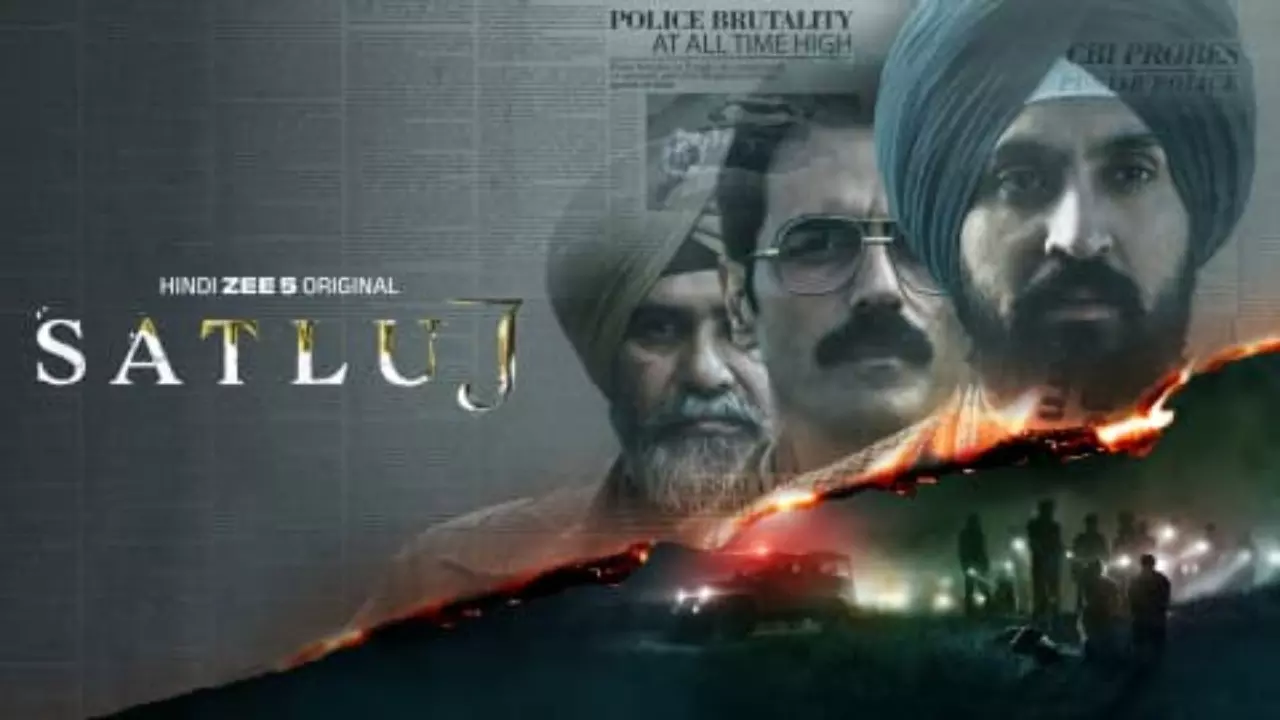
The film’s ban has renewed questions about the BJP's stance on Punjab militancy, Operation Bluestar, the 1984 anti-Sikh riots and state excesses
The Modi government’s decision to ban the film Satluj on OTT platforms presents an interesting irony and contradiction in the BJP's position on Punjab militancy and its aftereffects nearly four decades ago.
When Sikh separatism was at its violent worst in Punjab during the eighties and nineties of the last century, it was the Hindus who had to bear the brunt. Hundreds of them were killed and thousands had to flee the state to safety.
Also read | 'Satluj' OTT takedown sparks political firestorm across poll-bound Punjab
Similarly, hundreds of Sikh youths vanished mysteriously, never to return. A huge mismatch between the officially recorded number of deaths and the number of bodies cremated at Punjab's crematoriums bore testimony to this allegation.
Punjab’s troubled past revisited
Satluj has tried to capture precisely this through the story of the then human rights activist Jaswant Singh Khalra, who had exposed these extra-judicial killings of Sikhs and was later brutally done to death in police custody in 1995.
In the decade and a half before that, Sikh separatists led by Jarnail Singh Bhindranwale set in motion a sequence of events that culminated first in the Indian Army-led Operation Bluestar to flush out Bhindranwale and his band of armed militants from the Golden Temple, and later in the assassination of then Prime Minister Indira Gandhi by her own Sikh bodyguards in 1984.
Indira Gandhi's assassination was followed by massive riots against Sikhs in Delhi and other parts of the country in 1984. Thousands of innocent Sikhs were hacked to death by rampaging Hindu mobs.
The BJP's position over all this has been one of dilemma and confusion. While it supported Operation Bluestar, it condemned the anti-Sikh riots and has politically targeted the Congress, rightly so, for fomenting the trouble.
Now it has banned Satluj, which highlights state excesses in the name of anti-insurgency operations carried out by the then Congress government in Punjab led by Beant Singh, who was also subsequently assassinated.
Debating BJP’s double standards
There is an obvious contradiction in the BJP’s two positions: on the anti-Sikh riots and on Punjab Police excesses.
And the irony is that while Sikh separatists had targeted Hindus, the BJP chose to oppose the “reaction” against Sikhs in the 1984 riots, even as it not only justifies “reaction” against Muslims but also actively engineers it.
Also read | Satluj row: Is banning the film only making more people watch it?
So, it seems that for the BJP, Hindus being victims of Sikh separatism is fine, but the same is not acceptable when it comes to Muslims.
Similarly, anti-Muslim violence by Hindus is fine, but anti-Sikh violence is not, no matter if both are provoked by a perceived anti-Hindu sentiment.
Another telling irony in the BJP’s thinking is that while those involved in both the anti-Sikh and anti-Muslim riots are Hindus, it is the Congress, not Hindus that the BJP holds responsible for the 1984 riots.
In other words, the category of perpetrators in the 1984 riots case is ‘Congress’, not ‘Hindus’.
Clearly, the BJP’s hypocrisy is there for all to see: blame the Congress, not Hindus, for killing Sikhs in 1984 to secure both political advantage and Sikh sympathy.
The same BJP, however, plays the Hindu victim card when it comes to violence against Muslims.
Film ban fuels controversy
So, for the BJP, the anti-Muslim violence of 2002 in Gujarat is a justifiable “teaching of a lesson” (as Home Minister Amit Shah has preferred to put it) to Muslims, but the same is not true of the 1984 anti-Sikh riots.
In the current context too, this double standard is starkly evident in the BJP targeting protesting farmers in Delhi as “Khalistanis”.
Recently, BJP minister from Maharashtra Girish Mahajan stirred a major controversy by criticising Operation Bluestar as a “black chapter” and describing the militants killed in the operation as “martyrs” in a speech at Damdami Taksal, a Sikh seminary.
All these years, however, the BJP has politically exploited the anti-Sikh riots against the Congress to counterbalance the 2002 anti-Muslim riots in Gujarat under then Gujarat Chief Minister Narendra Modi’s leadership.
Also read | Satluj row: How CBI, SC brought Jaswant Singh Khalra’s killers to justice
In the case of Satluj, the Modi government’s purported stand is that it will feed a fresh spark into the Khalistan separatist movement and will also give Pakistan a handle to use it in its anti-India propaganda.
The same BJP hypocrisy and contradiction are on display in this case too.
For the BJP, which actively promotes films like The Kashmir Files and The Kerala Story with an overt anti-Muslim slant, Satluj has the potential to reignite Sikh separatism in Punjab.
Can it get more selective and hypocritical than this?
(The Federal seeks to present views and opinions from all sides of the spectrum. The information, ideas or opinions in the articles are of the author and do not necessarily reflect the views of The Federal.)