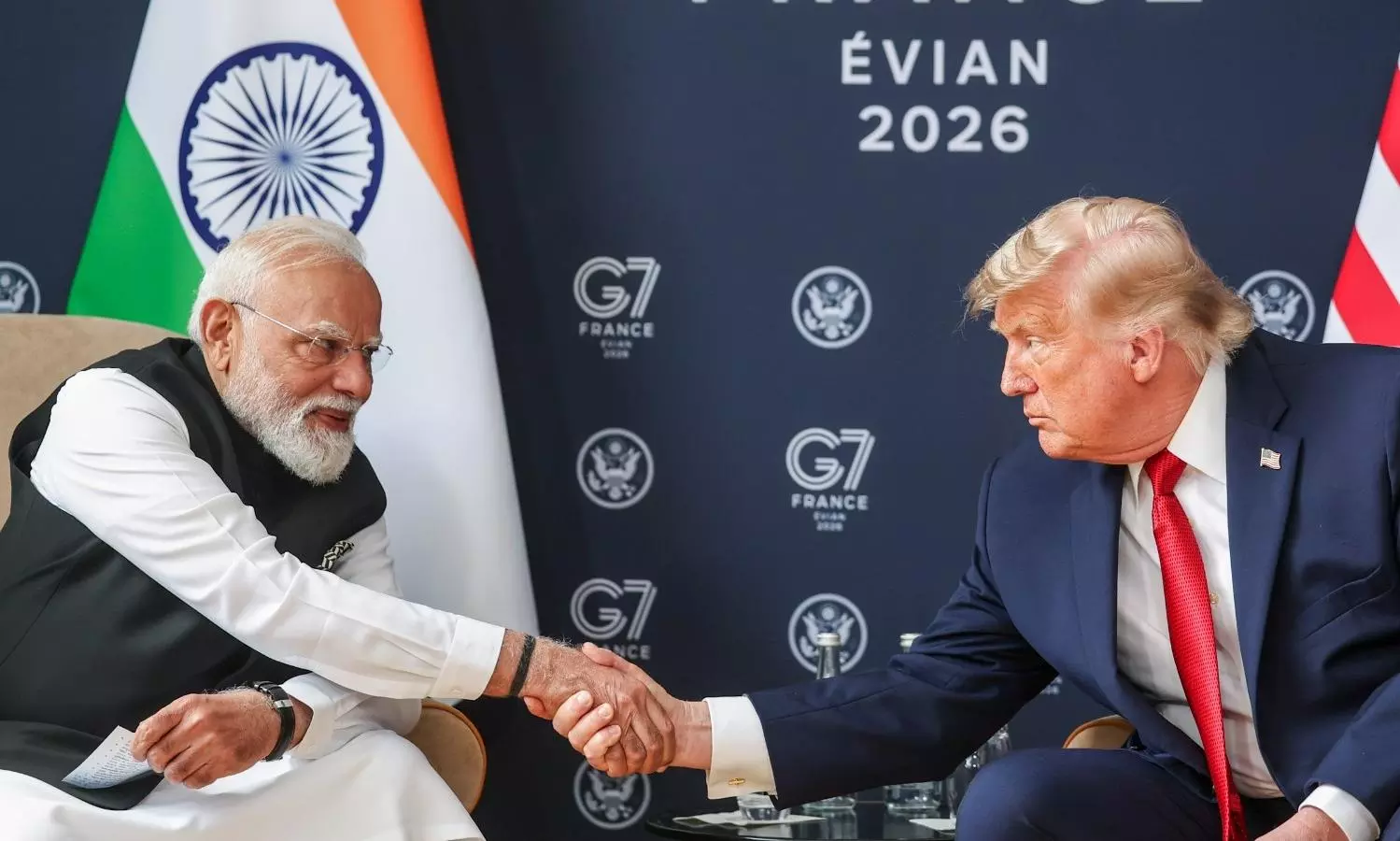
'Buy our oil, drop Russia's, open your markets': as the US turns partnerships into leverage, India is increasingly squeezed, while China gets a free pass
Recall Henry Kissinger's prophetic observation about the US, a country he served for long years as Secretary of State: "It may be dangerous to be America's enemy, but to be America's friend is fatal."
Having developed a close strategic partnership with the US in this century, India is steadily finding itself to be the victim of cold, one-sided transactional nature of US real politik.
Foreign Minister S Jaishankar's recent description of the US as the 'lonelier power' supporting Pakistani military dictators and Russia as an 'old trusted friend' supporting Indian democracy reflects New Delhi's admission that befriending Washington has not really worked.
Venezuela pressure
Since US President Donald Trump took complete control of Venezuela's huge oil reserves, he has relentlessly pushed India to buy more energy from US sources and reduce its dependence on Russian oil.
Since May this year, the US has become India’s largest supplier of both Liquefied Natural Gas (LNG) and Liquefied Petroleum Gas (LPG). Between April and May alone, US LNG exports to India jumped 227 per cent, while LPG exports rose 63 per cent.
Under relentless US pressure, India has also become the largest export destination for Venezuelan oil since American special forces seized its President Nicholas Maduro and jailed him in the US in a classic case of neo-colonial resource grab described by many as the ‘great Trump oil heist’.
Also read: Jaishankar details Ukraine outreach, defends Russia ties amid shifting world order
The US is the primary financial beneficiary of Venezuelan crude exports to destinations such as India. Under US sanctions and licensing arrangements, all proceeds, royalties, federal taxes and fixed per-barrel production levies generated from Venezuelan oil exports (including sales to trading firms for Indian refiners) are deposited into US Treasury Department-administered accounts, with Washington determining how and when portions of the revenue are released to Venezuela.
Unending pressure
Washington, however, is not content with India’s increasing dependence on US-origin and US-controlled energy supplies. A State Department official was recently quoted by Press Trust of India (PTI) as saying the US will use the new Lindsey O Graham Sanctioning Russia and Iran Act (SRIA) to induce India to completely end its Russian oil purchases and shift almost wholly to American-origin or US-controlled energy sources.
The objective appears to be to weaken the India-Russia strategic relationship by wielding the threat of sweeping sanctions to force New Delhi’s hand over Russian oil imports. That will ensure a steady end to Indian reliance on Russian weaponry and growing Indian dependence on US military hardware.
India's purchases of Russian oil have experienced periodic dips and overall moderation in 2026 due to refinery maintenance, narrowed discounts, and rising geopolitical pressure from new US sanctions. Imports plunged in January 2026 and dropped over 15 per cent in April 2026, partly due to the planned maintenance at major refineries like Nayara Energy's Vadinar facility. Purchases of Russian crude rebounded to record highs in July, but fell again by August and September to multi-month lows as refiners cautiously diversified sourcing.
SRIA, the Damocles Sword
One of the reasons is the drop in discounts that has narrowed the landed price advantage of Russian Urals over Brent significantly from earlier highs. But oil industry sources say the main reason for India shying away from Russian crude is huge US pressure, especially the Damocles Sword hanging over Delhi in the shape of the recently-signed SRIA targeting major petroleum buyers, especially India.
Also read: US House passes Russia sanctions bill, India faces up to 100 pc tariff; MEA reacts
Though China is the largest buyer of Russian oil, it has been largely let off by the Trump administration. The US and China have now extended the Busan Agreement to January 2027, which offers Beijing protection through national security exemptions.
Trump fears China can choke its rare earth supply chain, as once demonstrated in the early days of his second presidency. That leaves India the main victim of the new US law SRIA, and energy analysts fear that Washington may even impose up to 100 per cent tariffs on countries buying Russian oil, including India.
Trade leverage
The primary US objective is neither generating revenue nor shielding domestic industry from Indian goods. It is, in fact, all about Washington leveraging the threat of severe oil tariffs to coerce India into reducing Russian oil imports and signing a deeply unequal Bilateral Trade Agreement (BTA).
The US strategy aims to leverage 100 per cent tariff threats to extract major trade concessions, especially to open up the large Indian market for export of American agricultural products and also force India to buy US-origin military hardware.
The latest expose on US defence firm Powerus — with a large presence in the Indian combat drone market — now tying up with Pakistan army's combat drone development program is indeed worrying. This firm, which employs Ukrainian drone technicians with battlefield experience, has on its list of investors Trump's sons, Donald Jr and Eric. That may explain the US Deep State's persistent backing to Turkish-Pakistani efforts to install a Yunus-led Islamist regime in Bangladesh — something that would add to India's security anxieties and leave it vulnerable to American pressure for purchase of US military hardware.
Also read: Modi-Putin meet: Why India won't walk away from Russia, even under US pressure
With Trump treating China as its peer as a Superpower in the G2, India can hardly expect any real support from Washington in the event of a face-off with China. This may explain the Modi government's urgency to normalise ties with China.
But how it will handle the deadly embrace of Washington and maintain strategic autonomy will remain the major challenge of Indian foreign policy in this decade and the next.
(The Federal seeks to present views and opinions from all sides of the spectrum. The information, ideas or opinions in the articles are of the author and do not necessarily reflect the views of The Federal.)