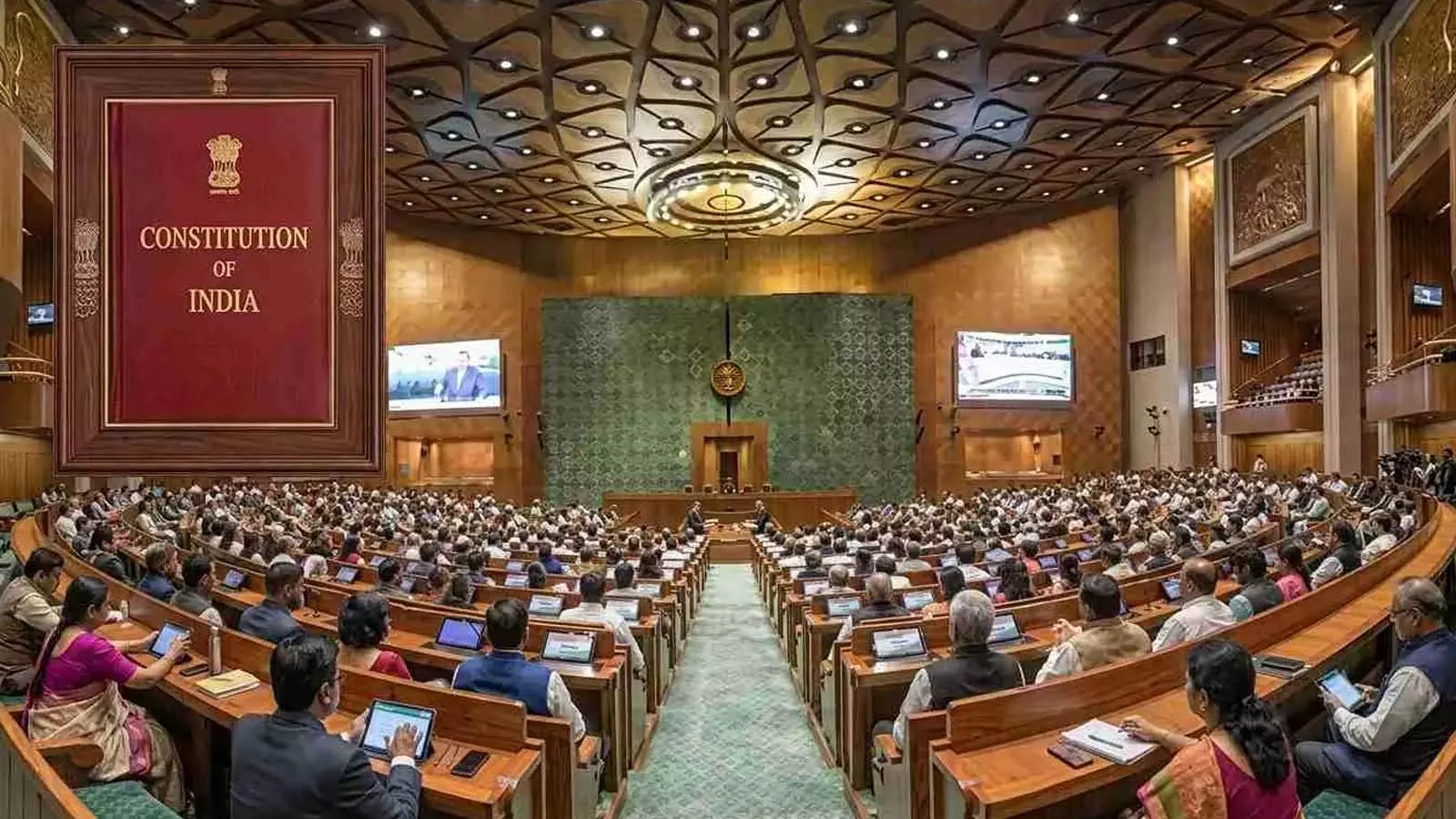
How Modi govt hopes to railroad Constitution 130th Amendment Bill amid hurdles
Centre likely to use tweaks in JPC report to fast-track controversial pieces of legislation during monsoon session, despite lacking a two-thirds majority

The Joint Parliamentary Committee (JPC) examining the controversial Constitution (130th Amendment) Bill, 2025 and two other related Bills, is expected to finalise its report on July 17.
Despite a series of defections from the Opposition ranks over the past three months, the Centre still lacks a two-thirds majority required in both Houses of Parliament to pass a Constitution amendment.
However, sources in the ruling NDA coalition told The Federal that once the JPC headed by BJP MP Aparajita Sarangi submits its report, the Union Cabinet could act swiftly to adopt “some changes” suggested by the committee and railroad the Bills through Parliament in the monsoon session slated to commence on July 20.
What the Bills are about
The Bills, introduced in the Lok Sabha last August by Union Home Minister Amit Shah and referred to the JPC in November, vest the President, governors, and lieutenant governors with unprecedented powers to sack the prime minister, any chief minister or minister who has been arrested and held in custody for 30 consecutive days.
Also read: 130th Constitution Amendment Bill: 'Passage impossible without Opposition consensus'
A senior Opposition MP, who is among the four non-NDA members of the currently 29-member panel, suspects that the Centre could use the Constitution (130th Amendment) Bill “to test whether it can manufacture a two-thirds majority in Lok Sabha”. The MP told The Federal, “If the Bill passes, the government will get the confidence to also push the Constitution (131st Amendment) Bill in the same session.”
The Sarangi-led JPC’s report is likely to retain the Bill’s draconian provisions allowing for the sacking of a PM, CM or minister merely on grounds of the individual being arrested for an offence and failing to secure bail within 30 days.
The Constitution (131st Amendment) Bill, which proposes to reconfigure the Lok Sabha from the currently 543-member House to an 850-member House, with one-third seats reserved for women, had been negated in April during an extended Budget session, as the Centre could muster only 298 votes for the Bill against the 360 votes currently required in the Lower House to amend the Constitution.
A lot hinges on Presiding Officers
The NDA’s numerical strength in both Houses of Parliament could, however, increase sharply if the Rajya Sabha Chairperson and Lok Sabha Speaker reject the petitions filed by Arvind Kejriwal’s Aam Aadmi Party, Mamata Banerjee’s Trinamool Congress, and Uddhav Thackeray’s Shiv Sena (UBT) against their party MPs who have defected in recent months.
Also read: Why delimitation Bills appear more ominous than originally thought
In April, seven of the AAP’s 10 Rajya Sabha MPs had defected to the BJP. Their names have already been added to the BJP’s list of 114 MPs in the currently 242-member Upper House. Last month, 20 Trinamool MPs in the Lok Sabha met Speaker Om Birla to inform him that they have merged with the Tripura-based Nationalist Citizens Party of India and decided to align with the ruling NDA coalition.
Subsequently, six of the Shiv Sena-UBT’s nine Lok Sabha MPs, too, defected to Maharashtra Deputy CM Eknath Shinde’s Shiv Sena.
Opposition petitions
While AAP’s Sanjay Singh and Trinamool’s Abhishek Banerjee have moved disqualification petitions, citing violations of the anti-defection law, against the defecting lot before Rajya Sabha Chairman CP Radhakrishnan and Lok Sabha Speaker Om Birla, no ruling has been given by the presiding officers so far.
The Bills under focus
130th Constitution Amendment Bill: Mandates the removal of any PM, CM or Minister if they are arrested and held in custody for 30 consecutive days for a "serious" criminal offence.
131st Constitution Amendment Bill: Proposes increasing the maximum number of Lok Sabha seats from 543 to 850 and enables a fresh delimitation of constituencies based on recent census data.
Delimitation Bill: Provides the legislative framework to carry out the seat redistribution and internal boundary redrawing, while also operationalising the reservation of one-third of seats for women.
In the case of the Shiv Sena (UBT), since a formal request by the defecting MPs to merge with Shinde’s Sena has not yet been made, Sena (UBT) floor leader Arvind Sawant has petitioned Birla to act in accordance with provisions laid down in the 10th Schedule (the anti-defection law) as and when he received the merger request from the rebels.
If the presiding officers of both Houses choose to defer any action on the petitions moved by Abhishek, Sanjay Singh, and Sawant or rule in favour of the defecting MPs, the NDA’s tally is bound to go up steeply.
Also read: Congress alleges BJP wants a two-thirds majority to scrap reservation
While the ruling coalition would still be over 30 MPs shy of the two-thirds majority mark in the Lok Sabha, leaders from the INDIA bloc fear the government could try to convince some Opposition MPs to cross-vote or abstain when the Constitution (130th Amendment) Bill is moved for consideration and passing.
If the Centre’s ploy succeeds, it would embolden Prime Minister Narendra Modi to also railroad the Constitution (131st Amendment) Bill as well as the related and equally contention Delimitation Bill through Parliament during the monsoon session, say sources.
What JPC is likely to do
Sources told The Federal the Sarangi-led JPC’s report is set to retain the Bill’s draconian provisions allowing for the sacking of a PM, CM or minister merely on grounds of the individual being arrested for an offence and failing to secure bail within 30 days. The panel may, however, provide a schedule for the kind of serious offences for which the law can be invoked.
The original Bill empowered the President, Governors and Lieutenant Governors to sack a prime minister, Union minister, chief minister, or minister in a state arrested and kept in custody for a period exceeding 30 consecutive days against an offence “which is punishable with imprisonment for a term which may extend to five years or more”.
Also read: ‘130th Constitution Amendment Bill can be misused to topple rivals before polls’ | Capital Beat
A BJP MP on the panel told The Federal that the JPC, in its final report, could further “fine-tune this formulation” but is expected to justify the 30-day timeline on grounds that this was sufficient time for an accused to “not only seek bail but also seek remedy against an adverse order in a higher court through an appeal”.
A new tool to harass Opposition
The Opposition has, from the time of the Bill’s introduction during the last monsoon session, held that the proposed amendment is being pushed to “harass Opposition leaders” and “topple non-NDA governments” using various probe agencies.
The rush to enact the Bill comes at a time when the BJP and the wider Sangh Parivar is battling charges of massive corruption, financial irregularities, impropriety and conflict of interest.
The INDIA bloc, except Sharad Pawar’s NCP(SP), had decided against joining the JPC, originally constituted with 31 members, claiming that its views would anyway be rejected as the panel, like any other parliamentary panel, is bound to have a majority of NDA members.
In November, the JPC was finally constituted with only five non-NDA representatives—Supriya Sule of the NCP(SP), Shiromani Akali Dal’s Harsimrat Kaur Badal, AIMIM chief Asaduddin Owaisi, YSRCP’s S Niranjan Reddy, and nominated MP Sudha Murthy. While Badal subsequently resigned from the panel, Reddy and Murthy, according to sources in the panel, largely subscribed to the NDA’s views on the Bill.
Also read: Why 130th Constitution Amendment Bill reeks of a red herring
In its 10 sittings and consultations with various state governments (bulk of them NDA ruled) and legal experts, NDA MPs are learnt to have steadfastly pushed the Centre’s narrative on the need for the Bill “instead of allowing for any objective discussions and suggestions”, said an Opposition MP. The MP said it was always clear that the panel, like the JPC on the Waqf Amendment Bill (now enacted), was “working towards a pre-determined report” and added that “the only power that the Opposition MPs on the panel have is to submit a dissent note when the draft report is adopted at the next sitting and that is what we will do”.
The dirt in BJP’s own house
The Centre is expected to brandish the Bill as yet another historic step by Modi’s government in cracking down on corruption and impropriety in public life. Interestingly, the rush to enact the Bill comes at a time when the BJP and the wider Sangh Parivar is battling charges of massive corruption, financial irregularities, impropriety and conflict of interest.
Donations worth thousands of crores by Hindu devotees at Ayodhya’s Ram Mandir have allegedly been siphoned off with the complicity of high-ranking members of the temple’s Trust, most of whom have an umbilical connection to the Sangh Parivar.
Also read: How the anti-defection law lost its bite, and why Tamil Nadu will prove it
The BJP’s Chief Minister Mohan Yadav, too, is in the eye of a storm over allegations about his direct and extended family purchasing massive parcels of land in Ujjain ever since he was picked to head the Madhya Pradesh government and, in that capacity, became privy to knowledge about all infrastructure schemes planned in the temple town, which also happens to include his assembly constituency. The Opposition has been highlighting both these scandals as examples of rampant corruption by the BJP.