Congress emerges as INDIA bloc’s fulcrum amid criticism and fragile unity
Despite sharp rebukes from allies, Monday’s meeting sees Congress being reaffirmed as the coalition’s centre, with consensus on a five-point agenda

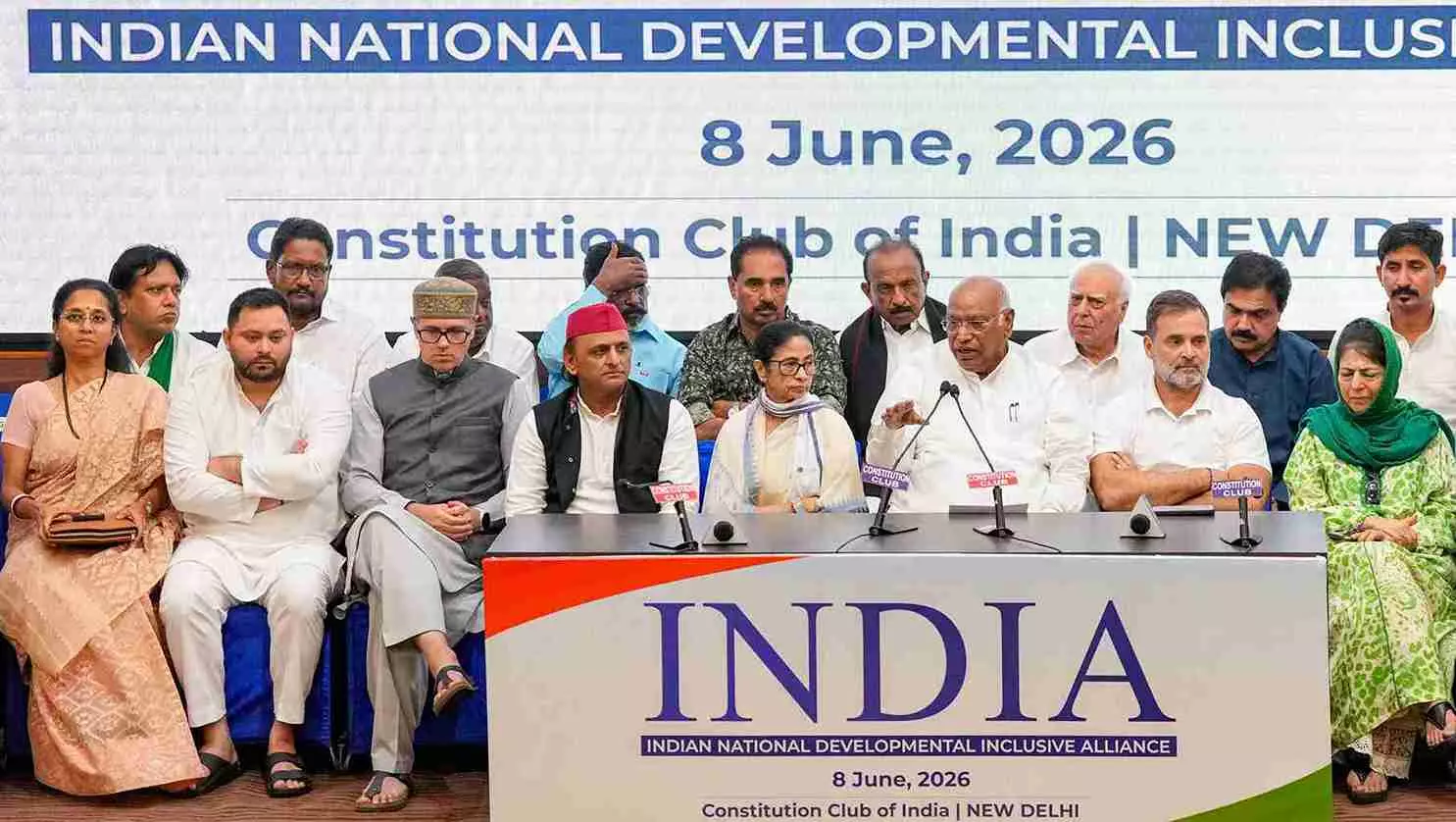
As Congress president Mallikarjun Kharge, flanked by Rahul Gandhi, Mamata Banerjee, Akhilesh Yadav and a host of top INDIA bloc leaders, read out to the media a five-point agenda unanimously agreed upon at their meeting on Monday (June 8), the image was one of solidarity and cohesion.
In contrast, over the preceding two and a half hours, as Opposition leaders brainstormed at Delhi’s Constitution Club to assess the recent turbulence and chart a collective future, there was plenty of plain speaking, with the Congress coming under criticism from allies for its conduct towards them. Yet, the Congress could scarcely have hoped for a better outcome from Monday’s meeting.
Five-point agenda for public consumption
For public consumption, the INDIA bloc arrived at a consensus on five points. The 23 parties present would write a joint letter to Chief Justice of India Surya Kant reiterating their concerns over the Special Intensive Revision (SIR) of voter rolls and the alleged “vote theft”. The parties would continue pressing for Union Education Minister Dharmendra Pradhan’s resignation. The bloc would demand that Prime Minister Narendra Modi convene an all-party meeting to discuss the country’s “precarious economic situation”, unemployment, price rise, farmers’ issues and other people-centric concerns.
Also read: Kharge calls for stronger unity in INDIA bloc to take on Modi govt’s ‘misgovernance’
To address persistent criticism over the alliance’s lack of coordination and unity, INDIA bloc leaders would meet every two months, with the next meeting scheduled for August in Hyderabad. Leaders of all constituent parties in the Lok Sabha and Rajya Sabha would also continue holding daily meetings during Parliament sessions to coordinate floor strategy.
Criticism directed at Congress
The outcome of Monday’s meeting may seem underwhelming to many. But given the fissures that had emerged within the alliance over the past several months, perhaps this was the only fresh start the leaders could agree upon for now, hoping to build on it in Hyderabad. What mattered more, arguably, were the conversations that took place behind closed doors to air frustrations and renegotiate the bloc’s internal balance of power.
The sharpest, and somewhat paradoxical, message to emerge concerned the alliance’s largest constituent: The Congress. Leaders from several parties—Samajwadi Party chief Akhilesh Yadav, RJD’s Tejashwi Yadav, CPM’s John Brittas and even the usually measured Supriya Sule of the NCP-SP and D Raja of the CPI—did not hold back in criticising the Congress.
Allies air grievances
If Akhilesh objected to the Congress portraying itself as the only party fighting the BJP, Brittas took strong exception to Kharge and Rahul’s direct attacks on former Kerala chief minister Pinarayi Vijayan during the recent Kerala campaign. Tejashwi pointed out that understandings reached between allies and the Congress’s central leadership were repeatedly undermined by the party’s state units. Sule, among several others, expressed disapproval of the manner in which the Congress allegedly sidelined its long-time ally, MK Stalin’s DMK, following the Tamil Nadu election results. The DMK, for its part, skipped the meeting and has maintained that it is no longer part of the INDIA bloc because of the Congress’s betrayal.
While this steady stream of criticism may ordinarily have scorched Kharge, Rahul and Sonia Gandhi, all of whom were present at the meeting, the Congress may still view Monday as a triumph. For perhaps the first time, there appeared to be an unstated consensus on the Congress’s centrality to the Opposition coalition.
Congress reclaims centrality
This reaffirmation had long eluded the Grand Old Party. Ever since the alliance began taking shape, its primacy was challenged directly or through sly shenanigans by regional satraps such as Trinamool Congress chief Mamata Banerjee, NCP-SP chief Sharad Pawar and, in the alliance’s early days, AAP leader Arvind Kejriwal and JD(U) chief Nitish Kumar, neither of whom remains part of the INDIA bloc.
Most of these challengers now find themselves struggling to maintain their grip over their parties and political turf. Elevated to the Rajya Sabha after relinquishing the chief minister’s chair he had held for nearly two decades, Kumar is now merely another BJP ally, his influence significantly diminished despite helping the NDA secure a sweeping victory in Bihar last year. Kejriwal, no longer part of the bloc either, has lost control of Delhi—the AAP’s political foundation—and failed to stem defections to the BJP.
Regional rivals weakened
Sharad Pawar and Uddhav Thackeray saw their original parties split vertically by BJP-backed machinations even before the INDIA bloc came into existence. Today, both the NCP-SP and Shiv Sena (UBT) face existential challenges in Maharashtra. Stalin may be directing his anger at the Congress, but his actual political nemesis is Joseph Vijay’s TVK, which is now in business with the Congress.
Also read: Can the INDIA bloc stay united? Five-point consensus masks fault lines | Capital Beat
As for Mamata, the alliance’s most vocal Congress critic until recently, the loss of power in Bengal would now seem a minor setback compared to the rapid unravelling of her own party that she is witnessing. Even as she attended Monday’s meeting, her troubles deepened, with former confidante Kakoli Ghosh Dastidar reportedly declaring herself and 19 other Trinamool MPs a separate bloc that intends to join the NDA. Little wonder, then, that the stormy petrel of Indian politics appeared a pale shadow of her former self on Monday.
Mamata’s changed posture
Humbled by defeat and stung by defections, it was Mamata who had urged the Congress to convene Monday’s meeting. The contrast with her past posture was striking. A year ago, when asked during a visit to Delhi whether she intended to meet Sonia, Mamata had retorted, “Do I have to meet her every time I come to Delhi?”
On Monday, as Sonia warmly embraced her and ensured she sat by her side, Mamata appeared far removed from her usually combative avatar. Instead of projecting herself as an alternative power centre within the alliance, she played the role of a chastened ally, grateful for solidarity and seeking continued support.
Rahul’s conciliatory tone
Despite the criticism directed at it, the Congress could hardly have failed to appreciate this reversal. Even amid its own electoral setbacks, it now stood as the undeniable fulcrum of the INDIA bloc.
Also read: INDIA bloc to write to CJI on SIR, demands Dharmendra Pradhan’s resignation
This perhaps explains why Rahul, during his nearly 15-minute intervention at the meeting, candidly accepted much of the criticism directed at both his party and himself. He also noted that the Congress had often faced attacks from many of those present and lamented that few allies had initially supported his “vote chori” campaign, only to recognise its significance now.
Rahul urged those present to trust him, let bygones be bygones and move forward with “love and respect”. Addressing Left leaders, he said he harboured “no personal enmity” towards Vijayan and that his attacks should be seen purely as campaign rhetoric. He added that while Mamata might be “90 per cent” certain and Akhilesh and Tejashwi “50 per cent” certain that the elections in Bengal and Bihar had been stolen by the BJP, he was “100 per cent” certain.
On another occasion, such remarks may have been interpreted as an attempt by Rahul to place himself above his allies. On Monday, however, they reportedly drew little objection.
Omar’s reminder
Jammu and Kashmir Chief Minister Omar Abdullah, often among those taking potshots at the Congress, also struck a markedly different note. Perhaps mindful of growing discontent within his own National Conference, Abdullah urged leaders to remain united. He reminded them that it was their coming together under the INDIA banner that had, for the first time since 2014, prevented Narendra Modi from securing a BJP majority on his own in the 2024 Lok Sabha elections.
Abdullah articulated openly what others only implied: The Congress is the alliance’s binding force. It is the only constituent with a national footprint and the natural link connecting disparate regional outfits.
The leadership question
The question, therefore, is no longer whether the Congress should lead the INDIA bloc but the kind of leadership it should provide.
Also read: Sharad Pawar signals high-level meet as INDIA bloc moves to curb cracks within
Rahul Gandhi’s response reflected an awareness of that dilemma and sought to shift the conversation from grievance to common purpose. Saving the country and its Constitution, he is learnt to have told allies, should remain the alliance’s sole common objective—a reiteration of the theme he has championed ad nauseam in recent years.
The tensions surrounding the Congress’s functioning remain but the context has changed. For now, allies are not dictating terms to the Grand Old Party. Instead, they are urging it, as Akhilesh put it, to show “a large heart”.
Looking ahead to UP polls
The significance of that appeal is evident. The next major political battle against the BJP will be fought in Uttar Pradesh. While the Samajwadi Party remains the senior partner in the state, it also recognises that without recreating the chemistry that powered the alliance’s gains in the 2024 Lok Sabha elections, neither party stands much chance in 2027.
Punching above its weight, the Congress is said to have demanded around 120 of Uttar Pradesh’s 403 Assembly seats, while the SP is reportedly willing to concede only 65 to 80. These are, of course, very early negotiations. How they progress will depend as much on Rahul as on Akhilesh’s willingness to display the same large-heartedness the latter seeks from the former.
Also read: DMK boycott clouds INDIA bloc’s future as rift with Congress widens
For now, however, the Congress need not break a sweat. Its allies have spoken their minds and the party has offered assurances. When they reconvene in Hyderabad in August, Parliament’s monsoon session will have concluded and the trajectory of the BJP’s next major political move—be it delimitation, implementation of women’s reservation, or even One Nation, One Election—may be clearer.
If that happens, the pressures pushing INDIA bloc constituents towards greater consolidation behind the Congress may prove stronger than those pulling them apart.