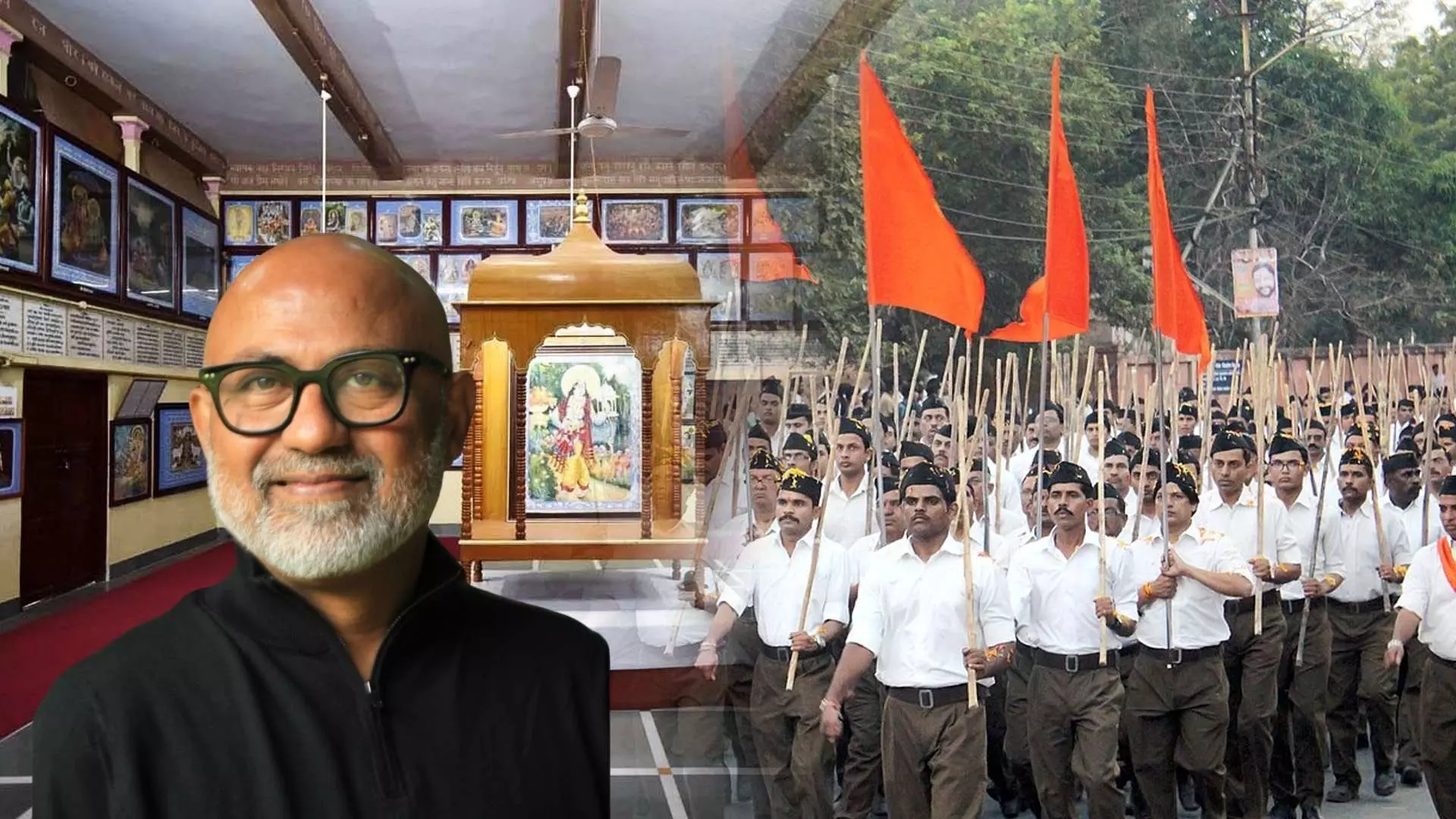
Akshaya Mukul interview
Gita Press and RSS: Akshaya Mukul on how ideas shaped Hindu politics for a century
The author-journalist discusses how the Gorakhpur publisher used spiritual texts and its journal Kalyan to quietly build a political and social base for the Sangh Parivar

The idea that Gita Press helped carry a century-long political project into ordinary Hindu homes — quietly, cheaply, and persistently — is at the heart of journalist Akshaya Mukul’s argument on the publisher’s parallel journey alongside the Rashtriya Swayamsevak Sangh (RSS), which completed its centenary last year.
Also read: Move over, Sanatana, what RSS truly cares about is political power
The Federal spoke to Mukul, who has authored Gita Press And The Making of Hindu India, on how the Gorakhpur-based publisher — founded in 1923 — and its house journal Kalyan (launched in 1926) shaped ideas, rituals, and social attitudes that later became central to Hindutva-era politics.
Excerpts from the interview:
How have the paths of Gita Press and the RSS converged over the years and also remained distinct from each other?
It all begins in the first quarter of the 20th century. Gita Press in 1923, Kalyan in 1926, and the RSS in between in 1925 — those three to four years are a ferment when what we now call the Hindu right wing got organised. The Hindu Mahasabha was already there, besides a few other organisations.
If you track similarity and distinction, look at the early 1930s — specifically around the Poona Pact — when Gita Press and Hanuman Prasad Poddar, the founding editor of Kalyan, get into a major argument with Mahatma Gandhi on issues such as caste, temple entry and inter-dining. Since then, Gita Press has been saying it works for bhakti, gyan, vairagya, kalyan, and to a large extent it does. But at every flashpoint from 1926 onwards, there’s a choreography between the RSS, Gita Press and similar organisations.
Also read: Why Felix Pal thinks RSS is an 'aloof parent' of the Sangh Parivar
In the 1940s, for instance, Gita Press forgets its claimed spiritual lane and actively participates in politics — a very intense and polarised period — and becomes a vehicle for what the Hindu Mahasabha and the RSS were doing.
What Gita Press did exceptionally well was bring a Hindutva-flavoured Hinduism into ordinary Hindu homes. It does it under a cover that doesn’t look political. Pick up a Kalyan issue: it will have fasting advice, moral stories, illustrated tales of children, women, men — on the face of it, you won’t think it’s political.
But beneath what catches the eye, it’s highly political — and you can see the template in the very first editorial of Kalyan in August 1926. It speaks of "sangh bal" (unity of strength), it creates an “otherness” of Muslims, and it keeps returning to cows, women, and whatever the politics of the time is. They even used to do things like “vote kisko dein” (who to vote for) — for a journal claiming bhakti and gyan, that’s a clear departure.
You’ve written about Kalyan’s first editorial, blaming Muslims for riots and presenting Hindus as innocent. How does that fit the larger project?
The purpose was exactly that. The editorial talks about a deep-seated inferiority complex among Hindus, and then contrasts it with Islam — it says Islam speaks in one voice, Hindus don’t, because they have multiple sects, gods, creeds.
There, the "sangh bal" becomes important. The message is: become united. Over time, Gita Press tries to become the sole spokesperson of the Hindus. They will talk of Shaivism and Vaishnavism, but they won’t foreground distinctions — they present Hindus as one united face. That translates directly into the politics we now call Hindutva.
Also read: Why, in 2025, centenarian RSS is having to weather the belief that it has been diminished by Modi
And importantly, the RSS or Hindu Mahasabha didn’t have a vehicle that reached ordinary Hindu homes the way Kalyan did. Not everyone reading Kalyan is polarised — not at all — but the worldview gets carried into homes through it, consistently, over decades.
You call Gita Press a “foot soldier” of the Sangh Parivar — but not in the street-mobilisation sense. What do you mean?
There isn’t one uniform “foot soldier”. It’s not only the one burning mosques or chasing Muslims. There are organisations that work at the level of mind and ideas, and brick by brick they built what we know as Hindutva and its political manifestations — from the Hindu Mahasabha to the Jana Sangh to today's Bharatiya Janata Party.
Gita Press worked quietly and efficiently at that level. It also did remarkable things: it took texts like the Ramayan and Mahabharat into ordinary homes at low prices, with fine illustrations and production quality. It was a strong Marwari enterprise.
Alongside that, politics was thrown into Kalyan — even into moral stories. Subtly, persistently, it worked.
I’ll give you one example: a monograph called Stri Dharma Prashnottari from 1926 is still in circulation. It’s a conversation between Sarla and Savitri, guiding women on how to live within four walls, how to bring up children, how to “build the nation” through sons, and how to “protect” themselves from libidinous Muslim men. That’s the pattern.
Today, leaders frequently invoke "Sanatan Dharma under attack". Do you see echoes of Poddar-era messaging?
I smile when I see it. I still subscribe to Kalyan for some reason. The centenary issue just came out, and it has a whole article on "putra prapti" — how to get a male child. They were saying this in 1926, and they’re saying it in 2026.
Also read: MGNREGA renaming row: Why dropping Gandhi is more than a name change
This comes from a worldview that began with a churn inside parts of the Marwari world: “We have money, but not respect. Modernity is destroying youth.”
The explanation they settle on is: bad influence of Muslim rule followed by Christian/British rule — so the solution becomes “go back to Sanatan Dharma”.
And remember: Marwaris are not monoliths. There was a liberal, Gandhian stream too — people like Ghanshyam Das Birla and Jamnalal Bajaj. But the stream led by Poddar was different. Gita Press is a community enterprise: a trust, headquartered in Calcutta, historically restricting membership, still run by Marwaris, and operating on a no-profit-no-loss basis.
So when today’s political discourse repeats these ideas, it’s not new — it’s continuity.
Why is “Sanatan” being projected as the only valid version of Hinduism now?
Because the stress in recent years is on one nation, one election, one religion; one religion becomes the Sanatan version, not the thousands of lived versions of Hinduism.
They don’t like diversity — not of religions, not within Hinduism. They want a strident, militant version where people fight over small things. Look at what happens repeatedly in Uttarakhand — every few days, there’s something.
And think about how absurd it is: where in history does it make sense that an 80 per cent majority is “under threat” from a small minority? But people are convinced daily that religion is under threat, women are under threat, and everything is under threat. That anger is the politics.
You cited Kalyan’s 1950 ‘Hindu Sanskritik Ank’. Is that aligned with RSS-style “cultural nationalism”?
Largely, yes. Look at views on women, Islam, and social order — there’s no meaningful difference. RSS won’t talk about ritual fasting on the festival of Kartik Purnima — they leave that to Gita Press — but the larger political and social worldview is in sync.
Also read: Christmas attacks show how hate in India is politically emboldened
In the mid-1940s, in the Hindu Mahasabha meeting in Gorakhpur, the demands for what Hindustan should be — and how Muslims would be treated — you find those demands mirrored in Kalyan. They wanted to be the sole spokesperson, and they didn’t encourage internal debate. Once or twice, something like a rejoinder appeared, then they shut it down.
So yes: ritualistic detail is Gita Press’s lane; the wider ideological narrative is shared.
What was Hanuman Prasad Poddar’s role around Ayodhya and the 1949 idol installation?
Poddar was remarkable as an editor: he could get Premchand to write, convince Nirala, and others. He served for over 45 years. He was also actively involved in politics.
On Ayodhya, I was told by Ram Bahadur Rai — a senior journalist — that there was a recording saying Poddar was present the night the idol was installed. Rai later wrote it himself in his journal, and I cite that. Separately, Gita Press records show that the first fund for the Ram temple construction was started by Poddar — about Rs 1,500 in those days.
After Gandhi’s assassination, Poddar and Seth Jai Dayal Goenka — one of the main founders of the press — were rounded up with thousands. And when the Hindu Code Bill came, they led a campaign into ordinary homes: readers were asked to send postcards opposing it. The arguments are the same as today’s: fear-mongering about Hindu girls marrying Muslim men, beef in the house, property being taken — it’s the same script.
They also attacked B R Ambedkar in deplorable terms, calling him “Heenavar Ambedkar”, blaming him along with Jawaharlal Nehru.
Also read: 75-year retirement to caste census: Decoding Mohan Bhagwat’s speech
They participated directly in elections too — like in Phulpur in 1951, pushing slogans such as cow protection, Hindi as "rashtrabhasha" (national language), saffron flag, and openly telling readers who to vote for. I saw similar messaging even in 2014, and I mention that in the epilogue: they celebrated it as the arrival of the Hindu Rashtra.
What about Mathura and Gyanvapi?
On Krishna Janmabhoomi, they were invested early — agitating from the 1950s onwards, presenting it as an “eyesore”, and carrying the argument into homes through Kalyan.
On Gyanvapi, they spoke off and on, but not as continuously as on Ram Janmabhoomi and Krishna Janmabhoomi. Still, the method is the same: using Kalyan as the vehicle.
In today’s India, what role is Gita Press likely to play?
The press itself isn’t under threat — there’s a broader Hindu ecosystem, and it still has circulation.
Also read: Swadeshi Jagran Manch backs India-US interim deal, says Trump did it under pressure
What worries me is that the centenary issue is talking about "putra prapti", and someone somewhere is reading it. Issues like 'Nari Ank' and 'Hindu Sanskritik Ank' (volumes on women and Hindu cultural matters, respectively), get reprinted year after year. Since it’s no-profit-no-loss, it’s not printing blindly — there’s a constituency.
Who is reading it? Who is following those steps? I’m sure people are. That’s part of what explains continuing female foeticide.
We live in bubbles, but there’s a world out there convinced of these rituals and this worldview. That’s what keeps Gita Press relevant, and I don’t see it going away soon.
The content above has been transcribed from video using a fine-tuned AI model. To ensure accuracy, quality, and editorial integrity, we employ a Human-In-The-Loop (HITL) process. While AI assists in creating the initial draft, our experienced editorial team carefully reviews, edits, and refines the content before publication. At The Federal, we combine the efficiency of AI with the expertise of human editors to deliver reliable and insightful journalism.