Kejriwal vs Delhi HC judge: Protest against the law or political gamble?
Is Kejriwal’s ‘satyagraha’ a political strategy, a legal protest, or a broader institutional confrontation, particularly in the backdrop of exits from the party

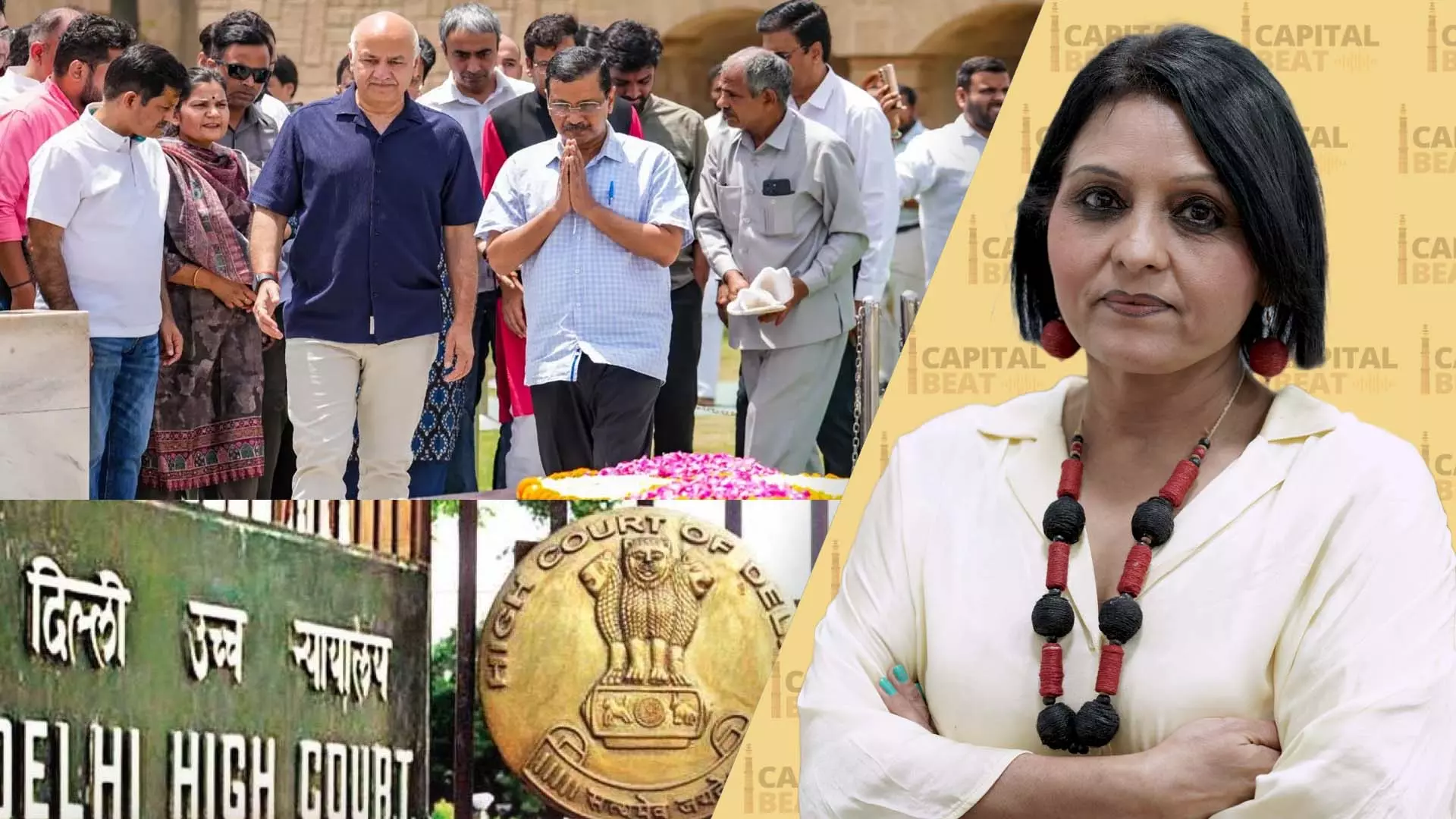
Amid the standoff between Aam Aadmi Party (AAP) chief Arvind Kejriwal and Delhi High Court judge Swarnakanta Sharma, this episode of the Capital Beat focused on Kejriwal’s decision to skip court proceedings in the excise policy case and instead pursue a path of “satyagraha.”
The discussion with Brijesh Kalappa, Senior Advocate and former AAP Leader, Prof. Akash Deep Muni, former AAP supporter, and The Federal's Puneet Nicholas Yadav centred on the legal, political, and institutional implications of the move, as AAP leaders, including Kejriwal and Manish Sisodia, visited Raj Ghat and announced they would not pursue the matter in the same court.
Kejriwal, in his communication, stated: “We respect the judiciary but due to certain circumstances we have to do this satyagraha. I have mentioned all the details in my letter to the high court.” The development followed his refusal to appear either personally or through legal representation.
The panel examined whether the move signalled a political strategy, a protest against the law, or a broader institutional confrontation, particularly in the backdrop of internal developments within the AAP.
Legal questions around recusal
Brijesh Kalappa raised objections to comparisons between Mahatma Gandhi’s satyagraha and the present situation. “Comparing Mahatma Gandhi to the present date may not be appropriate,” he stated, noting the historical context of colonial rule.
Also read: Between appeal and acquiescence: Kejriwal’s withdrawal offers a middle path
Kalappa also questioned Justice Swarnakanta Sharma’s refusal to recuse herself. “I don’t agree with that… she is doing a great disservice to the judiciary itself,” he said, citing allegations raised by Kejriwal regarding the judge’s associations and potential conflicts of interest.
He referred to the General Pinochet case as a precedent on judicial conflict of interest, stating: “This is the leading case on the subject… clearly she would have had to dissociate herself from Arvind Kejriwal’s case.”
Kalappa added that the appropriate legal course remained available. “The other option is for Kejriwal… to have appealed to a higher court,” he said, questioning the decision to adopt a satyagraha route instead.
Politics versus institutions
Kalappa described the confrontation with the judiciary as problematic. “If you are fighting against the judiciary, you are basically fighting against the people of India,” he stated.
He warned that such actions could affect institutional trust. “What is the public confidence in the judiciary going to be?” he asked, adding that both the judiciary and political actors were contributing to a negative perception.
Also read: Punjab power play: Raghav Chadha's BJP switch sparks anti-defection debate | AI with Sanket
Puneet Nicholas Yadav characterised the developments as a political strategy. “This is pure political theatrics,” he stated, describing Kejriwal as a leader who “excels in the art of political theatrics.”
He added: “If on the one hand you are saying I reserve the right to go and appeal in the Supreme Court, then just go and appeal… why do you have to do this?”
Political messaging and party dynamics
Yadav linked the developments to internal party issues. “There is also the background of… what is happening within the Aam Aadmi Party… the exit of Raghav Chadha and others,” he noted.
He described the move as an attempt to reinforce a political identity. “It’s basically trying to show that we are still the kind of street fighters that distinguished us,” he said.
Also read: Why Chadha-led exodus presents an existential crisis for AAP and Kejriwal
However, he questioned its effectiveness. “I don’t think there is any relevance… on how the case is to be adjudicated or how the party is supposed to fare in elections,” Yadav said.
On the legal aspect, Yadav criticised the refusal to participate in proceedings. “By saying that you are not going to participate because you don’t trust the judge… you have the option of appeal. Why are you not exercising that?” he argued.
Judiciary under scrutiny
Prof. Akash Deep Muni acknowledged broader concerns about judicial conduct. “Judiciary… sometimes it had to be questioned,” he stated, referring to past instances where judicial comments were criticised.
He contrasted Kejriwal’s actions with historical satyagraha. “When Mahatma Gandhi did it… it was against the oppressive British rule… here Arvind Kejriwal is fighting for an individual which is himself,” he said.
Also read: Chadha, others’ exit was a disaster waiting to happen for AAP
Muni questioned the confrontation with the judiciary. “Why are you fighting with the judiciary? It is a platform… where you can tell the opposite point of view,” he stated.
He also echoed the characterisation of the move as political strategy. “This is political theatrics… but now this political theatrics won’t work,” he said.
Impact on credibility and governance
Yadav raised concerns about institutional credibility. “Courts… should not be reduced to a political boxing ring,” he stated, emphasising the responsibility of both judges and politicians.
He added: “You have to draw a line somewhere… instead of taking a wrecking ball to whatever little trust is left in the institutions.”
Also read: Why Delhi HC judge’s refusal to recuse in Kejriwal case may not be the last word
Kalappa highlighted electoral implications. “The Aam Aadmi Party is becoming less and less of an option for the Indian elector at large,” he stated.
He pointed to broader voting trends. “The vote against the BJP is larger than the vote in favour of the BJP… but whom do they invest their votes on?” he asked.
Street politics and future trajectory
Yadav suggested that the current approach aligns with Kejriwal’s political style. “It’s an instinct that comes naturally to him… this kind of street politics,” he said.
However, he reiterated concerns about institutional consequences. “What this whole drama does to the credibility of the courts… that’s the basic question,” he stated.
Also read: Raghav Chadha targets Kejriwal over ‘Sheesh Mahal 2’ row as BJP, AAP trade charges
Muni emphasised the need for political engagement beyond courtrooms. “He should be on the ground… his dharma is that he should fight for people, not for himself,” he said.
He added that such strategies may not yield electoral benefits. “These political theatrics… he is losing votes. He is not gaining votes,” Muni stated.
The discussion concluded with the ongoing standoff between Kejriwal and Justice Swarnakanta Sharma remaining unresolved, with legal and political implications continuing to unfold.
(The content above has been transcribed from video using a fine-tuned AI model. To ensure accuracy, quality, and editorial integrity, we employ a Human-In-The-Loop (HITL) process. While AI assists in creating the initial draft, our experienced editorial team carefully reviews, edits, and refines the content before publication. At The Federal, we combine the efficiency of AI with the expertise of human editors to deliver reliable and insightful journalism.)