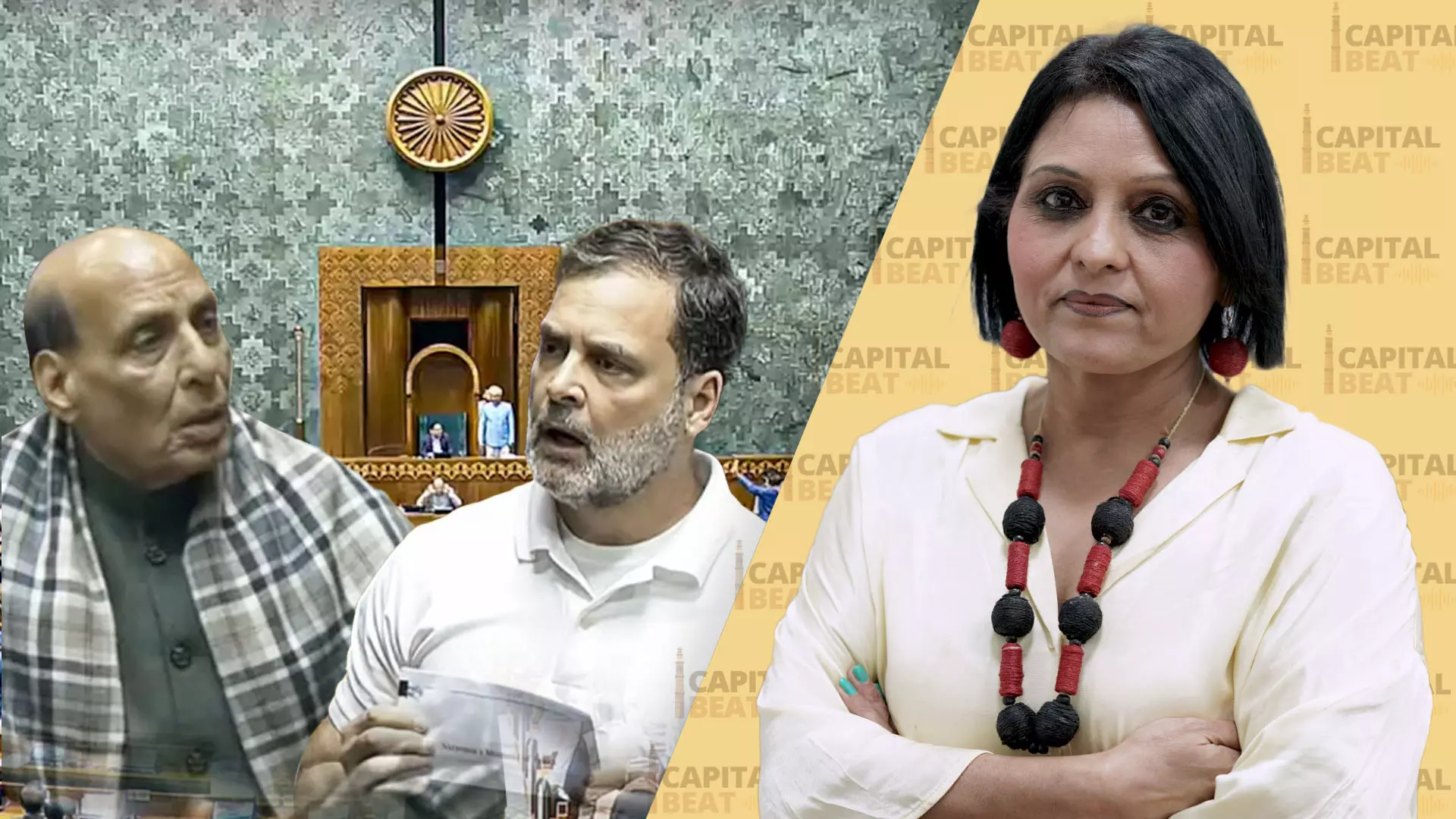
Why Rahul citing Naravane’s memoir sparked Parliament showdown | Capital Beat
Lok Sabha sees heated exchanges after Opposition leader Rahul Gandhi tries to read excerpts from former Army chief Gen MM Naravane’s unpublished memoir

The Congress’s blunt charge in this Capital Beat episode, focused on the sharp Lok Sabha exchanges during the Budget Session over Leader of Opposition Rahul Gandhi’s attempt to cite excerpts linked to former Army chief Gen. Manoj Mukund Naravane’s unpublished memoir, was that “the government is scared”.
The panel featured Sujata Paul Maliah, Congress spokesperson, Gen Ashok K Mehta, independent security analyst, TK Rajalakshmi, senior journalist, and PDT Achary, former Secretary General of the Lok Sabha.
The disruption began during the Motion of Thanks to the President’s Address when Rahul sought to quote from a magazine article carrying excerpts attributed to Naravane’s unpublished memoir, Four Stars of Destiny. Defence Minister Rajnath Singh objected on the floor of the House, questioning the use of unpublished material and its authentication, triggering protests from the Treasury benches and a procedural row over what can be cited in Parliament.
Also Read: Rahul Gandhi’s Naravane memoir remarks: What Lok Sabha rules say
What triggered the confrontation
The programme described how the dispute escalated after BJP MP Tejasvi Surya was referenced as having made an allegation against the Congress related to patriotism and national culture, prompting Rahul to argue that he wanted to read from the memoir to respond.
Also Read: What is former Army chief Naravane’s memoir ‘Four Stars of Destiny’ about?
The show also laid out a set of excerpts circulated via a published essay, including lines presented as Naravane’s words: “To each and everyone my question was what are my orders?” and “There was neither any authorisation to fire, nor any restriction, no guardrails, no contingency framework.” The excerpts were framed in the episode as relating to decision-making during the India-China military standoff period.
The Treasury benches objected to Rahul’s reliance on unpublished material, while the programme stated that Parliamentary Affairs Minister Kiren Rijiju cited rules to argue that non-published memoirs could not be quoted and that members must bring evidence and authenticate material.
Suppression and 'review' of memoir
Sujata Paul Maliah presented the confrontation as an attempt to block Rahul Gandhi from placing the excerpts on record. “The fact of the matter here clearly is that the government is scared,” she said, linking the objection to the claim that the memoir remained unpublished and was “under review of the Ministry of Defence and other government bodies.”
Also Read: SC chides Rahul over Galwan remarks: ‘If you were a true Indian, you wouldn’t say this’
The Congress spokesperson also asserted that the excerpts “are mentioned in the book,” and framed the interruption as fear of political embarrassment if discussion proceeded in the House. On the conduct of the Chair, she argued: “The Speaker was so partisan,” contrasting the interventions during Rahul Gandhi’s speech with how other members were allowed to speak.
Maliah also connected the parliamentary disruption to the debate over China, stating: “China has come really into our homes,” and asserted that questions raised in the House were being resisted because they could “expose” the government on the issue.
Military angle
Gen Ashok K Mehta argued that the sensitivity around China has produced a pattern of caution and avoidance in Parliament. “There is no compunction about speaking about Pakistan, but when it comes to China,” he said, before linking the episode to the government’s response to discussion of the memoir excerpts.
Also Read: Congress slams Modi govt over 'move' to lift curbs on Chinese companies
On the specific episode described in the programme, Mehta referred to an account presented as Naravane’s and described a lack of political clarity at a critical moment. “Secondly, he said there was no strategic or political guidance given to me,” Mehta said, while arguing that such revelations, if discussed, would raise questions about how decisions were handled.
He also questioned the adequacy of political direction described in the excerpts, stating: “The answer should not be that 'jaisa aapko uchit lage',” in response to the idea that the final call was left to the military without firm political guidance.
Rules and Parliament
PDT Achary set out the constitutional basis for parliamentary speech and the limits imposed by House rules. “Under Article 105 of the Constitution of India, members of Parliament have freedom of speech in the house,” he said, adding that this freedom is “subject only to the other provisions of the Constitution and the rules of the house.”
On the specific restriction cited in the House, Achary referred to “rule 349,” explaining its scope: “This rule 349 simply says that you cannot read a newspaper or a book etc in the House unless it is related to the business of the House.” He then linked the Motion of Thanks convention to the scope of debate, stating: “Normally the practice is, you know, when the motion of thanks is under discussion in the House, people can speak about any subject under the sun.”
Also Read: Feb 2 LIVE | Every jawan knows what you are hiding from people: Rahul in Lok Sabha
Achary also referred to precedents involving confidential or unpublished material. “Confidential documents of the government, CBI reports, many such confidential things you know have been brought before the house,” he said, describing a practice where the Speaker allows references if the member takes responsibility for authenticity. “The only thing is that he has to take responsibility for what he says,” Achary said.
On potential action against Rahul Gandhi, Achary noted: “There is a rule which states that a person can be… suspended from the house… if we continuously defies the chair,” while rejecting the possibility of membership being revoked in this context.
Media and disclosure
TK Rajalakshmi argued that the Motion of Thanks discussion allows a wide scope and that issues of national importance can be raised even if not tightly confined to the text of the President’s Address. “the MPs rights to freedom of speech is there,” she said, noting that such rights are “only circum scribe by… certain specific conditions.”
On why the discussion should have been allowed, she offered a procedural alternative: “I think it could have taken its own time and it could have and it could have suggested that that this can be taken up… at a subsequent… later date.”
Rajalakshmi also argued that attempting to block discussion was counterproductive. “The book is going to come out… and everybody has read that excerpt,” she said, adding that efforts to prevent debate “fails reason,” given the excerpts were already in public circulation.
The content above has been transcribed from video using a fine-tuned AI model. To ensure accuracy, quality, and editorial integrity, we employ a Human-In-The-Loop (HITL) process. While AI assists in creating the initial draft, our experienced editorial team carefully reviews, edits, and refines the content before publication. At The Federal, we combine the efficiency of AI with the expertise of human editors to deliver reliable and insightful journalism.