By staging Jharkhand counter-protests, is BJP underestimating scale of student anger?
BJP’s Jharkhand pivot faces a bigger test as youth unrest over jobs, education and accountability spreads far beyond Delhi’s Parliament clash

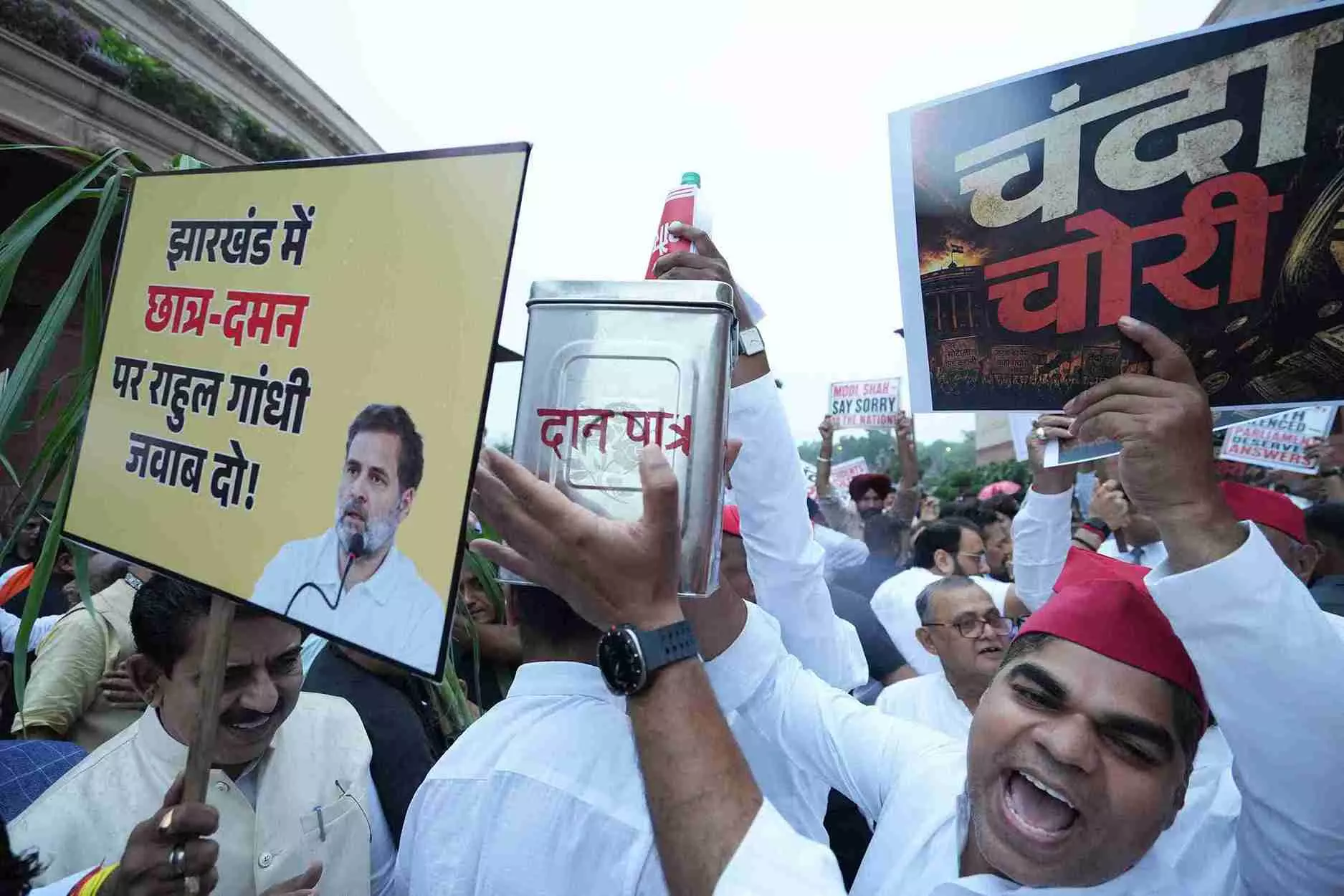
The BJP-led NDA’s counter-protest outside Parliament on Tuesday (August 11) has raised a larger political question: Can the government answer mounting student anger by shifting the focus to Jharkhand?
The confrontation outside Parliament came as the Opposition continued to demand answers from the government over the July 20 student protest at Jantar Mantar and the police crackdown. The NDA, meanwhile, mounted a counter-protest accusing Rahul Gandhi of avoiding questions on student protests in Jharkhand.
During a panel discussion in The Federal’s Capital Beat programme, senior journalist Sunil Prabhu said the counter-protest was part of a strategy to change the political field.
Late response from Centre
Prabhu said such counter-protests have increasingly become a feature of parliamentary politics. According to him, the government’s strategy is aimed at countering the political ground it believes it has lost over the student protests.
Also read: BJP workers block Ranchi roads, burn tyres over police crackdown on students
He argued that the government’s response had come late, particularly after the Rajya Sabha chairperson urged the government to respond. With the monsoon session nearing its end, Prabhu questioned whether there was enough time left for a meaningful discussion in Parliament.
The BJP’s counter-protest, he said, should therefore be viewed against the backdrop of a government attempting to regain the political narrative. The question is whether changing the subject from Jantar Mantar to Jharkhand can prevent the student issue from becoming a larger political challenge.
Anger beyond Jharkhand
Senior journalist Anand Sahay took a broader view of the unrest. He argued that the phrase “Gen Z” risks narrowing what is actually a much wider movement among young Indians.
Sahay said the concerns being expressed by young people revolve around education, corruption, employment and governance. He argued that these are secular and everyday issues that affect young people irrespective of which party governs their state.
Also read: What explains govt’s late U-turn on student protest debate?
He pointed to political gatherings in Prayagraj and Dehradun as signs that the sentiment cannot simply be confined to Jharkhand or Delhi. Young people who participated in the Jantar Mantar protests came from as far away as Tamil Nadu too, he said.
BJP’s changing narrative
Senior journalist TK Rajalakshmi focused on the BJP’s changing position on the demand for a parliamentary discussion. She argued that the goal posts had shifted repeatedly over whether the home minister should respond to the events of July 20.
The initial position was that the Opposition could not dictate which minister should respond. The next argument, she said, was that the discussion could not be conditional. Subsequently, the government indicated that the home minister could speak but that order and calm in the House were necessary.
Rajalakshmi said this sequence suggested that the delay had come from the government rather than the Opposition. With the session approaching its end, she questioned whether the home minister would actually make a statement before Parliament adjourns.
Youth sentiment
Rajalakshmi also argued that the government appeared to be underestimating resentment among young people. She cited unemployment among graduates as one indication of the pressures facing the country’s youth.
Also read: Centre’s ‘divide-and-rule’ bid on parliament debate backfires as Oppn calls its bluff
She questioned whether mounting a counter-offensive against the Congress could address those concerns. The political strategy, she suggested, risks turning a substantive discussion about students and employment into another partisan confrontation.
What happens next?
The panellists converged on the possibility that the student protests could have consequences beyond the immediate parliamentary confrontation.
Prabhu said the BJP and NDA were already preparing to return to their constituencies and reconnect with younger voters. He argued that the coming months would show whether the protests develop into a larger political force.
Sahay said issues such as hunger, unemployment and examination pressures cannot simply be wished away. If protests subside in one state, he argued, they could emerge elsewhere because the underlying grievances remain.
He also questioned the government’s level of political accountability over the July 20 events, arguing that the prime minister and home minister should have addressed the issue directly in Parliament rather than leaving the response to a minister of state.
Bigger political test
The central question emerging from the discussion was whether the Jharkhand counter-narrative could contain a much wider debate over youth aspirations and government accountability.
Also read: Crackdown and counter-rallies: How NEET protest led to political showdown in Bengal
The panellists argued that the political impact may ultimately depend less on the competing slogans and more on whether the government addresses the concerns that brought young people onto the streets.
For Sahay, the danger is that dismissing those concerns could push young Indians further away from the political establishment. He argued that the responsibility for keeping the confrontation within democratic bounds ultimately lies with the country’s political leadership.
The immediate parliamentary battle may end with the monsoon session. But the larger question — whether student anger becomes a sustained political force — is likely to extend well beyond Parliament’s current confrontation.