Artemis II lifts off, ushering in humanity’s second honeymoon with the Moon
Artemis II, with its diverse crew and modern vision, launches a new era in humanity’s journey to the Moon 53 years after Apollo; here’s all you need to know

Artemis II, carrying four crew members, soared into space in the wee hours of Thursday (April 2) from the launch pad LC-39B at NASA's Kennedy Space Centre in Florida. The same launch pad that sent Neil Armstrong on his history-making journey. This launch marks the first time humans have left low-Earth orbit in over 53 years.
Several technical issues had plagued the project, and the launch was rolled back in February 2026. At last, at 3:54 AM Indian Standard Time on April 2, 2026, NASA's "Moon Rocket" Space Launch System (SLS) rocket was ignited. The rocket placed the Orion, the newly designed nextGen spacecraft, into orbit. The crew and the craft are now on their way to the Moon. In this ten-day mission, critical data will flow back for the return-to-the-Moon efforts: a second honeymoon with Earth's nearest neighbour.
Also read | Artemis II mission marks return of humans to Moon’s vicinity after decades
By March 31, 2026, nearly 650 humans had reached orbital space around Earth, going beyond 100 kilometres and circling the planet at least once. Of these, only 24 have travelled to the lunar realm. Among those 24, exactly 12 have landed on the Moon. The other 12 orbited it. The remaining 630-plus travelled only to low-Earth orbit, typically between 100 and 2,000 kilometres in altitude. No human has flown beyond low-Earth orbit since Apollo 17 in December 1972. Artemis II will change that.
NASA's next-generation super-heavy-lift rocket, the Space Launch System, placed the spacecraft into orbit. It is the most powerful rocket ever built. The ascent, the booster separation, and the moment Orion separates from the upper stage were watched by millions.
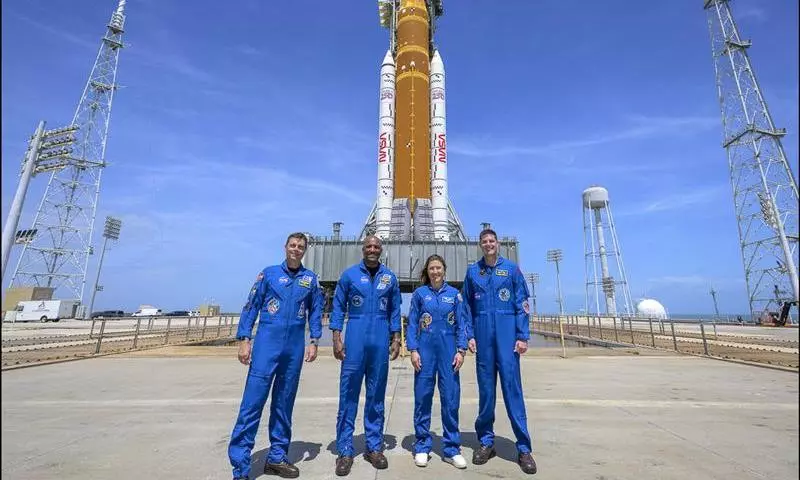
There is another notable aspect to this mission: inclusivity. The crew includes the first Black astronaut on a Moon mission, the first woman on a Moon mission, and the first Canadian in deep space.
Mission objective
Artemis II is not a lunar landing mission. It will not even orbit the Moon multiple times. It will go to the far side and return to Earth. This is a ten-day free-return lunar flyby.
A lunar flyby means the craft will not land. It will go around.
What is 'free-return'? When the craft swings around the Moon's far side, it will not fire its rockets to head back to Earth. Instead, it will use a slingshot. A slingshot uses the Moon's gravity to change a spacecraft's path without burning much fuel. Think of a ball swung on a rope. Let go, and it flies off in a new direction. For Artemis II, the Moon's pull will swing the capsule around, aiming it back toward Earth for the trip home.
Crew roles and duties
Among crew members are NASA Commander Reid Wiseman; Pilot Victor Glover, the first Black astronaut in deep space; Mission Specialist Christina Koch, the first woman to fly to the lunar vicinity; and CSA Mission Specialist Jeremy Hansen, the first Canadian on such a mission.
Each crew member has specific duties, though they share many tasks: daily exercise, meals, and emergency drills.
Reid Wiseman commands. He will make the final calls. He will keep the crew coordinated and watch over safety. He steps in wherever needed.
Victor Glover pilots. He will handle the spacecraft's steering. A critical job comes early: the big engine burn that pushes them out of Earth's orbit toward the Moon. He also flies Orion manually during key tests.
Christina Koch serves as a mission specialist. She will run health experiments and check life-support gear. During the flyby, she will photograph the Moon and note details of its surface. She draws on her experience in long-duration spaceflight for this.
Jeremy Hansen, the second specialist, will activate the water system and emergency equipment shortly after launch. He will assist with daily system checks. He represents the Canadian space program on this journey.
During the flyby day, all four turn their attention to the Moon. Observations. Photographs. The rest of the time, they test the Orion capsule, its engines, its life support systems, and its handling to ensure it is ready for future crews who will land.
Also read | Explained | Artemis Accords: What they mean for India, ISRO's astronauts
The standby crew, André Douglas, stood ready for any of the three NASA astronauts. Jenni Sidey-Gibbons was the backup for the Canadian crew member. Their job: insurance. However, no untoward incidents occurred, and the four-member crew could take the mission.
In the final hours before lift-off, Douglas helped strap the prime crew into their seats. He was the one who closed the hatch before the launch. Sidey-Gibbons prepared the inside of the spacecraft. Should an astronaut fall ill, they were backup ready to replace them immediately.
Their role does not end there. Once in flight, Sidey-Gibbons becomes a voice from Mission Control, speaking directly with the crew. Both backups offer expertise from the ground up, drawing on identical training to support every step. Their four hands may not be available to the crew, but their two minds will always be there to help if the mission faces a challenge.
A tight squeeze
How big is the spacecraft? The Orion capsule is compact. Think of a Maruti Omni van. Remove all the seats. Now, squeeze four people inside that empty cabin space for sleeping, eating, working, and using the toilet. For ten full days. Roughly 330 cubic feet of habitable space. Sleeping bags attached to walls. Six windows for views. Storage that doubles as a radiation shelter. It feels Spartan compared to the International Space Station, but the short duration makes it livable.
Daily life follows a structured ten-day schedule. The crew will not follow any Earth timezone—not GMT, not IST, not EDT. Instead, they will follow Mission Elapsed Time. A simple countdown that starts at T-plus-zero, the exact moment of launch, and counts forward in days, hours, and minutes. The crew's sleep, meals, exercise, system checks, and lunar observations are scheduled according to this clock. Mission Control in Houston also works on MET. Everyone stays perfectly synced.
Schedule of crew members
Mornings, as per MET, begin with system checks. Ensure that the life support is working. The water, the food, the toilet, the air filters. Then the crew performs trajectory correction burns, medical checks, and mock survival drills.
Exercise is mandatory. Each crew member must spend at least 30 minutes per day on a flywheel device. Rowing, squats, and deadlifts are all used to counteract the effects of microgravity.
One full off-duty day on Flight Day 7 is permitted. Some personal time for the crew. Meals, hygiene, and cabin rearrangement fill other slots. The crew will practice moving in weightlessness. They will even use Orion as a docking target for future missions. In between, there will be media contact with Earth.
Free time is limited, but it exists. During those moments, the crew will enjoy stunning views of Earth and the Moon. Photography during the flyby. Shared meals. Quiet moments in sleeping bags. Reading and listening to music will also be possible. The mission emphasises testing procedures over leisure; every activity validates hardware for longer future trips. Unscheduled radiation-shelter mock drills and emergency training are also undertaken.
Exercise is a daily priority and a key test objective. The crew uses a suitcase-sized flywheel device near the hatch for thirty to sixty minutes of resistance workouts. Workouts are scheduled—Wiseman and Glover in the morning, Koch and Hansen later —to spread the load on the life-support systems.
Food and hygiene
All food on Artemis II is pre-packaged. They have a long shelf-life and are ready-to-eat or rehydratable. No fresh ingredients. No refrigeration. No full kitchen. The menu avoids crumbs, requires minimal water, and stays safe for the full ten days without resupply. Crews pre-tested everything on the ground. NASA has selected 189 menu items plus more than ten beverages, including coffee, based on crew preferences and nutrition. Mac and cheese, vegetable quiche, barbecued beef brisket, tortillas, cookies, and cake.
Food preparation is simple and microgravity-friendly. The crew uses a potable water dispenser to rehydrate pouches, then warms them on a compact briefcase-style hot plate. Rationing is strict: each crew member gets scheduled breakfast, lunch, and dinner plus two flavoured drinks daily.
Also read | Artemis II: NASA’s 1st moon crew in 50 years includes woman, Black astronaut
Hygiene is basic. No showers for the entire ten days. Astronauts use wet towels, body wipes, no-rinse shampoo, and a specially designed toilet, which is activated on Flight Day 1. The toilet collects the excreta in a sealed bag, which is expelled into space. Clothes are not changed often. They wear the same garments for multiple days. They take minimal spares due to weight constraints.
Overall, the daily routine includes sleeping in wall-mounted bags, three meals, system checks, lunar observations, and medical monitoring. The crew will evaluate how these procedures work in deep space for future Artemis missions.
Mark the days
Right after reaching orbit, the crew will manually fly Orion for the first time. This is called the proximity operations demonstration. If any hitch occurs, something like what happened to the Boeing Starliner with Sunita William, the craft can turn back. During this crucial test ride, Victor Glover, the pilot, will take control and manually test how the spacecraft handles with humans inside. The crew will also activate the toilet, water system, and life support. The first real test of living in deep space.
On day two of the mission, the big engine will burn and fling Orion toward the Moon. This is technically called the trans-lunar injection burn. It is akin to a plane taking off. If this burn is successful, there is no turning back. The crew and mission are now committed to the free-return trajectory. A high-stakes moment. Mission Control will monitor closely, ensuring all parameters are within acceptable limits. They will also compute the actual flight path the mission will take.
Watch the media around days five and six. NASA will announce the exact moment the crew sets a new record. Depending on the exact launch time, the crew will likely travel farther from Earth than any humans in history, possibly beating the Apollo 13 record of 400,000 kilometres. This milestone, the farthest humans have ever been, will generate huge headlines.
The day of swing
Then comes the big day. Day six. The emotional and visual highlight of the mission. Orion will swing around the far side of the Moon, coming within 6,400 to 9,600 kilometres of the surface. From Earth, the Moon can fit into a one-rupee coin held at arm's length. When the craft is closest, the Moon will look like a basketball held at arm's length. Incredibly detailed. Dramatic. We cannot see the far side of the Moon from Earth. So this swing around offers a great opportunity to see the hidden face. During a window of about 30 minutes to 1 hour, the crew will spend most of the day taking photos and videos and recording live observations of lunar features. Areas never seen up close by human eyes before.
While the crew cruises around the far side, they will lose radio contact with Earth for 30 to 50 minutes. No line of sight. This blackout will be a tense, silent period. The crew is completely on their own.
Over the next four days, the craft will be on its way back toward Earth. Gaining speed every minute. On the final day, Orion will slam back into Earth's atmosphere at nearly eleven kilometres per second. Faster than any crewed vehicle since Apollo. The crew will experience intense heat and G-forces. After nail-biting moments, the parachutes will deploy. Orion will splash down in the Pacific Ocean off California. Recovery teams will rush to pick up the crew and capsule. This fiery return will be watched live.
Risks and tests for crew
During this 10-day sojourn, the crew will live in the cramped Orion capsule. Daily exercise. Meals. Sleep. Four people living in a minivan for ten days. Patience and endurance will be tested.
Beyond Earth's protection, radiation poses a threat. Solar astronomers will stay busy, watching for any abnormality in the Sun's activity. They will measure the solar wind and look for coronal mass ejections. If intense activity sends high-speed radiation toward the craft, they will forewarn the crew. The crew will build a temporary shelter using storage bags to protect themselves from the solar storm.
Also read | NASA’s Artemis 1 mission: Here’s what to expect and why it’s important
The capsule's life-support systems are brand new. An air circulation system cleans the air and ensures it is breathable. The water recycling system recycles sweat and excretions. The toilet has been upgraded. It should suck the waste and safely dispose of it in a sealed bag. These systems have never been tested with humans so far from Earth. Any failure would be serious.
When the craft swings around the Moon, it will be hidden from Earth's view. Radio communication will not be feasible. A communication blackout will occur when the capsule passes behind the Moon.
Coming home is another trial. The heat shield must withstand a fiery, high-speed plunge through the atmosphere. During the peak heating period, the air around the craft will be ionised. A plasma layer will envelop the craft. Radio waves cannot penetrate the plasma. Another radio blackout. Then, dramatically, the parachutes will deploy.
None of these risks is new in space travel. But this crew is the first to face them together so far from Earth.
The countdown has ended. The Mega Moon Rocket has already soared into the sky. The world watched as four astronauts began a historic journey — one that could mark the beginning of a second honeymoon with the Moon.