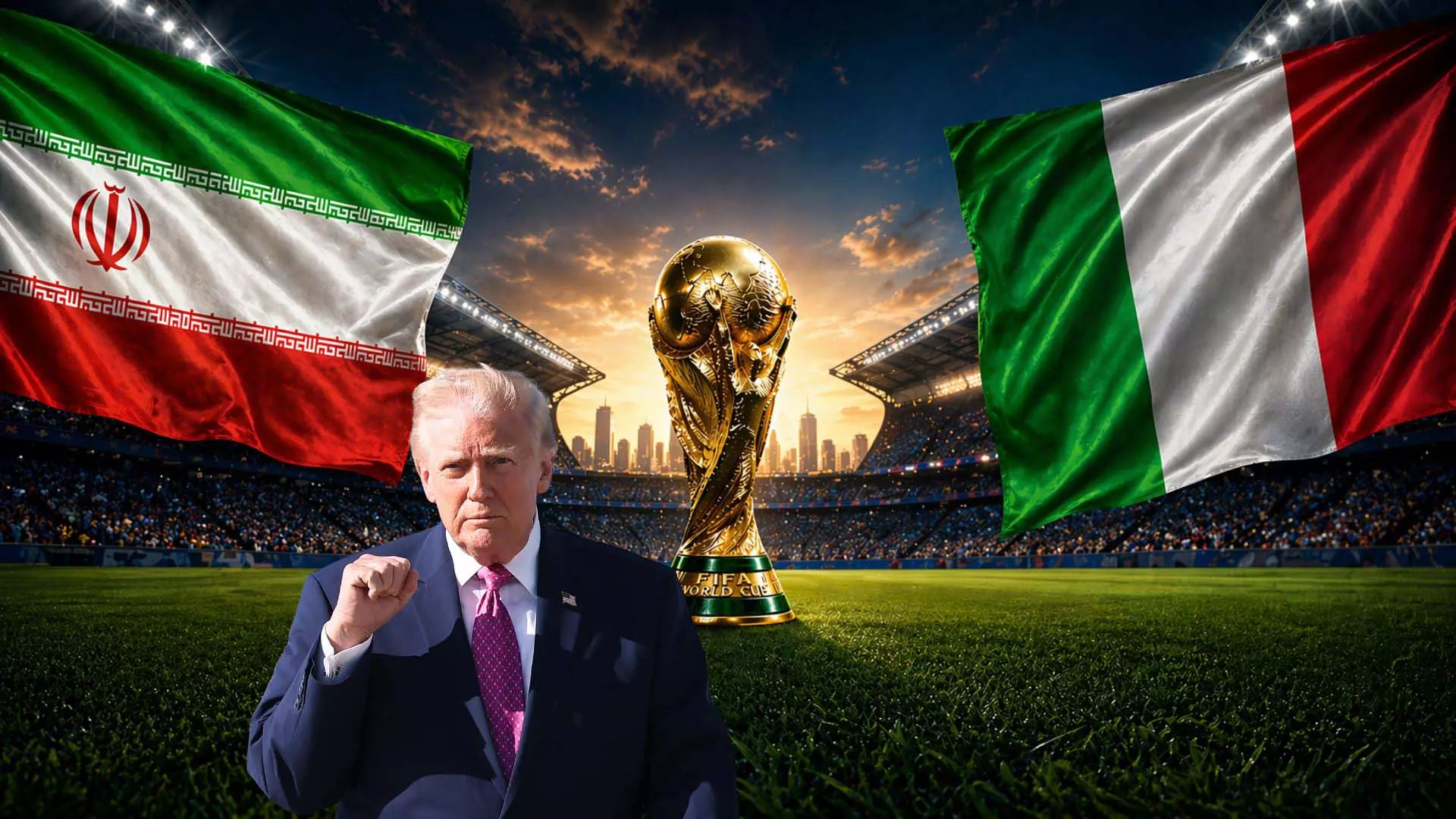
Football World Cup 2026: Can Trump replace Iran with Italy?
As Iran’s participation in the World Cup faces uncertainty, talk of Italy replacing Iran raises questions about FIFA rules, geopolitics, and sporting fairness

The Iran crisis and the upcoming FIFA World Cup 2026 to be held in the US, Canada, and Mexico have once again brought football and geopolitics into sharp intersection. A recent suggestion by US special envoy Steve Witkoff — that Italy could replace Iran if it decides not to participate — has triggered widespread debate.
The idea, though informal, immediately clashes with the structure of international football. Iran qualified for the tournament on merit through the Asian qualification system, while Italy failed to qualify for a third consecutive World Cup.
Qualification rules
According to FIFA regulations, if a qualified team withdraws, the replacement is typically chosen from the same confederation — in this case, Asia. This ensures competitive balance and avoids perceptions that commercial or political influence overrides sporting merit.
There have been speculative discussions about a one-off playoff or an exceptional mechanism involving teams from different regions. In such a scenario, Italy could theoretically enter the frame.
Also Read: Iran: Won't play FIFA World Cup due to 'wicked acts' by US
However, such a move would require FIFA to bend its own rules — no small decision for a governing body built on standardised global structures.
Geopolitical layer
The issue becomes more complex given that the United States is not just a co-host of the 2026 tournament, but also a central actor in ongoing tensions involving Iran.
Also Read: World Cup 2026 football on doorstep, but media rights still unsold in India
Iran has previously raised concerns about playing matches on US soil, with suggestions that some fixtures could be moved to Canada or Mexico. However, Iranian football authorities have indicated their readiness to participate, while the political leadership remains cautious.
As highlighted, “the uncertainty is real".
US influence
Can the United States influence FIFA? The answer is nuanced. The US holds significant soft power in global sport, with its market size, broadcasting reach, and logistical control as a host nation.
This includes influence over visas, security, and infrastructure — factors that create indirect leverage.
Yet, FIFA’s structure — comprising over 200 member associations — prevents any single nation from exerting outright control.
Global balance
Historically, European football has wielded strong influence due to financial power and administrative presence. However, even that influence has limits.
Also Read: New York to host 2026 FIFA World Cup final; opening game will be in Mexico City
Replacing an Asian team with a European one would likely face resistance from Asia, Africa, and South America. Such a move would raise broader questions about fairness and representation.
As the narrative suggests, this is not just a US-Iran issue, but “about global balance within football".
Historical context
Football and politics have often intersected. In 2022, Russia was excluded from the World Cup pathway following its invasion of Ukraine.
Earlier, in 1966, several African nations boycotted the tournament over qualification rules they deemed unfair.
These precedents show that while FIFA responds to global pressure, it attempts to frame decisions within sporting logic.
What next
The current situation is particularly delicate. Iran remains qualified, and Italy remains out — for now.
If Iran participates, the issue shifts to logistics and security. But if it withdraws, FIFA faces a critical decision: follow established rules or create an exception.
Also Read: Cape Verde qualify for FIFA World Cup; here’s list of 5 smallest countries in WC history
In moments like this, football becomes more than just a game — it becomes a stage where global political realities quietly, yet unmistakably, play out.
(The content above has been transcribed from video using a fine-tuned AI model. To ensure accuracy, quality, and editorial integrity, we employ a Human-In-The-Loop (HITL) process. While AI assists in creating the initial draft, our experienced editorial team carefully reviews, edits, and refines the content before publication. At The Federal, we combine the efficiency of AI with the expertise of human editors to deliver reliable and insightful journalism.)