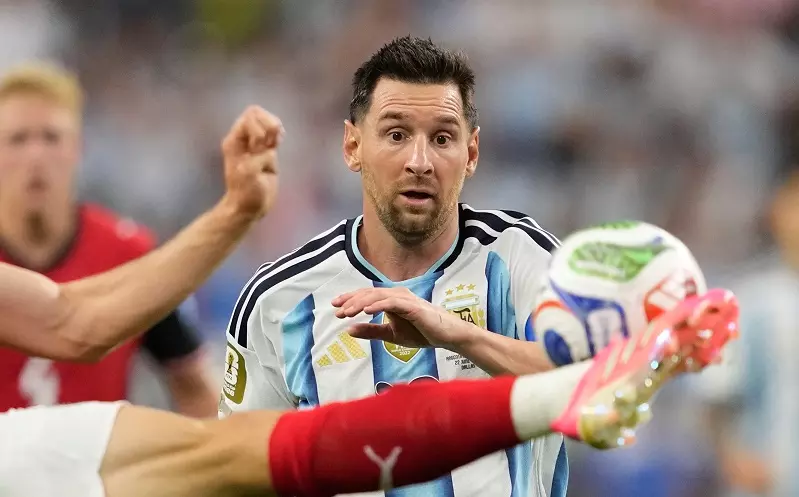
Why FIFA World Cup orbits around Argentina’s ‘North Star’ Messi
Despite moments where he looks out of rhythm, Messi continues to score, anchors a team trying to find its offensive identity, and gives the crowd lessons in football

If there’s one thing that refuses to change this World Cup, it’s the way Lionel Messi keeps pulling the entire tournament back into his orbit. Every time it feels like the narrative is about to move on to someone else, he draws it right back.
Two matches, five goals. That brings him to 18 World Cup goals overall. And yet, sitting right alongside those massive numbers like a persistent shadow is a stranger stat, three missed penalties in World Cups. Honestly, it’s exactly that contradiction that makes this tournament feel like his all over again. It’s not because everything he touches is perfect, but because even his imperfections somehow get absorbed into the grander story.
Even an injured Messi is formidable
There are moments out there where he looks completely out of rhythm. For long stretches against Austria, his first touch wasn't just sitting right. That usual, effortless flow between receiving the ball and letting it go felt just a fraction too slow, and even his body language seemed slightly off.
Even a slightly misaligned Messi is never irrelevant. He still bends the game to his will.
In any other era, you’d probably hear people quietly whispering about fatigue or the natural decline of age. But then, he still goes and scores. He still shapes the entire result. He still leaves the pitch as the absolute defining presence of the match.
Also read: Messi breaks World Cup scoring record with 18 goals as Argentina beat Austria
Jorge Valdano once famously said that the best player in the world is Messi, and the second best is an injured Messi. Watching him against Austria, you feel like you are watching something very close to that second version – not actually injured, but just not fully in sync. Yet, even a slightly misaligned Messi is never irrelevant. He still bends the game to his will.
Command over crowd
By all rights, that penalty miss should have been the headline. Missing three penalties in World Cup history is the kind of stat that usually invites endless media scrutiny. But here, it felt strangely neutralised by everything that followed. The game didn’t stall out on his mistake, but it just shifted right back to him. That’s become the pattern now. Even when he isn't at his absolute sharpest, the final whistle still carries his signature.
The brace against the Europeans didn't feel like a sudden burst of dominance; it felt more like a quiet correction. It was as if he were gently nudging the game back into its proper shape.
Also read: Lionel Messi becomes oldest to score hat-trick in FIFA World Cup, joint highest scorer
And then came that last-second free kick, the kind of moment that makes an entire stadium hold its breath at once. It didn't go in, but it brought back that familiar feeling where everyone in the crowd knows exactly what’s about to happen before it actually does. That’s a completely different kind of influence. It’s not just about execution; it’s about controlling everyone's anticipation.
Strong anchor of a lost team
When you look closely at this Argentina side, it is clear Messi isn’t exactly being carried by a firing front line. In fact, their attack feels a bit incomplete right now. There’s plenty of talent there, sure, but the consistency just isn't showing up yet.
Strangely enough, that lack of rhythm from his teammates only sharpens Messi’s role. He isn't just floating around inside a beautifully oiled attacking machine; he’s anchoring a team that is still desperately trying to find its offensive identity.
Thiago Almada is the perfect example. We’re seeing flashes of brilliance rather than a complete, sustained performance. He made a couple of great runs down the left to open up space, carried the ball with real purpose for a couple of moments, or pulled off that subtle dummy that gave Messi a cleaner lane to shoot. But it was still fragmented. The chemistry wasn't quite continuous.
Also read: FIFA World Cup 2026 full schedule, venues, times in IST, live TV, streaming details
Strangely enough, that lack of rhythm from his teammates only sharpens Messi’s role. He isn't just floating around inside a beautifully oiled attacking machine; he’s anchoring a team that is still desperately trying to find its offensive identity.
Why Messi’s doing the heavy lifting?
This is where Lionel Scaloni’s practical, no-nonsense logic shines. There’s very little room for romance in his team selection. He doesn’t care about reputations or past glories; he cares about profiles that fit a very specific blueprint.
Even the heavy prestige of the premier league doesn't seem to sway Scaloni. He initially picked Leo Balerdi over the fan-favourite Marcos Senesi.
That same logic explains the rest of the squad. The fact that Emiliano Buendía can’t get a look-in while Exequiel Palacios remains a fixture tells you everything you need to know. This system values functional intelligence over expressive potential every single time.
Also read: Messi, David and Undav lead fierce FIFA World Cup Golden Boot race
It also explains Angel Di María’s absence in purely tactical terms, rather than emotional ones. What Di María gave Argentina wasn't just magic; it was incredible fluid movement across different zones. He could start wide, drift into the middle, drop into midfield, or stretch the left flank, depending on exactly what Messi needed in that exact moment. That telepathic connection wasn't just romantic, it was a tactical masterpiece.
Teams can compress the pitch and plan their defensive traps all they want, but you simply cannot prepare for the moments where Messi alters the entire geometry of a game with a single touch.
The memories of that partnership are still so vivid, like the goal against Mexico in Qatar where Messi broke the deadlock, or Di María’s iconic spare man's finish in the final. Those moments stick with us not just because they were beautiful, but because their roles fit together so perfectly. Without that kind of fluid partner on the pitch, the burden on Messi becomes even heavier.
When Almada, Lautaro Martinez, and the others aren't clicking, the pressure doesn't get shared out evenly. It all flows right back to Messi.
Masterclass in decisive moments
It’s also fascinating to see how he handles the teams around them. Against intense, Ralf Rangnick-style gegen pressing systems like Austria designed to suffocate space and force errors, Messi remains the ultimate wild card. Teams can compress the pitch and plan their defensive traps all they want, but you simply cannot prepare for the moments where Messi alters the entire geometry of a game with a single touch.
Also read: FIFA World Cup 2026 opener sees three red cards, raising fears of more to come
The drawback of this is that Argentina’s system isn't designed to replace Messi’s influence; it’s built to support it without needing to look pretty.
In this pack, known as La Scalonetta, Messi remains the North Star.
Even when his touches don't land, even when he looks a little off, even when he misses from the spot, the game always returns to him.
That is what makes this specific phase of the World Cup so different. It’s no longer about him putting on a masterclass for 90 minutes every game. It’s about the sheer accumulation of decisive moments that all cluster around his name.
Why Messi is Argentina’s soul
If there’s anything for Argentina to worry about, it isn’t Messi; it’s a front line still searching for its groove. Yet, through it all, Argentina just keeps winning, and the path to victory always goes through Messi. That’s the part that refuses to change.
Also read: Fastest goals in FIFA World Cup history: Where do Galarza, Saibari’s 64, 71-second goals rank?
No team can game-plan for a single version of Messi anymore. There is only Messi, and whatever version of himself the match happens to call for on the day.
And both of them keep winning.