








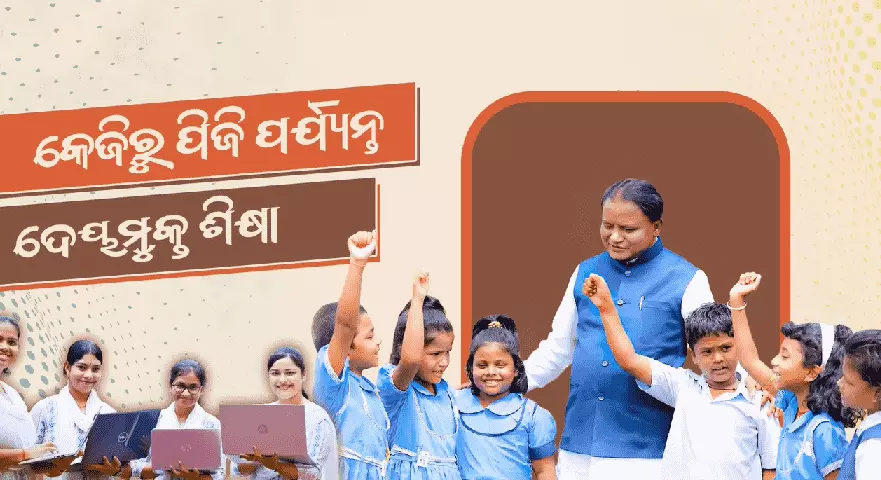
Odisha makes education free from KG to PG: All about Majhi govt’s 'Gyanodaya' scheme
Scheme in line with NEP and Odisha Vision 2036 and 2047, aims to improve enrolment, retention and reduce dropout rates, while enabling more students to pursue higher education

Setting a new milestone in BJP Chief Minister Mohan Majhi’s double-engine governance, the Odisha government has cleared a scheme to provide free education to students from kindergarten (KG) to post-graduation in all government and government-aided institutions.
The 'Gyanodaya-Shiksharu Samruddhi: KG to PG Free Education' scheme, which promises to transform the lives of nearly 32 lakh students, especially women and those from underprivileged backgrounds, was approved by the Odisha cabinet on Wednesday (July 1).
The government’s decision to greenlight the scheme comes at a time when it is smarting from criticism over the flagging of almost 1,678 errors in newly published textbooks for Classes 1-8 for the 2026-27 academic year, published in line with the National Education Policy (NEP) 2020.
Earlier, Kerala had made education free up to graduation level.
Here is the lowdown on the scheme:
CM Majhi calls scheme ‘historic’
Chief Minister Majhi, who called the scheme “historic” and “first-of-its-kind” in the country, said that under it, eligible students admitted to regular courses in government and government-aided institutions will receive a complete waiver of admission fees.
As education up to Class 8 in government schools in Odisha is already free, the new scheme will cover students in Classes 9 to 12 as well as those pursuing undergraduate (UG) and postgraduate (PG) studies in government colleges, government-aided colleges and state public universities.
Also read: Newton the ‘pilot’, Hampi as Konark, Nimbuda: 1600+ errors in Odisha textbooks
The scheme, however, will not cover self-financing courses or institutions, unaided institutions, PPP-mode institutions, as well as professional and technical courses.
Majhi said the scheme aims to ensure that no deserving student is deprived of education due to financial constraints and will help reduce the burden on economically weaker and disadvantaged families.
The move is expected to improve enrolment and retention, reduce dropout rates, and enable more students to pursue higher education.
Odisha Vision 2036 and 2047
The scheme, which is aligned with NEP 2020, has been implemented as part of the Odisha government’s development blueprint of Odisha Vision 2036 and 2047. The blueprint, which is part of the broader ‘Viksit Odisha for Viksit Bharat’ agenda, aims to make Odisha a developed state by 2036 and a $1.5 trillion economy by 2047.
Education is a key component of the five foundational pillars laid out in the development roadmap. Under the Viksit Odisha vision, the government plans to achieve a 100 per cent literacy rate, 100 per cent gross enrollment ratio under primary, upper primary, secondary and higher secondary levels by 2047, zero dropouts at all levels, ensure foundational literacy and numeracy for all children and achieve 100 per cent digital literacy rate among students. It also aims to help Odisha universities stand among the top 500 global varsities.
The Odisha cabinet has earmarked Rs 895.57 crore for the first year and Rs 5,457.55 crore for a five-year period, in what is being called the largest public investment seen in the state’s education sector in recent times.
Struggle with dropout rates
The scheme, promising accessible education through fee waivers, comes at a time when the state is striving to bring down its dropout rates, improve retention and increase enrollments.
According to a decadal analysis of India’s school education system by Niti Aayog, the state’s secondary school dropout rates showed an impressive slump from 49.47 per cent in 2014-2015 to 15 per cent in 2024-25, recording a reduction of over 34.47 percentage points in dropout rate within 10 years.
Earlier this year, the state government, however, raised concerns over the slight yet significant rise in the state’s dropout rate – from 12 per cent to 15 per cent in 2024-25 academic year – after reporting a dip for three consecutive years.
Also read: Marathi compulsory in Maharashtra schools as state strengthens language policy
Sharing the data in Assembly, School and Mass Education Minister Nityananda Gond said that the highest dropout – 15 per cent –has been reported in Classes 9 and 10, with that among boys – 17.3 per cent – being higher than girls (12.5 per cent).
The dropout rate in Classes VI to VIII was recorded at 3.2 per cent, while at the primary level (Classes I to V), the rate remained low at 0.7 per cent.
2.34 lakh out-of-school children
A report in Agrus says that dropouts, transition failures and abandonment of higher education studies midway keep almost 3.8 lakh students out of the state’s formal education system every year.
During the Odisha Shiksha Survekhyan, the state’s comprehensive door-to-door child tracking survey, conducted between April 30 and May 4, 2025, it was found that the state had 2.34 lakh out-of-school children in the 7-18 age group.
The Argus report, quoting official records, says that of 5.47 lakh children enrolling in Class 1, almost 1.5 lakh discontinue their education before completing school.
Students from vulnerable communities like the Scheduled Tribe communities often miss out on education, mostly due to a combination of factors including remoteness of their villages and extreme poverty to be able to afford tuition and accommodation fees or transportation costs.
Low transition rate
These factors also prevent students at the secondary level from pursuing or continuing higher studies. Quoting a report by Comptroller and Auditor General (CAG), the government in December last year informed the Assembly that the state’s Secondary-to-Higher Secondary transition rate (until 2022-23) is only around 70.3 per cent. That means around 1.53 lakh students who clear Class 10, fail to enter Class 11 or discontinue their studies.
“The transition rate in secondary to higher secondary was only 70.3 per cent, indicating that approximately 30 per cent of the students were not able to make the transition to higher classes, either due to dropping out of school or due to not qualifying for promotion to the next level,” The Hindu quoted the CAC report as saying.
Also read: CBSE: Current Class 10 exempted from 3-language policy, Class 9 can study 2 foreign languages
The Argus report says that only 2-2.2 lakh students enroll for undergraduate studies even though 3.4 lakh pass out annually. Similarly, the report quoting AISHE-based enrollment trends says that 70 per cent of degree holders also do not transition into postgraduate education, mostly due to rising educational costs and pressure to earn a livelihood.
High retention rate
The state, however, has managed to record an increase in retention rate (percentage of students enrolling and continuing in a school over a specific period of time) between the 2023-24 and 2024-25 academic years.
According to the Unified District Information System for Education Plus 2024-25 report, released by the Union Ministry of Education and published last year, the state’s retention rate increased from 87.8 per cent to 92.4 per cent at the middle level and 48.3 per cent to 53.1 per cent at the secondary level in 2024-2025.