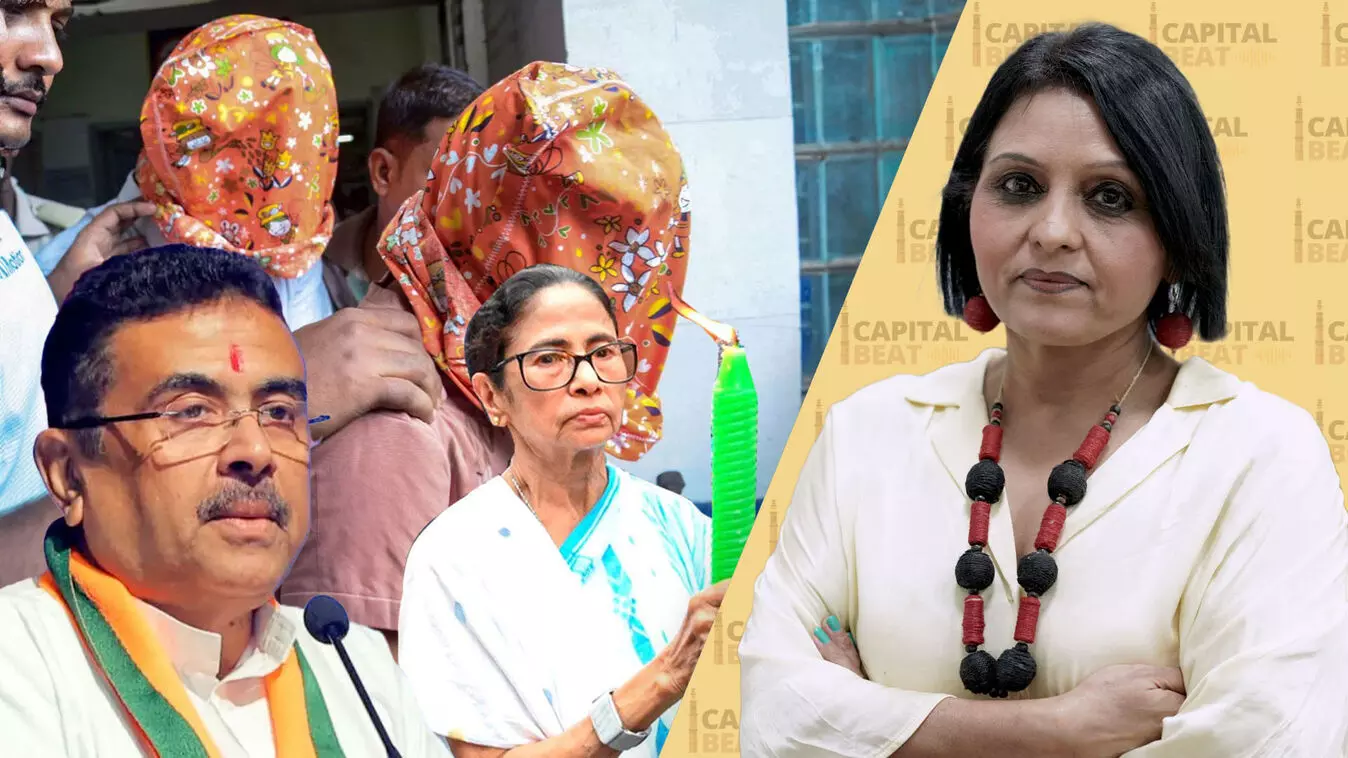
Baruipur tragedy: 'Nothing has changed in Bengal except govt's political colour'
After the brutal assault of an 11-year-old girl, panellists are deeply disappointed over unfulfilled promises made by BJP leaders about transformation of Bengal into a peaceful state

"Nothing has changed in Bengal except for the political colour of the government," said senior journalist Samir K Purkayastha, highlighting a stark continuity in administrative failures despite the recent transition of power from Mamata Banerjee-led TMC to BJP.
The brutal rape and murder of an 11-year-old girl in Baruipur, located nearly 30 kms from Kolkata, has triggered massive public outrage and a fierce political showdown. The Federal spoke to women's rights activist Saswati Ghosh, West Bengal's Congress spokesperson Chandan Ghosh Chowdhury, and The Federal journalist Samir K Purkayastha to dissect the systemic apathy and political friction surrounding this tragedy.
The horrific incident unfolded when the minor girl’s body was recovered from a sack in a local pond in the Surjapur area on Sunday (July 5), a day after her family reported her missing. Although the local police initially registered a standard missing person complaint, intense public scrutiny and preliminary findings forced them to add severe charges. These include rape, gang rape, murder, destruction of evidence, and relevant provisions under the Protection of Children from Sexual Offences (POCSO) Act. A crucial link in the investigation emerged via a CCTV clip showing the young girl shortly before she vanished.
As anger intensified, the National Commission for Women (NCW) intervened by demanding an action-taken report from the state police. The political stakes surged rapidly given that the Bharatiya Janata Party (BJP) had taken over the reins of the West Bengal government just two months prior to this incident. During Mamata Banerjee’s tenure, the BJP campaigned aggressively on a platform of eradicating what it termed complete lawlessness, promising an environment where fear would be replaced by trust. However, recent events, including sudden instances of localised vigilante attacks, have prompted critics to question whether the new administration has failed to deliver on its foundational law-and-order promises.
Police inaction
The immediate institutional response to the minor's disappearance drew sharp criticism from civil society, with activists pointing out a historical pattern of negligence. Saswati Ghosh, a seasoned women's rights activist, slammed the standard operating procedure of local law enforcement when handling missing cases involving young girls. She stated that when the family approached the police to complain, the authorities casually suggested that the girl might have left voluntarily with a friend or a boyfriend. This classic deflection remains a persistent hurdle that activists have battled for over nearly four decades in the state’s women’s rights movement.
Also Read: Baruipur case: TMC claims cops prevented Mamata, Abhishek from meeting victim's family
Compounding the grievance was the total absence of police personnel during the critical search and recovery operations, despite a police camp and an outpost operating in close proximity. According to Ghosh, local residents and political workers had to manually locate the victim's body and transport one of the accused in a local vehicle because the situation threatened to dissolve into mob justice. She questioned why no police officers accompanied the locals until the body was recovered, drawing direct parallels to past tragedies in Kamduni, Jalpaiguri, and Dhupguri.
This administrative inertia suggests that despite a transition in political leadership over the last 62 days, the functional approach of the state police has seen no tangible improvement. Activists remain deeply concerned that the standard operating procedures formulated over a year ago, particularly following high-profile cases like the RG Kar medical college incident, are being routinely ignored. The lack of proactive enforcement continues to endanger vulnerable demographics, especially amid fears that missing children are frequently channelled into human trafficking networks.
No structural reforms
The political narrative has grown increasingly volatile as opposition parties accuse the new ruling regime of failing to break the cycle of violence. Chowdhury expressed deep disappointment over the unfulfilled promises made by central leaders regarding the absolute transformation of Bengal into a peaceful state. He argued that the current chief minister, despite leading a relatively new 62-day-old cabinet, is a veteran administrator with decades of political experience who cannot hide behind the excuse of a short tenure.
Chowdhury criticised the government for attempting to project a polarising perception rather than ensuring direct, impartial justice. He alleged that the institutional failures have allowed public frustration to escalate to the point where an accused individual was reportedly beaten to death by an angry mob. For the opposition, the chaotic sequence of events indicates that the deeply entrenched "powers of evil" are merely changing hands from one political faction to another without delivering structural reforms.
Also Read: Bengal now has Gujarat-style goonda law; critics warn of civil liberty risks
While ruling party leaders like Agnimitra Paul claimed that the victim's family expressed satisfaction with the prompt actions of Chief Minister Suvendu Adhikari and top police officials, opposition leaders remain skeptical. Trinamool Congress (TMC) figures like Sayani Ghosh called for an exhaustive investigation into what she described as a potential trafficking racket. She emphasised that while no chief minister across party lines desires such atrocities, the ultimate test of a government lies in how it manages the aftermath and whether it secures capital punishment for the perpetrators.
'Same political containment strategies'
The tactical handling of the Baruipur crisis has mirrored past political standoffs, drawing sharp comparisons to the previous administration's strategies. Purkayastha observed that the current establishment became proactive only after public outrage reached a boiling point, replicating the exact structural pattern seen during the RG Kar case. He emphasised that local residents, rather than the police, initially undertook the foundational legwork of scanning local CCTV footage to track down the suspects.
Purkayastha also highlighted the irony of political containment strategies currently deployed in the state. When TMC leaders, including former chief minister Mamata Banerjee and Abhishek Banerjee, attempted to visit the aggrieved family, they were placed under de facto house arrest with massive police and paramilitary deployments blocking their residences. This retaliatory blockade strongly echoed the tactics used during the TMC regime to obstruct opposition leaders from accessing restive areas like Sandeshkhali or Bogtui.
Also Read: RG Kar case: Three IPS officers suspended over alleged lapses in initial probe
Ultimately, the panel concluded that meaningful change requires looking beyond superficial political transitions and addressing deep-seated societal intolerance. Panellists noted that the escalation of everyday violence, combined with toxic political rhetoric on social media, has created an unstable environment. To restore genuine law and order, the administration must enforce strict adherence to standard operating procedures, insulate the police force from political interference, and focus on delivering exemplary judicial outcomes rather than engaging in partisan optics.
(The content above has been transcribed from video using a fine-tuned AI model. To ensure accuracy, quality, and editorial integrity, we employ a Human-In-The-Loop (HITL) process. While AI assists in creating the initial draft, our experienced editorial team carefully reviews, edits, and refines the content before publication. At The Federal, we combine the efficiency of AI with the expertise of human editors to deliver reliable and insightful journalism.)