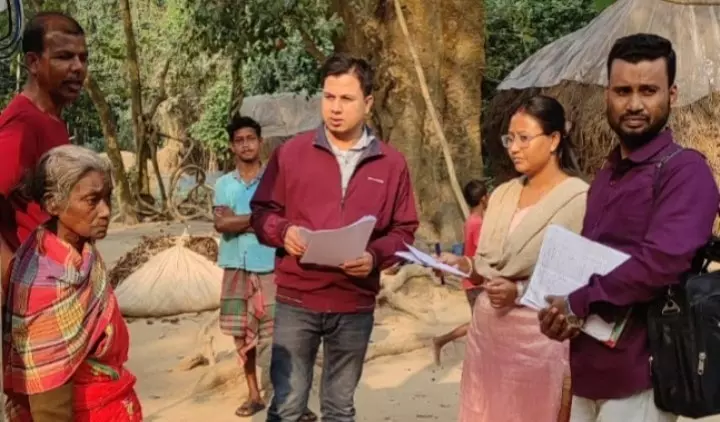
House to house physical verification of voters by EC officials in Dakshin Dinajpur district of West Bengal. Photo: X/@CEOWestBengal
Bengal SIR: BJP does volte-face, alleges irregularities, seeks probe
BJP delegation submits memorandum to EC, demanding scrutiny of around 1.25 crore voter list entries reportedly enrolled between November 26 and 28

In a dramatic reversal, the West Bengal BJP has shifted from backing the Election Commission’s (EC) voter roll update to alleging serious irregularities in the ongoing Special Intensive Revision (SIR), a change that signals the party’s political wariness of the exercise.
A BJP delegation led by its senior leader Suvendu Adhikari submitted a memorandum to EC, demanding scrutiny of around 1.25 crore voter list entries reportedly enrolled between November 26 and 28, alleging an unusually high number of entries were made in a short span.
BJP demands probe by independent agency
Stating that the number of entries jumped from 5.50 crore to 7.75 crore in just three days, the party claimed the figure is “abnormal and statistically impossible”.
Also read: Tainted lists, protests, SC ruling: How Bengal’s SSC row has become a political flashpoint
“We want an investigation by an independent agency,” Adhikari told reporters, insisting that the suspicious entries be examined by the technical team of EC or its specially deputed observers.
Notably, the BJP has now echoed concerns raised by the Trinamool Congress (TMC) and other parties that many eligible voters could be excluded, pointing to fears among Matuas and other communities.
The party’s renewed criticism comes two days after a delegation led by state president Samik Bhattacharya met EC officials in Delhi, alleging large-scale voter list manipulation and urging safeguards for vulnerable communities, including the refugee-origin Matua community and booth-level officials (BLOs).
In one of the strongest criticisms of EC, Bhattacharya flayed the Commission’s handling of the SIR, urging the chief election commissioner to personally visit Kolkata rather than monitor the process remotely from Delhi.
He said West Bengal’s situation is distinct and cannot be effectively overseen from afar.
BLOs under pressure
Bhattacharya also alleged that BLOs are under pressure from the ruling party and stressed that the Commission must take responsibility for their circumstances.
Also read: 26 lakh Bengal voters' names not matching with 2002 list: EC
“The volte-face signals two key concerns. The party appears wary that the SIR process may not be working in its favour, and it is growing increasingly anxious over potential backlash from refugee-origin Matua communities and recent deaths of field-level poll officers,” said political commentator and writer Nirmalya Banerjee.
This wariness within the party is rooted in EC’s latest data.
As of the evening of December 2, around 46 lakh SIR enumeration forms remain “uncollectable”, according to sources in the office of the state chief electoral officer (CEO).
At the same time, EC sources initially flagged 2,208 polling booths across West Bengal, out of around 80,000, where all distributed enumeration forms have been returned filled, with no single “uncollectable” form. That means no deceased, duplicate, shifted or untraceable voters were recorded in those booths.
However, following the EC’s order for a probe, the number of such booths reportedly fell overnight to 480, according to the latest figures from the CEO’s office.
Large share of ‘uncollectable’ forms
The trouble for the BJP lies in the finer details. Although the CEO’s office has not released any figures yet, sources indicate that a large share of the “uncollectable” forms comes from areas dominated by the Matua and Hindi-speaking communities, constituencies in which the BJP has a strong support base.
Also read: ‘Citizenship under question’: Mamata alleges NRC is objective behind SIR
Among the districts, North 24 Parganas reported the highest number of “uncollectable” forms, accounting for about seven per cent of the total, sources said. The district has a high concentration of both Matua and Hindi-speaking communities. Again, within the district, the highest concentration of untraceable voters is reportedly in Barrackpore, at over 15 per cent. Barrackpore has a predominantly Hindi-speaking population, estimated at around 75 per cent as per the last census data.
The distribution of booths with zero uncollectable forms is also telling for the BJP. The initial count of 2,208 such booths was concentrated in districts considered TMC strongholds, with South 24 Parganas leading at 760 booths, followed by Purulia (228), Murshidabad (226), and Malda (216). Except for tribal-dominated Purulia, the TMC holds a clear edge over the BJP in these areas. A district-wise breakdown of the revised figure of 480 booths is not yet available.
An internal assessment cited by BJP insiders suggests that several Assembly segments in the Bongaon and Ranaghat Lok Sabha constituencies could see 25 to 40 per cent of registered voters flagged as ‘at risk’ if the roll-matching process falters. Both constituencies have a predominantly Matua population.
In light of this assessment, the BJP sought assurances from the poll panel that voters from the Matua community, characterised by a sensitive demographic profile and high mobility, should be treated fairly, and their electoral status safeguarded during the SIR process.
The BJP’s volte-face is driven not merely by demographic considerations. An internal blow to the SIR campaign’s credibility came from mounting reports of fatalities among BLOs, as well as common citizens. According to the state government’s estimate, at least 39 SIR‑linked deaths, including that of four BLOs, were reported in West Bengal.
Protests by BLO associations
Among them were BLOs who died by suicide or suffered health crises, allegedly driven by heavy workloads, stress and rushed deadlines pertaining to the revision exercise.
These deaths have already triggered protests by BLO associations, and also drawn public sympathy.
“We cannot remain indifferent to the magnitude of distress and the tragic human toll. That is why our state president has urged the Chief Election Commissioner to witness firsthand how the BLOs are working in Bengal,” said Ali Hussain, a party leader and former president of the BJP Minority Morcha.
“For the BJP, the shift in stance became more imperative as the TMC is positioning itself as the protector of potential disenfranchised voters, particularly among the Matua community and other vulnerable groups, as well as of the BLOs,” explained political commentator Amal Sarkar.
Chief Minister Mamata Banerjee on Tuesday (December 2) announced financial assistance for the families of those who have passed away or died by suicide in connection with the state’s SIR exercise. She also said individuals who have fallen ill due to stress related to the exercise would receive support.
Bereaved families will receive Rs 2 lakh each, while 13 people currently undergoing treatment for SIR-related health issues will be granted Rs 1 lakh each.