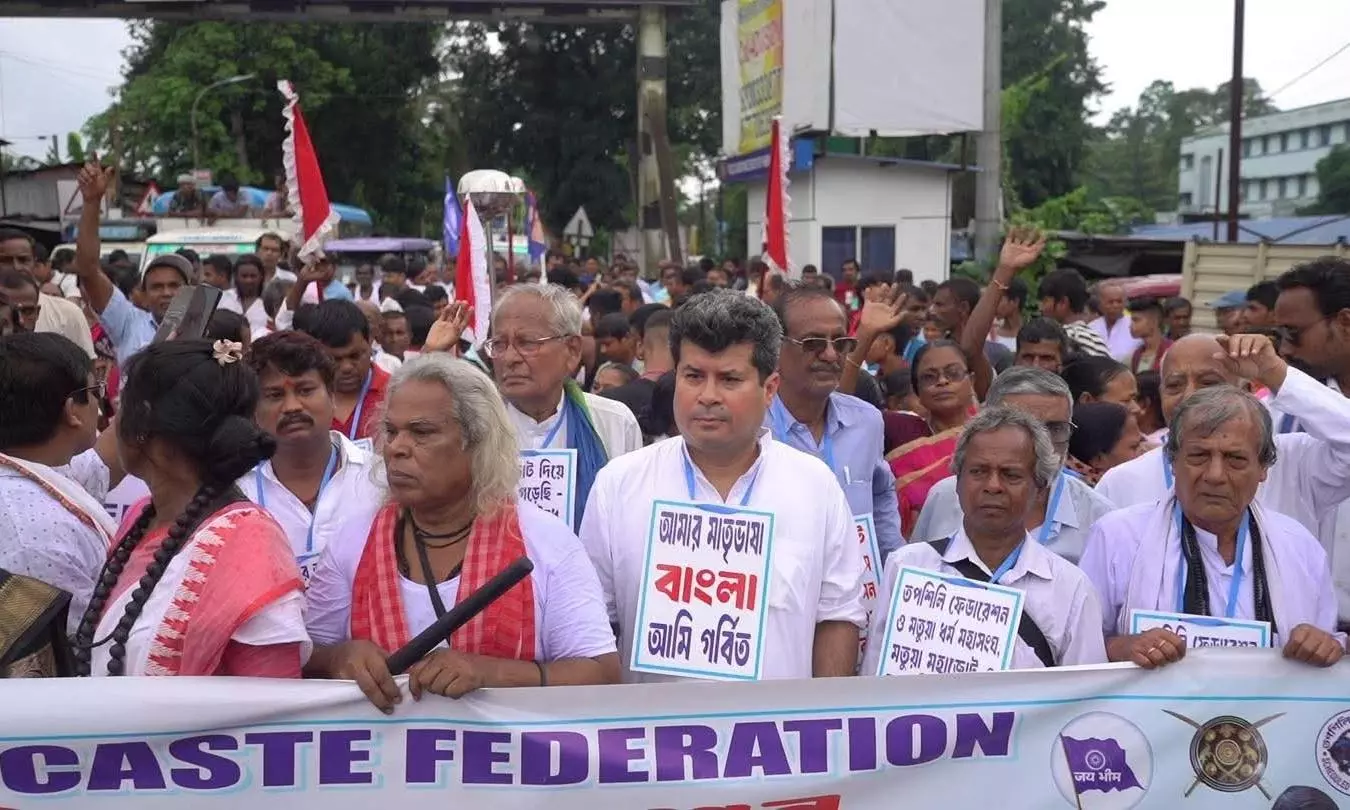
Bengal SIR: Matuas face disproportionately high deletion risk
Around 1.35 lakh voters summoned in Matua-dominated Bongaon; Muslim-majority districts like Murshidabad (2 per cent) and Malda (1.9 per cent) show far lower 'unmapped' rates

The draft electoral roll published after the first round of scrutiny under the Special Intensive Revision (SIR) in West Bengal indicates that, as expected, it is the Matua community, and not Muslims, that has emerged as the most vulnerable group.
Early district-wise data indicates that Matua-dominated areas have witnessed disproportionately high deletions and large-scale scrutiny, while Muslim-populated regions have seen comparatively fewer exclusions.
Nowhere is this contrast sharper than in North 24 Parganas, long regarded as the political and religious heartland of the Matua community.
1.35 lakh in Bongaon summoned for hearings
According to Election Commission’s (EC) figures, around 1.35 lakh voters in Bongaon subdivision have been summoned for hearings, while about 86,000 names have already been deleted from the draft roll.
Also Read: Mamata flays EC over electoral roll revision, CAA in Matua belt
Across the Bongaon North, Bongaon South, Gaighata and Bagda Assembly segments, only around 15 per cent of Matua voters could establish a direct linkage with the 2002 electoral roll, the benchmark used in the SIR process.
In Gaighata, which includes Thakurnagar, nearly 39,000 voters have been asked to appear before election officials.
’85 per cent of those summoned are Matuas’
Trinamool Congress (TMC)’s Rajya Sabha MP Mamatabala Thakur, who is also head of the TMC-backed faction of the All India Matua Mahasangha, said nearly 85 per cent of those summoned are Matua voters, many of whom lack documentary proof.
“Their names do not figure in the draft list, and without documents, they may not be able to defend their inclusion,” she told The Federal, expressing deep concern over the community’s prospects in the final roll.
Also Read: Home Ministry notifications on immigrants trigger political storm in Bengal
In contrast, preliminary trends suggest that areas dominated by Muslim Bengali-speaking voters have witnessed relatively fewer deletions.
According to EC data, districts with significant minority populations such as Malda (1.9 per cent) and Murshidabad (2per cent) recorded some of the lowest “unmapped” rates in the SIR exercise.
By comparison, districts like Nadia (6.1 per cent), which again has a sizeable Matua population and Darjeeling (9 per cent) that has a large Nepali population reported much higher proportions of unmapped voters.
Abhishek slams BJP for fake narrative
Reacting to this revelation, TMC general secretary Abhishek Banerjee slammed the BJP, saying, “What the BJP has deliberately done is spin a fake narrative of 1‑1.5 crore ‘Rohingya infiltrators,’ a claim that has effectively been punctured by the Election Commission itself.”
“The way Bengal has been deliberately defamed, I firmly believe that the Chief Election Commissioner, Election Commissioners, the Union Home Minister, and BJP leaders who spread this fake infiltrator narrative should publicly hold their ears and seek forgiveness from the people of Bengal,” he further added.
Also Read: Bengal Matuas seek audience with Rahul Gandhi: Are they eyeing third option?
However, merely finding one’s name in the draft list does not guarantee inclusion in the final roll, as the commission is set to undertake an extensive verification and hearing process that could still lead to large-scale exclusions.
‘Real scrutiny has only just begun’
Election officials have made it clear that the real scrutiny has only just begun. They say that inclusion in the draft roll was permitted even if the form carried only a signature, without complete verification.
Of those listed, more than 1.66 crore voters have been categorised as “doubtful”, with the commission not fully convinced of their eligibility.
These voters may be called for hearings and risk deletion if they fail to satisfy officials. The figure was initially pegged at close to two crores before being revised downward.
Also Read: BJP plays Matua Dalit identity card, snubs RSS’s unified Hindu rhetoric
Among them, 30.59 lakh voters fall into the most-vulnerable category as their details could not be linked to the 2002 electoral roll.
Classified as “non-mapped”, all of them will mandatorily face hearings. Other “suspicious” voters have been flagged due to discrepancies such as inconsistent age gaps between parents and children, unusual family linkages, or repeated parental names.
Door-to-door verification, hearings
“With the publication of the draft roll, the next and more decisive phase of the SIR has begun. Booth Level Officers (BLOs) will conduct door-to-door verification and issue hearing notices,” said a source in the state CEO’s office.
The hearings will be conducted by Assistant Electoral Registration Officers (AEROs), with 10 AEROs appointed per Assembly constituency. Unsatisfactory explanations could lead to permanent deletion from the rolls.
Also Read: Bengal’s Matuas wait and watch, refuse to take CAA bait as poll battle hots up
So far, 58.21 lakh names have already been excluded from the draft list. According to the commission, these deletions primarily involve voters marked as deceased, permanently shifted, missing, holding duplicate entries, or those who failed to submit enumeration forms.
Draft-level errors
Errors in the process have added to the controversy.
In Hooghly’s Dankuni municipality, TMC councillor Surya Dey was wrongly marked as “dead” in a booth-wise list, prompting a public protest and an admission of error by the BLO. The state Chief Electoral Officer has sought a report from district authorities.
Also Read: BJP leaders insulting Matuas by offering fresh citizenship: TMC's Abhishek
Another embarrassment followed when CPI(M) state secretary and former MP Mohammed Salim and his son Atish Aziz were listed with a Brahmin surname in the draft roll. The CPI(M) has rejected claims of a clerical lapse, accusing the commission of inadequate preparation and training during the SIR.
Faced with such criticism, the poll panel has insisted that draft-level errors are normal and will be corrected before the final roll is published by February.