BJP sets Bengal agenda; embraces Bengali identity, re-strategises border security
Amit Shah’s Siliguri visit institutionalises BJP's emphasis on border security, illegal infiltration; praise for Bengal’s literature and culture a bid to soften BJP’s nationalist and pro-Hindi image

Union Home Minister Amit Shah's three-day visit to West Bengal ended on Sunday (July 19) with the inauguration of Shabdalok, the country's first language-themed museum, at Kolkata's National Library.
BJP’s parallel objectives
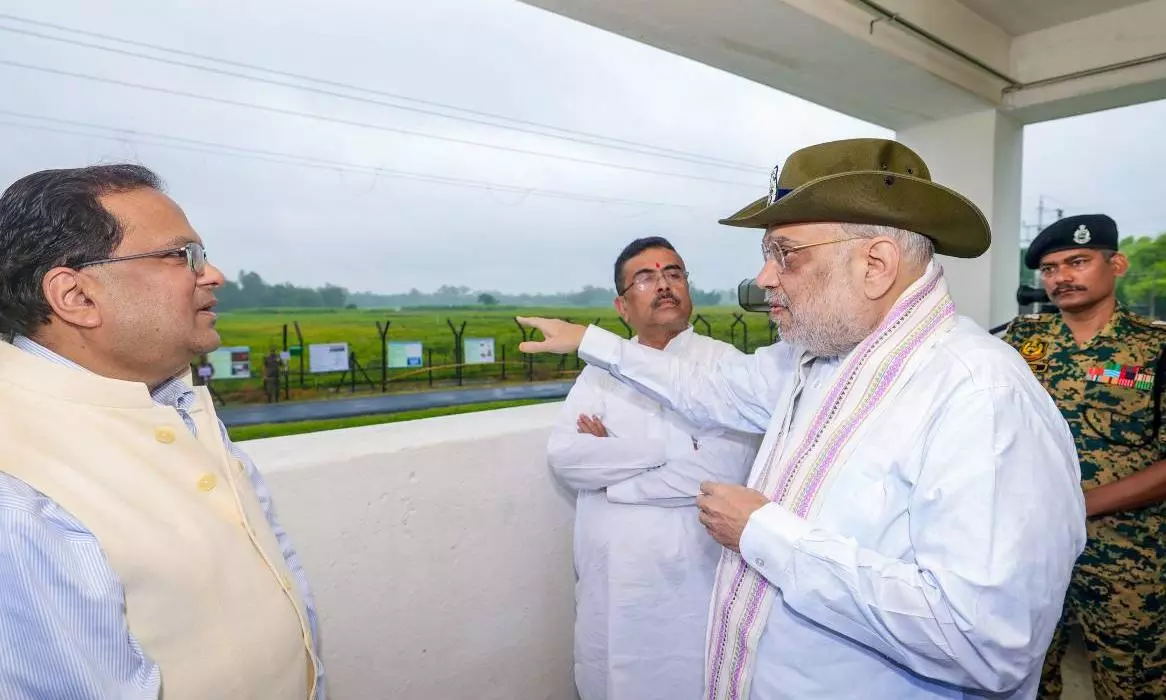
After reviewing security along the India-Bangladesh border and the strategically important Siliguri Corridor on Saturday (July 18), Shah's final event reinforced what appeared to be a carefully planned political and administrative message from the BJP's first government in the state.
Taken together, Shah's engagements suggested that the Centre is pursuing two parallel objectives in West Bengal.
Also read: Bengal BJP govt’s renaming drive sparks row over history and public memory
One is to institutionalise the BJP's long-standing emphasis on border security and illegal infiltration. The other is to expand its political appeal by engaging with Bengal's linguistic and cultural identity, an area where the party has traditionally struggled against regional forces.
Border management redefined
At Uttarkanya in Siliguri, Shah chaired a series of high-level meetings attended by Chief Minister Suvendu Adhikari, senior officials, the Border Security Force (BSF), Sashastra Seema Bal (SSB), Railways and other agencies.
The security review suggested that the party is moving to translate its long-articulated concerns over the Bangladesh border into administrative policy through tighter border management, stronger identity verification and closer coordination among security agencies.
The discussions went beyond conventional border management. Along with smart fencing, cross-border smuggling and infiltration, the review covered birth and death registration, Aadhaar, illegal voters and coordination among enforcement agencies, according to sources privy to the discussions.
Also read: What Subhasgram church attack reveals about Bengal's political crossroads
Seen individually, many of these subjects fall under different administrative departments. Their inclusion in a security review indicates that the Centre increasingly views border management as extending beyond physical fencing to encompass identity verification and documentation.
That approach reflects a continuity with the BJP's political campaign in West Bengal.
Crackdown on illegal infiltration, smuggling
During successive elections, Shah repeatedly argued that illegal infiltration from Bangladesh was not merely a law-and-order issue but one with implications for national security, electoral integrity and welfare delivery.
The Trinamool Congress consistently rejected those allegations, accusing the BJP of communalising migration and using the Bangladesh issue for electoral mobilisation.
Also read: What is behind West Bengal’s violent turn amid electoral churn?
Now, with the BJP in power in the state, several of those campaign themes are beginning to find expression in governance.
The review also underscored how the change in government has altered Centre-state coordination on border infrastructure.
“Projects that had remained pending because of disputes over land acquisition, including border fencing and BSF infrastructure, have begun moving after the state government handed over land sought by the central forces,” Chief Minister Adhikari claimed.
Shah's direction that whichever agency first receives intelligence on infiltration or smuggling should act immediately also points to an effort to create a more integrated enforcement mechanism along the Bangladesh border.
Focus on India-Bangladesh border
Significantly, the review's focus remained firmly on the Bangladesh frontier. Although the Siliguri corridor has long been strategically important as India's link to the northeast, the review focused mainly on challenges along the India-Bangladesh border such as infiltration, document fraud, smuggling and border surveillance, rather than conventional military threats.
Also read: Modi propels BJP vision to reshape Bengal's foundation narrative
That emphasis comes amid the BJP government's efforts to recast border management as a central element of governance in West Bengal.
By linking identity documents, civil registration and border enforcement within the same policy framework, the centre appears to be broadening the definition of what constitutes national security in a border state.
Cultural-linguistic outreach
While the first day of Shah’s engagement centred on security, Sunday's programme in Kolkata highlighted language and culture, adding another political dimension to the visit.
By emphasising Bengali language and cultural heritage, Shah sought to reinforce the party's claim that cultural nationalism need not come at the expense of regional identity.
Inaugurating Shabdalok at the National Library, Shah praised the richness of the Bengali language and described language as the foundation of civilisation and culture.
Also read: How Bengal is embracing a stronger Bengali identity with policies, protests
He highlighted the Narendra Modi government's decision to confer classical language status on Bengali, paid tribute to Rabindranath Tagore, Sri Aurobindo and Bankim Chandra Chattopadhyay, and said Bengal had historically shown the country the way in several spheres.
His remarks sought to broaden the BJP's image among many in Bengal, where the party is often associated with nationalism and Hindi identity.
By emphasising Bengali language and cultural heritage, Shah sought to reinforce the party's claim that cultural nationalism need not come at the expense of regional identity.
Efficacy remains to be tested
Overall, Shah's itinerary reflected the BJP's governing priorities in West Bengal after its historic electoral victory.
The security review suggested that the party is moving to translate its long-articulated concerns over the Bangladesh border into administrative policy through tighter border management, stronger identity verification and closer coordination among security agencies.
That approach was reflected in the Kolkata Police's decision to set up a special task force to identify, trace and process overstaying foreign nationals and illegal migrants in the city following Shah's review meeting.
Also read/watch: Baruipur tragedy: 'Nothing has changed in Bengal except govt's political colour'
The cultural outreach in Kolkata, meanwhile, signalled an attempt to deepen the BJP's engagement with Bengali linguistic and cultural identity as it seeks to consolidate its political base beyond the electoral coalition that brought it to power.
Whether these initiatives reshape governance or remain politically contested remains to be seen.