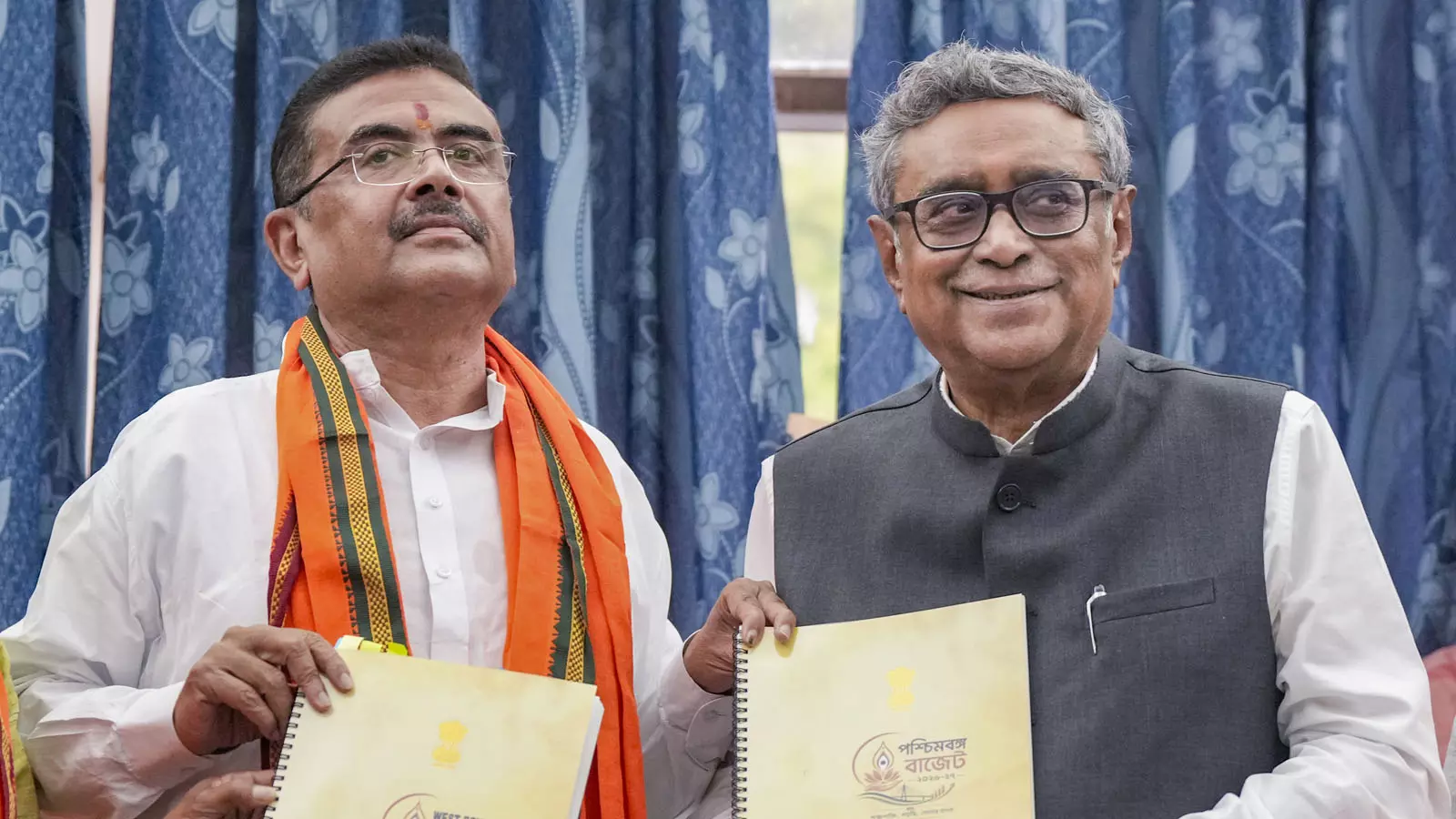
West Bengal Chief Minister Suvendu Adhikari and State Finance Minister Swapan Dasgupta display copies of the state Budget 2026 after its presentation in the West Bengal Legislative Assembly, in Kolkata, on Monday, June 22. PTI
Bengal Budget 2026: Despite attacking TMC, BJP retains Mamata's welfare model
The Budget reflects the new government's effort to simultaneously retain welfare beneficiaries, project an investor-friendly image, and embed its ideological priorities into state policy

West Bengal's first Budget under a BJP government was expected to provide a clear economic roadmap after the party's historic victory ended more than a decade of Trinamool Congress (TMC) rule.
In his nearly 90-minute Budget 2026 speech, Finance Minister Swapan Dasgupta signalled both the government's economic agenda and its broader political priorities.
‘No radical change’
The Budget reflects the new government's effort to simultaneously retain welfare beneficiaries, project an investor-friendly image, and embed its ideological priorities into state policy.
Also read: Bengal: 96 pc of TMC's defeated candidates defy Mamata, refuse to contest poll results
For years, the BJP attacked the TMC for turning Bengal into a welfare-dependent state.
Yet its first Budget leaves virtually the entire welfare structure intact. The Annapurna scheme alone receives Rs 36,000 crore, while unemployment allowances, pensions for widows and senior citizens, and benefits for various categories of workers have all been expanded.
Rather than dismantling Mamata Banerjee's welfare model, the BJP appears to have concluded that it is politically impossible to govern Bengal without it.
"The Budget is broadly on expected lines. There is no radical change in approach," renowned economist Abhirup Sarkar told The Federal. "More than laying out a detailed economic roadmap, it reflects the political objectives of the new government."
Greenfield airport near Kalyani
The Budget suggests that the BJP's governance model in West Bengal will not be built on replacing welfare with development.
Instead, it combined welfare spending with a pro-business narrative. The problem is that the "growth" side of that equation remains thin on detail.
Also read: Kolkata’s Suhrawardy Avenue renamed after Gopal ‘Patha’; why is Opposition against it?
The government has announced a greenfield airport near Kalyani, feasibility studies for metro networks, and plans to create new districts and municipalities.
It has also proposed reconsidering the Urban Land Ceiling Act, a long-standing demand of developers and industry groups who argue that land regulations have hindered investment.
Industry bodies have repeatedly argued that easier land aggregation is necessary to attract large projects and integrated townships.
New law against ‘syndicate raj’
The government has also proposed a major easing of approval requirements for large investors, announcing that projects involving investments of more than Rs 100 crore would no longer require clearances from panchayats or urban local bodies.
The move appears aimed at addressing one of industry's long-standing complaints about procedural delays and local-level hurdles.
Critics, however, may view it as reducing the role of local self-government institutions in decisions involving large projects.
Another notable announcement was the proposal for a new law against what the BJP describes as Bengal's entrenched "syndicate raj", a reference to the networks of political patronage, extortion and informal control over construction and business activity that the party frequently accused the previous TMC government of nurturing.
The effectiveness of the proposed legislation, however, will ultimately depend on its implementation rather than its announcement.
Creation of 1 lakh jobs
Yet beyond these broad signals, the Budget offers few specifics about how Bengal intends to attract major industries, generate private investment or create large-scale employment.
Notably absent is a new industrial policy, something business groups had identified as a key requirement for reviving investment in the state.
The employment story reveals a similar contradiction.
The government has announced one lakh jobs, but half of them are in education and another 20,000 are in policing. This is less a strategy for economic transformation than an expansion of public employment. Government recruitment may provide short-term relief to educated youth, but it does little to answer the larger question of where private-sector jobs will come from in a state that has struggled to attract large manufacturing investments for decades.
DA hiked
The agriculture section exposes another gap between campaign promises and Budget delivery.
The BJP had promised a paddy procurement price of Rs 3,100 per quintal. The Budget increases support but stops short of delivering the promised figure. Instead, the government now says the target will be achieved gradually.
The biggest surprise, however, may be the scale of the Dearness Allowance (DA) hike.
The government has announced a 20 percentage-point increase in DA.
The move is politically attractive, particularly given the BJP's support for the DA movement while in Opposition. But it also raises questions about the state's fiscal capacity.
The Budget speech provides little indication of how these additional liabilities will be financed over the medium term.
The assumption appears to be that stronger Centre-state cooperation under a "double-engine government" and future investment flows will generate the necessary funds.
Whether those expectations materialise remains to be seen.
‘Budget reflects benefits of double-engine government’
Sarkar noted that while the state's debt burden remains substantial, its fiscal position has improved compared to previous years.
"The Budget reflected some of the benefits of the double-engine government arrangement, including higher grants-in-aid from the Centre," Sarkar said.
Rathindra Nath Pramanik, head of the department of Rural Studies at Visva-Bharati University, broadly agreed with that assessment.
"The government today has more financial room than before, which is why it has been able to announce a 20 per cent DA hike in one go, raise support for paddy farmers and unveil several infrastructure projects," he pointed out.
Pramanik described the Budget as broadly progressive in intent but cautioned that its success would depend on execution.
"The announcements are significant, but the real test will be how effectively they are implemented on the ground," he said.
Budget cut for Minority Affairs
Another important aspect of the Budget is that the ideological imprint of the new administration is hard to miss.
The proposed Shakti Peeth Circuit, a Chaitanya Mahaprabhu pilgrimage route, substantial allocations for temple and heritage restoration, the promotion of Sanskrit, and a holiday on Syama Prasad Mookerjee's birth anniversary together signal a significant shift in the state's budgetary priorities.
Incidentally, the allocation for the Minority Affairs and Madrasah Education Department has been reduced from about Rs 5,713 crore in the previous interim Budget to around Rs 2,165 crore in the BJP government's first Budget.
Every government uses Budgets to communicate political priorities.
In this case, the BJP is signalling that Hindu cultural and religious identity will be an integral part of governance.
Just as revealing are the Budget's silences. It contains no mention of hawker rehabilitation despite widespread eviction drives and court interventions.
There is little detail either on labour-intensive industrialisation. Nor does it offer a comprehensive explanation of how Bengal's long-standing structural economic challenges, including stagnant private investment and limited manufacturing growth, will be addressed.