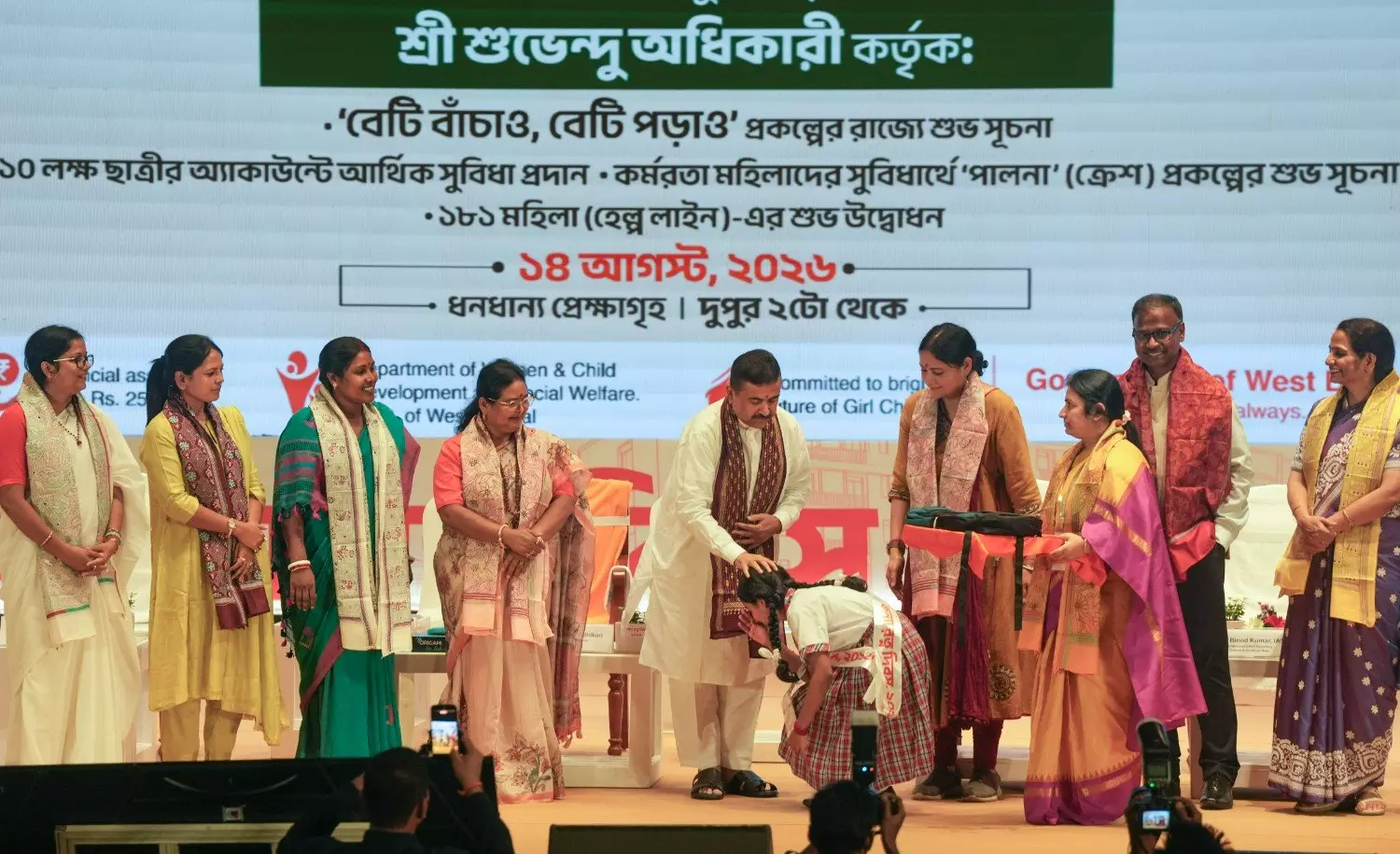
West Bengal Chief Minister Suvendu Adhikari, being greeted by a student as state Ministers Malati Rava Roy and Agnimitra Paul look on, during 'Kanya Ratna' Diwas at Dhono Dhanya Auditorium, in Kolkata, West Bengal, Friday, August 14. PTI
Facing Gen Z heat, Bengal BJP bets big on AI and digital outreach
With CJP's youth appeal growing and a Kolkata meeting cancelled amid 'pressure', the ruling party turns to AI posters and reels

Gen Z seems to be the in-thing, and India's ruling party is feeling the pinch.
The West Bengal BJP is turning to Artificial Intelligence and social media to reach Gen Z voters as it prepares to take its 100-day report card to nearly 4 crore people across the state. The push comes even as the BJP is ramping up digital outreach to counter outfits like Cockroach Janata Party's (CJP) growing pull among young voters.
The ruling party's unease over Gen Z surfaced after a CJP meeting in Kolkata was cancelled on Tuesday (August 18), reportedly after several venues backed out under BJP pressure.
CJP’s Kolkata meeting cancelled over ‘BJP pressure’
Also read: Eggs, egos and an anti-goonda law: Bengal BJP govt's first 100 days
“Our scheduled Kolkata meet-up at Bharat Sabha Hall in north Kolkata has now been cancelled after the owners received threats from BJP leaders. Six other halls refused, stating massive pressure from the state,” CJP co-convenor Ashutosh Ranka wrote on X (Twitter).
Training camp
The party’s central and state leadership at a training camp at the New Town Convention Centre trained 350 selected trainers to take its digital campaign to the district level.
The trainers will conduct programmes for party workers across the state’s organisational districts from August 22 to 30, party sources said.
Also read: 100 days of Bengal BJP govt: Will face public 'test' after 1 year, says CM Suvendu
“The emphasis is on using AI to produce posters, motion graphics and short videos, while platforms such as Instagram, Facebook, YouTube and X will be used to convey the government’s first 100-day achievements to people, particularly younger voters,” a BJP leader privy to the training told The Federal.
“The party has also asked workers to reach not only committed BJP voters but new voters and those who will shortly become eligible to vote,” he added.
Realising the growing influence of AI-generated memes, reels and other digital content in disseminating political messages, the party used the training camp to move beyond experimentation to build a trained network capable of producing and distributing such material in a more impactful manner, sources added.
Physical outreach
The camp was addressed by BJP national joint general secretary (organisation) Shiv Prakash, the party's Bengal in-charge Sunil Bansal, state president Shamik Bhattacharya, Rajya Sabha MP Rahul Sinha and state organisational secretary Amitabh Chakraborty.
Also read: Why West Bengal Census has kicked off under NRC cloud
Bansal told party workers that the organisation had to keep pace with changing technology and use it to make its work more dynamic.
The digital push comes alongside a physical outreach. The BJP plans to take its 41-page report card on the first 100 days of the government to about four crore voters over the next seven to 10 days.
Workers will go into neighbourhoods, present the government's achievements and seek public feedback.
A BJP spokesperson said the party had sought the support of these voters before the Assembly election and was now answerable to them.
What's in BJP govt’s report card?
The report card is intended to shift the BJP's message from election promises to the performance of a government in office, he said.
Among the achievements the party is highlighting are the implementation of Ayushman Bharat in Bengal, the transfer of land to the Border Security Force (BSF) for border fencing, an increase in the upper age limit for state government recruitment and the launch of the Annapurna Yojana.
Also read: Netaji or Mookerjee? BJP's ideological tightrope walk in West Bengal
The party also plans to highlight the renaming of Kanyashree as Kanya Ratna, the launch of Beti Bachao Beti Padhao in the state, the Anti-Goonda Bill, new helplines for complaints of extortion and syndicate activities and proposed recruitment in the police.
The state health department has separately listed 23 initiatives during the first 100 days, including the rollout of Ayushman Bharat and mobile and floating medical units for the Sundarbans.
“The combination of doorstep outreach and digital campaigning is significant because much has changed since the Assembly election, particularly among younger voters. The BJP’s support base among Gen Z is believed to have shifted following last month’s student-led protests,” said political commentator Debasish Chakrabarti.
During the campaign, the BJP used unemployment and recruitment controversies as political weapons against the Trinamool Congress (TMC). Its youth outreach included reels, social media posts, the Digital Warrior initiative and street-level mobilisation. Its Chakri Chai Bangla ( Bengal wants jobs) campaign put jobs at the centre of its appeal to young voters.
“Now, as the ruling party, the BJP has to address many of the same issues it had used to attack its predecessor. The emergence of the CJP has made that challenge more visible, particularly among younger voters who have shown a willingness to mobilise outside established political parties,” Chakrabarti added.
CJP volunteer’s father dies in alleged BJP attack
The CJP has continued to expand its activities in West Bengal. Its recent School Thik Karo (Fix the schools) campaign, which seeks to highlight deficiencies in government schools, has already drawn attention.
A CJP volunteer, Abdul Hafiz, allegedly faced an attack after visiting his former school and recording its condition in Bankura.
His father later died of injuries sustained in the incident, according to his family and police. The CJP has alleged BJP involvement, while the saffron party has denied responsibility and said action should follow if its workers are found involved.
The CJP poses a different kind of political challenge for the BJP. Young voters no longer need to join a party to participate in politics. A recruitment dispute, examination controversy or grievance over government services can generate its own online following and quickly move into street-level mobilisation.