From NCC to ‘surgical strike’, how BJP is trying to reshape West Bengal’s campuses
Party leaders take college governing roles as ABVP expands its campus network, while nationalism, curriculum changes and political clashes fuel debate

The BJP’s drive to change the political character of West Bengal’s campuses is becoming increasingly visible as the government places party leaders in college governing bodies and promotes its ideology, while the ABVP expands its activities across universities and colleges.
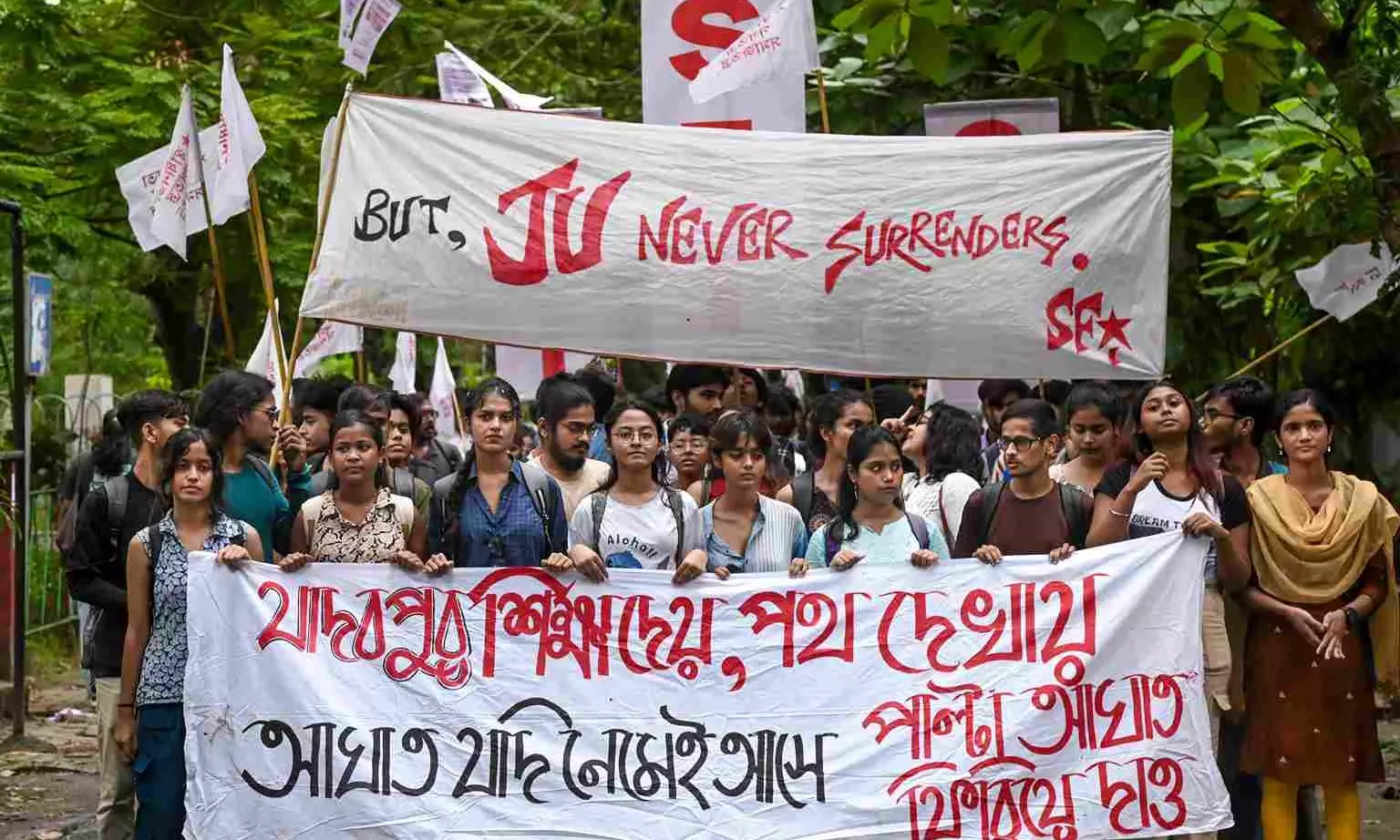
The latest manifestation of the push came on Friday, when Chief Minister Suvendu Adhikari joined a “Vande Mataram” programme near Jadavpur University, where thousands braved inclement weather to sing the song.
BJP expands footprint on campuses
Held on Rakhi Bandhan, the event was billed as a mobilisation to “instill the spirit of nationalism” around Jadavpur University, which BJP leaders have repeatedly accused of harbouring “anti-national” elements. The event follows Adhikari’s declaration that he would establish “nationalism both inside and outside Jadavpur”.
Also read | BJP sets Bengal agenda; embraces Bengali identity, re-strategises border security
The BJP’s drive has two parallel approaches. One is administrative, with the government appointing ruling party MPs, MLAs and ministers as heads of governing bodies in 247 government-aided colleges, giving BJP elected representatives a direct role in college administration.
The move came after the government initially dissolved the existing governing bodies and appointed administrators, with Adhikari announcing that educational institutions would be kept free of political influence.
The subsequent appointments have therefore raised questions about whether the BJP is now establishing its own political foothold in the institutions it had promised to keep free of party politics.
“The chief minister is simply following the path he learnt from Mamata Banerjee. I fail to understand why ministers need to run colleges when they already have their own responsibilities,” CPM leader Sujan Chakraborty said.
Mookerjee’s legacy enters classrooms
Higher Education Minister Jagannath Chattopadhyay, however, defended the appointments, saying the remaining 200 governing bodies would be headed by educationists and social workers. He said the government’s earlier promise not to allow colleges to become political arenas did not mean elected local representatives would have no role in running them.
However, appointments to the governing bodies are not the only government initiatives in colleges and universities that have drawn criticism. The government has also decided to include Syama Prasad Mookerjee’s life, political role and contribution to the formation of West Bengal in the curricula from schools to universities.
The decision, announced as part of year-long programmes marking his 125th birth anniversary and highlighting Mookerjee’s role in securing the Hindu-majority western part of Bengal for India, has drawn questions from sections of the teaching community over the prominence being given to one political figure.
The decision matters because Mookerjee founded the Bharatiya Jana Sangh, the political predecessor of the BJP. Critics have therefore questioned whether the move gives the party’s ideological predecessor a greater place in the state’s educational narrative.
Campuses see ideological expansion
Swapan Mondal, general secretary of the Bangiya Shikshak O Shikshakarmi Samiti, said that if Mookerjee was included in the curriculum for his role in the creation of West Bengal, other political leaders involved in the process should also find a place.
The government has also moved to put greater emphasis on defence training and national service in educational institutions. Adhikari said on Friday that his government had proposed to the Centre that NCC training be made compulsory in schools and colleges along the border, citing Israel as a model for youth defence training.
He also called for the revival of the National Service Scheme and the Bratachari movement, a social movement founded by Gurusaday Dutt in 1932 to promote physical fitness, discipline, community service and national awareness.
The second approach is organisational, with the RSS-affiliated Akhil Bharatiya Vidyarthi Parishad (ABVP) expanding its network across the state’s campuses.
The ABVP has significantly expanded its footprint in the past four months, with its presence growing from around 96 colleges before the BJP came to power to more than 400 now, according to the organisation.
Other RSS-linked organisations, including the Akhil Bharatiya Rashtriya Shaikshik Mahasangh and Bharatiya Shikshan Mandal, are also expanding their presence among teachers and education workers in Bengal.
Campus politics takes combative turn
ABVP leaders have said they want to build a stronger organisation across Bengal’s campuses. Their campaign has increasingly focused on “nationalism” and on challenging what they describe as the dominance of Left and Trinamool-backed student organisations.
That expansion has led to repeated confrontations on campuses. Clashes between the ABVP and rival student groups have been reported at Medinipur College, Calcutta University, Presidency University, West Bengal State University in Barasat and others.
The political rhetoric around the clashes has been sharper. Senior BJP leader and Bengal Minister Dilip Ghosh warned that there would be another “surgical strike” at Jadavpur if “anti-national” slogans were raised again.
The ABVP has used similarly combative language. Its state secretary Nilkantha Bhattacharya has said that “Dimagi Naxals” would be driven out of Jadavpur University within six months.
Also read | Durga Puja becomes new battleground for BJP factions in Bengal
Not all voices within the BJP, though, have taken the same combative line. Finance Minister Swapan Dasgupta described the violence as unfortunate and urged politicians and people from all political backgrounds to stay away from student politics, warning that such confrontations damage the university's reputation.
Academics reject ‘anti-national’ tag
The BJP has defended the broader campaign as an attempt to challenge what it describes as the longstanding dominance of rival political groups on Bengal’s campuses.
Academics and student organisations opposed to the BJP, however, have rejected the characterisation of Jadavpur as a centre of “anti-national” activity.
The Jadavpur University Teachers’ Association denounced the branding of the institution as anti-national, pointing to its origins in the Swadeshi movement and its role in the freedom struggle. “A university that was born out of the Swadeshi movement has never compromised with any anti-national activities,” it said.
Former JU professor Pabitra Sarkar said students raising “azadi” slogans should not automatically be branded anti-national. “When Left-aligned students shout ‘azadi’, they mean freedom from illiteracy. They are not anti-national,” he said.