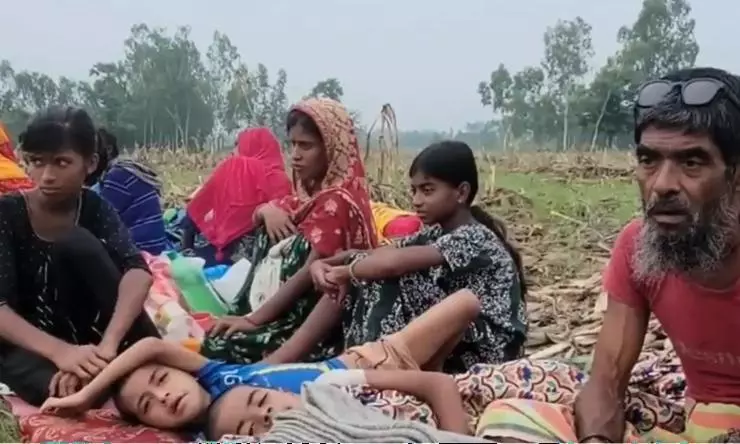
Women, children stranded in no-man’s land as India, Bangladesh spar over nationality
Dispute highlights limits of BJP's anti-infiltration campaign that can be implemented only up to the point where Bangladesh agrees to receive the deportees

As India steps up efforts to deport allegedly undocumented Bangladeshi migrants, a series of border standoffs is highlighting a key reality—the exercise cannot proceed smoothly without cooperation between the two countries.
At the heart of the issue is a disagreement over nationality verification. While India says it is identifying and deporting Bangladeshi nationals living in the country without valid documents, Bangladesh insists that anyone sent back must first be confirmed as one of its citizens.
Caught in no-man’s land
In the Karimpur sector of West Bengal’s Nadia district, the fate of several migrants remained uncertain as authorities tried to establish whether they could be sent across the border.
In another case in north Bengal, a family of 10 spent several days in no-man’s land after Bangladeshi border guards allegedly refused to allow them entry.
Also read: 'Detect, delete, deport': Suvendu signals tough border shift with BSF land handover
Similar standoffs have also been reported in Assam.
On Monday (June 15), sources said nine alleged Bangladeshi nationals remained stranded in a stretch of no man’s land along the India-Bangladesh border in Assam’s Mankachar sector after talks between the Border Security Force (BSF) and Border Guard Bangladesh (BGB) failed to resolve a dispute over their nationality.
The standoff continued for several hours, underscoring the difficulties authorities face when the two sides disagree over who should be accepted across the border.
Bangladeshi media, too, reported on Monday that a group of 12 people, including women and children, remained stranded for a third consecutive day in a no man’s land near the Kushtia border after BGB refused to accept them without nationality verification.
Some reports claimed women and children spent hours or days near border areas while officials from the two countries discussed their status.
BSF, BGB exchange concerns
The issue was even discussed prominently during last week’s talks between BSF and BGB, where both sides exchanged concerns over migration, border management and alleged pushbacks.
Bangladesh has repeatedly objected to what it describes as attempts to send people across the border without sufficient verification.
Also read: India-Bangladesh ties under strain as pushbacks threaten reset
“Our BGB men remain on high alert along the frontier. Any attempt of illegal push-ins or unlawful border crossings will be firmly resisted,” Bangladesh Home Minister Salahuddin Ahmed said.
BGB officials reportedly conveyed to their Indian counterparts that nationality cannot be determined solely by another country and that repatriation should proceed through bilateral mechanisms already in place.
Indian officials, meanwhile, voiced frustration over what they describe as delays in the verification process.
Thousands of requests pending
Officials familiar with discussions between the two border forces in New Delhi say India has submitted thousands of requests seeking confirmation of suspected Bangladeshi nationals. The process can take months, creating uncertainty over the status of people detained during deportation drives.
Indian authorities, however, claimed in private that the challenge goes beyond identifying undocumented migrants. Even when officials conclude that a person is a Bangladeshi national, deportation depends on cooperation from Bangladesh.
Also read: Wild East? BSF may use snakes, crocodiles to guard porous Bangladesh border
Border officials and migration experts say acceptance by the receiving country is an essential step in any repatriation process.
“The unresolved standoffs illustrate how disagreements over nationality can delay or halt deportation efforts without mutual cooperation between the two countries,” said civil rights activist Kiriti Roy, whose work focuses on documenting and advocating against alleged human rights violations by the BSF and other security forces along the India-Bangladesh border.
Claim versus reality
The BJP has long accused political rivals in West Bengal and Assam of either encouraging or failing to prevent undocumented migration from Bangladesh.
The issue frequently resurfaces during election campaigns and remains closely linked to debates over citizenship, border security and access to welfare benefits.
Immediately after coming to power, the BJP government in West Bengal launched a crackdown on alleged illegal migrants.
Also read: Several nationality verification requests pending with Bangladesh, says MEA amid BGB-BSF row
The government has said around 4,800 alleged illegal immigrants have been sent back to Bangladesh since it took office, while 836 remain in holding centres awaiting repatriation. The figures have been repeatedly cited by the administration as evidence of progress in delivering on one of the BJP's key political promises.
The recent standoffs, however, have exposed a practical constraint on that campaign. While authorities may be able to identify and detain suspected undocumented migrants, their eventual removal depends on Bangladesh agreeing to accept them as its citizens.
Citizenship disputes common in deportation cases
Enforcing deportation policies poses significant diplomatic challenges. Migration researchers note that citizenship disputes are common in deportation cases around the world.
“No country can simply decide another country’s citizens for it,” said Sucharita Sengupta who studies migration and border governance in South Asia. “The receiving country must be satisfied that the individual being returned is in fact one of its nationals.”
Also read: West Bengal hands over 142.79 acres to BSF for India-Bangladesh border fencing push
That difference in approach lies at the centre of the current dispute. For Indian authorities, the primary question is whether a person entered India illegally from Bangladesh. For Bangladesh, the central question is whether there is sufficient evidence proving that the individual is a Bangladeshi citizen.
Nowhere people
The consequences can be significant for those caught in the middle, as seen in cases where people spent prolonged periods in border areas while officials attempted to establish their identity or negotiate their deportation.
In some instances, local administrations and border forces reportedly arranged temporary food and shelter while discussions continued.
Rights advocates like Roy warn that prolonged disputes over nationality can leave vulnerable people in legal uncertainty, particularly when documentation is incomplete or contested.
Even the United Nations is monitoring reports related to alleged pushbacks along the border, according to sources. Human rights groups have also urged authorities to ensure due process during any deportation exercise.
Both sides stand firm
Neither side has so far shown signs of changing its position in recent meetings. India remains committed to tackling illegal immigration and expects neighbouring countries to accept their nationals. Bangladesh maintains that verification must come before repatriation and has rejected any suggestion that individuals can be transferred across the border without due process.
Also read: MEA figures cast doubt on BJP’s narrative of large-scale Bangladeshi infiltration
For the BJP government, the dispute highlights the limits of an anti-infiltration campaign that can be implemented domestically only up to the point where Bangladesh agrees to receive those being deported. As a result, the exercise is increasingly becoming a test of bilateral cooperation.
It also raises questions about how quickly the government can process the hundreds of people still awaiting repatriation if nationality disputes and verification delays continue to slow the deportation process.
For India, it raises questions about how large-scale deportation drives can be implemented when nationality itself is disputed.
For Bangladesh, the issue has become tied to sovereignty and the right to determine who qualifies as one of its citizens.