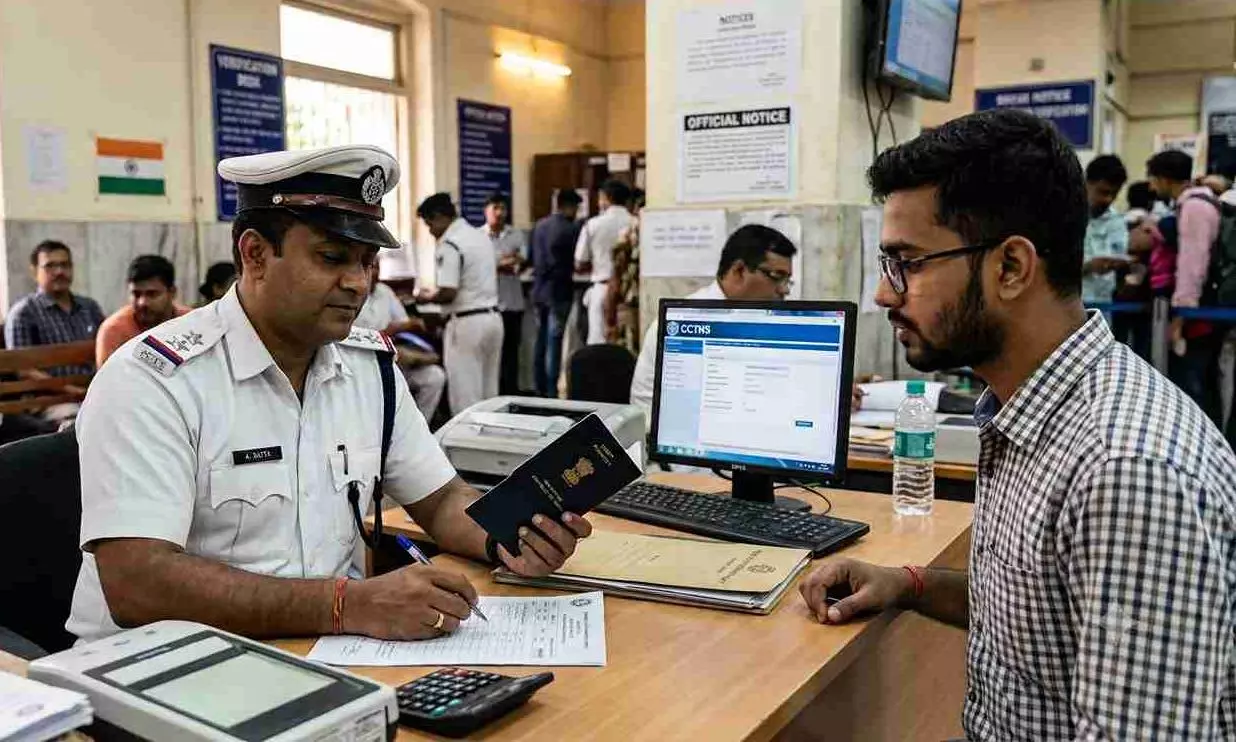
Journalists’ passport woes put lens back on Bengal’s rigid police verification system
Delays faced by R Rajagopal and Samrat Choudhury have reignited debate over West Bengal’s stricter passport checks, introduced after a fake‑passport scandal

The passport troubles of The Telegraph’s former editor R Rajagopal and author-journalist Samrat Choudhury have once again put West Bengal’s police verification system under scrutiny.
Their cases have revived concerns over a process that has become significantly more demanding since early last year.
Rajagopal has alleged that his passport renewal was held up after an adverse police verification report following the deletion of his name from the electoral rolls during the Special Intensive Revision (SIR).
However, Kolkata Police later said a voter identity card is not the definitive document for passport verification and that it was reviewing his file.
The case of ‘citizenship not established’
Choudhury has also spoken about the difficulties he faced with his passport.
His passport was first issued in 1993 and was renewed periodically, including under the Tatkal scheme in 2022, when no police verification was carried out.
Also read: Rajagopal passport row: Kerala CM seeks Bengal govt intervention after SIR-linked delay
On June 9 this year, however, he received a notice from the Regional Passport Office (RPO) directing him to appear within 21 days, failing which his passport would be liable to cancellation. The RPO flagged his case on the ground that “citizenship not established”.
After he appeared before the passport authorities, his case was referred to the police for fresh verification.
Fallout of a fake passport racket
Their experiences have brought renewed attention to a tightened verification regime introduced after a fake passport racket exposed serious flaws in the system. Since then, social media platforms have been replete with complaints from applicants alleging prolonged delays and uncertainty over when they would receive their passports.
In a June 9 post on a Facebook passport support group, Ambika Shaw claimed that police verification had remained pending for more than three months despite repeated follow-ups with the local police station.
Also read: Passport, citizenship, and the SIR debate: Why the govt’s stand faces scrutiny
In the comments, another user, Mahua Shyam, alleged that such delays were particularly common in West Bengal and urged affected applicants to report their experiences through official channels. A third user, Sourick Roy Chowdhury, said his police verification had also remained pending for three months.
25,000 applications await police clearance
While these accounts cannot be independently verified, they point to a mounting problem and growing public frustration with the process. Sources in the RPO Kolkata said more than 25,000 passport applications are currently awaiting police clearance across 72 police stations in the city.
The tougher verification process was introduced after the Kolkata RPO uncovered widespread irregularities in December 2024, according to sources privy to the development.
Around 250 passports were found to have been issued without proper police verification. More than another 150 applications were flagged before passports could be issued.
The revelations prompted the police to order a complete overhaul of the passport verification process.
The revised Standard Operating Procedure (SOP) was issued by the West Bengal Police under the leadership of the then Director General of Police Rajeev Kumar.
Also read: Passport row: If a passport isn't proof of citizenship, what is? Experts explain
Much has changed since then. The BJP is now in power in the state and Rajeev Kumar is no longer the DGP. However, the verification protocol introduced after the fake passport scandal continues to remain in force.
A stricter revised SOP
As per the revised SOP, police are required to carry out far more rigorous checks of identity documents.
Instead of relying only on copies submitted by applicants, officers were instructed to cross-verify Aadhaar and other documents with the issuing authorities wherever required.
Another major change was the introduction of a digital verification trail.
Under the new system, every document examined during verification is uploaded to police servers. The records remain permanently available for scrutiny by senior officers, including Assistant Commissioners of Police and Officers-in-Charge of police stations.
Police under pressure
The SOP also warns of departmental action against officers if any laxity is detected during the verification process. Officials familiar with the system said the provision has made officers more cautious while submitting verification reports.
Senior officers were instructed to monitor compliance to ensure that the revised procedure was followed uniformly.
Also read: ‘MEA statement on passport bizarre, sends out confusing message’
Officials said the system was designed to improve accountability and reduce manipulation of records, but for applicants, it has meant longer waiting periods and greater uncertainty over passport clearance.
The SOP also gives senior police officers a greater supervisory role. Superintendents of police in districts and deputy commissioners in commissionerates are now required to closely monitor passport verification.
Multiple layers of scrutiny
The overhaul marked a departure from the Centre’s 2018 framework, which had streamlined police verification to speed up passport issuance.
West Bengal Police argued after the fake passport racket that the existing framework left critical gaps in field verification.
Officials familiar with the revised procedure said the expanded checks have inevitably made police verification more time-consuming.
Every application now requires multiple layers of scrutiny that did not exist under the earlier system.
No justification for SIR link
The cases of Rajagopal and Choudhury have raised fresh questions over whether the stricter verification system has made it harder for genuine applicants to obtain passport clearance.
Rajagopal’s case has also added a fresh dimension to the debate because it comes against the backdrop of the SIR exercise.
Also read: Citizenship proof burden can’t be on people: Legal expert Faizan Mustafa | AI With Sanket
There is no official policy linking electoral roll verification with passport services.
The Supreme Court, while upholding the SIR, made it clear that deletion from the electoral roll is confined to electoral rights and is not a final determination of citizenship.
The court said such deletion cannot divest a person of claims to citizenship, which can only be decided by the competent authority under the Citizenship Act.
Nor has the ministry of external affairs ever indicated that SIR affects passport issuance.