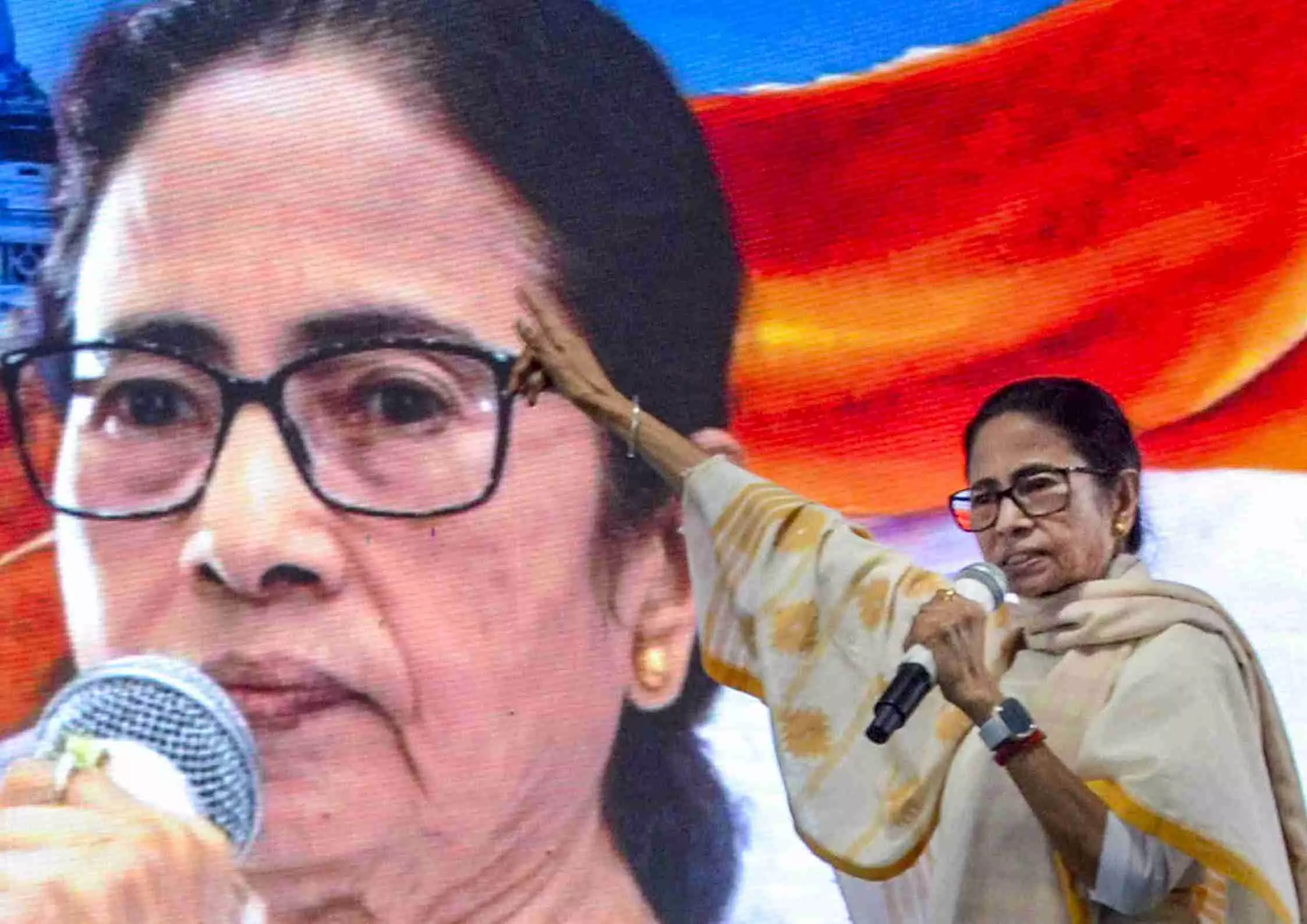
How Mamata turned ED raids to her advantage and neutralised BJP's Bengal plan
The TMC supremo recast the BJP's narrative on issues such as corruption and infiltration, showing who's the better master of the game

As West Bengal gears up for another high-stakes election, the political narrative in the state has been swinging sharply between infiltration, corruption, and interference from the Centre, with Chief Minister Mamata Banerjee repeatedly managing to seize control of the story.
The latest flashpoint came on early Thursday (January 8) when the Enforcement Directorate (ED) raided the Kolkata offices of political consultancy I-PAC (Indian Political Action Committee) and its director and co-founder, Pratik Jain, as part of a money-laundering probe in connection with a 2020 coal scam.
Also read: Adhir Chowdhury’s quiet comeback and a risky Bengal political gamble
The firm has been working closely with Mamata’s ruling Trinamool Congress (TMC) as a consultant on election management and strategy.
The Bharatiya Janata Party (BJP), which is aiming to end the TMC’s 15-year-long governance, attempted to project the raids as validation of its long-standing claim that corruption has become synonymous with the ruling outfit.
Mamata's quick offence against ED raids
The chief minister, however, acted swiftly to recast the narrative, barging into the raid sites, coming out with a “mysterious” green file and a hard disc that she claimed contained her party’s candidate list and other strategy-related materials for the upcoming polls, including documents related to the state’s special intensive revision (SIR) process.
She took advantage of the timing of the raid, suspiciously close to the elections, to considerably discredit it as politically motivated, designed to disrupt her party’s election machinery rather than to combat corruption.
Also read: Is SIR undermining voter rights in Bengal? | Jawahar Sircar interview
Her interference would clearly face legal challenges, but it successfully shifted the focus from the alleged coal scam and once again forced the BJP to defend the charges levelled by her, rather than go on the offensive over graft allegations.
Central agencies' track record benefited Mamata
The central agencies’ track record of becoming proactive ahead of elections, while failing to secure convictions in the corruption cases they have been investigating in the state for years, further lent some credibility to Mamata’s charges.
“The message she successfully conveyed to her constituency was that she had fought back against central agencies attempting to subjugate Opposition parties and render them subservient under the direction of the BJP leadership,” said Debashis Chakrabarti, a political commentator and Commonwealth fellow.
Also read: ED, I-PAC and Mamata: A pre-poll tug-of-war over power, data and agencies
Addressing a rally after a large protest march through Kolkata on Friday (January 9), Mamata claimed she had intervened in her capacity as party chairperson to “save” materials, to safeguard her party’s strategic interests.
“What I did…, I did as the chairperson of the All India Trinamool Congress. I did nothing wrong. You came to kill. You came like thieves to steal all my data. If the twin flowers (the party symbol) are not protected, how will I fight for the people?” she asked, framing her actions as both defensive and necessary.
Her party has also legally challenged the seizures in the Calcutta High Court, arguing that the ED accessed confidential political and electoral data unrelated to any scheduled offence, a move that underlined its claim of central agencies being misused for political ends.
Also read: Javed Akhtar event cancellation: Bengal on a slippery cultural slope
In the past few days, the stand-off has intensified, with the West Bengal Police registering FIRs (first information reports) against ED officials over the alleged removal of documents during the raids and initiating investigations to collect evidence, including CCTV footage and witness statements, to determine whether any files were taken unlawfully.
Her action has also turned the debate towards a perceived tacit understanding between the TMC and the BJP’s central leadership.
Left, Congress call it 'drama'
“As per standard operating procedure, any investigative agency cordons off the space where they are raiding or investigating. So, how was the chief minister allowed to infiltrate that zone? Why was no immediate action taken against her? It seemed that the ED offered her safe passage and allowed her to take away whatever documents she wanted,” alleged Mohammed Salim, state secretary of the Opposition Communist Party of India (Marxist).
“It is all drama, all match-fixing, and an attempt to reinforce a BJP-TMC binary, as if no one else exists,” said the state Congress president, Subhankar Sarkar.
Also read: After I-PAC raids, Mamata accuses Amit Shah of taking coal-scam money
Even within the BJP, there are people raising questions about the ED’s failure to stop the chief minister from taking away the materials.
'Mamata bowled aggressively, BJP couldn't bat'
“Mamata bowled aggressively, but the ED could not bat,” former India cricketer and BJP MLA Ashok Dinda said, arguing that the agency lacked a fighting spirit.
“The ED should have shown a more fighting spirit… I am a fighter, someone from the playing field… I feel that if Mamata Banerjee had broken in or taken the papers with a gun, the picture would have looked better.”
The ED raid was not the only episode where the TMC succeeded in reshaping the BJP’s narrative.
BJP's corruption, infiltration ploys failed?
The SIR of electoral rolls, which the BJP had positioned as a tool to expose alleged illegal migration of Bangladeshis and Rohingya refugees into India, was intended to reinforce the party’s broader campaign on illegal migrants and voter integrity.
Also read: ED raids at I-PAC spark political confrontation in West Bengal | Capital Beat
Union ministers and state BJP leaders repeatedly described the exercise as crucial to “cleaning up” the voter lists and claimed that millions of infiltrators had been added.
However, the SIR exercise produced errors and confusion, including the deletion of legitimate voter names from draft lists.
Mamata and the TMC seized on these missteps, portraying the process as arbitrary, poorly managed, and an attempt to harass ordinary citizens rather than to root out illegal voters.
She described the exercise as “inhumane”, alleging it had caused numerous health emergencies and even fatalities, and framed it as a case of federal overreach targeting Bengal’s residents.
Also read: What is I-PAC and how is it connected with Mamata’s TMC?
The TMC supremo even went further, accusing the BJP and central agencies of using the SIR not simply to ensure electoral integrity but to intimidate and control Bengali citizens, effectively turning the BJP’s intended infiltration narrative on its head.
According to analysts, the BJP’s effort to turn corruption and infiltration into key election issues has largely failed, as Mamata has linked central government actions to Bengal’s broader narrative of autonomy and resistance.
“In West Bengal,” said political analyst Amal Sarkar, “perceptions of central agency actions are shaped by decades of political contestation between the Centre and the state. What might be a routine intervention elsewhere can quickly be seen here as the Centre’s heavy-handedness.”
He added that by positioning the ED raid as a defence of the democratic process, the TMC chief has pushed the focus away from alleged wrongdoing to questions about fairness and political neutrality.