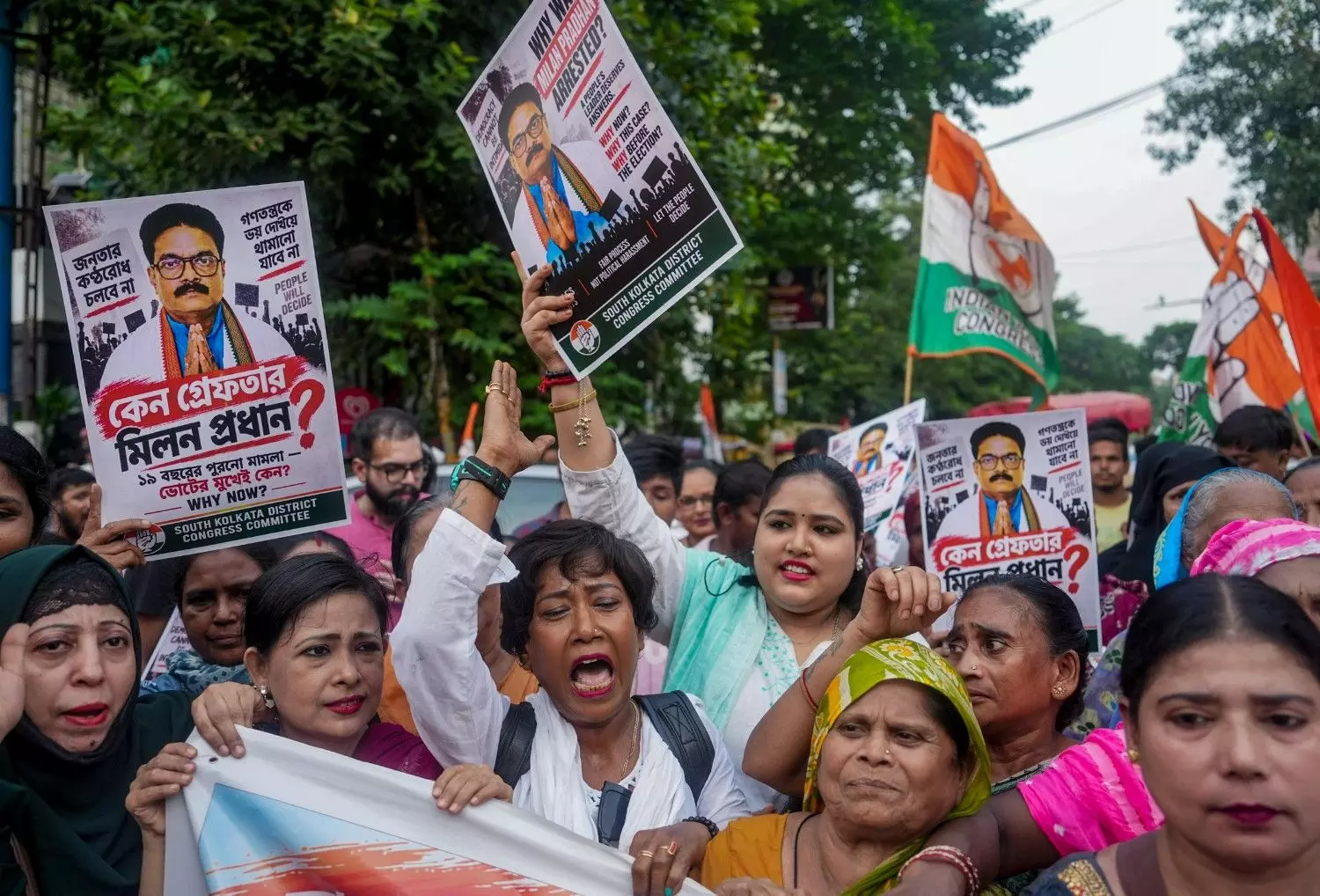
Congress party workers participate in a protest rally against the arrest of party candidate Milan Pradhan for the Nandigram Assembly by-election, in Kolkata, West Bengal, Saturday, September 19. PTI
Milan Pradhan’s arrest: Why 2007 Nandigram land movement protesters feel 'betrayed'
The history and impact of the fight against the 2007 land acquisition movement in Nandigram explain why Milan Pradhan’s arrest has resonated so strongly in the Bengal town

For Abu Taher, the arrest of Milan Pradhan, the Congress candidate for Nandigram Assembly by-election in West Bengal, has brought back memories of a movement that once drew farmers, political workers and ordinary villagers into a common fight against land acquisition in Nandigram.
Taher, one of the founding leaders of the Bhumi Uchchhed Pratirodh Committee (BUPC) (Committee for Resistance Against Eviction from Land), reminisced about how Pradhan was forced to flee his home during the violence that followed the CPI(M)’s November 2007 recapture of parts of Nandigram.
Pradhan had fled when CPI(M) cadres stormed his Sonachura house, dragged out his parents and set part of the house on fire, he recalled.
Also read: West Bengal bypolls: Rejinagar Independent candidate arrested in 2021 clash case
Pradhan escaped through the back door, rode a motorcycle to Nandigram Bazaar and spent the night at a relief camp in Nandigram High School.
In 2007, police firing killed 14
The history and impact of the movement explain why Pradhan’s arrest has resonated so strongly in Nandigram.
The BUPC brought together several political forces, including the Trinamool Congress (TMC) and Congress, as well as sections of the Left and other groups, in opposition to the Left Front government’s plan to acquire farmland for a chemical hub.
The resistance began in January 2007 and soon turned Nandigram into the site of a prolonged confrontation between villagers, anti-acquisition groups, the administration and CPI(M) cadres.
On March 14 that year, police firing during an attempt to regain control of Nandigram killed 14 people. The violence continued for months, including the CPI(M)’s armed return to parts of the area in November.
Suvendu Adhikari’s rise within TMC
The movement subsequently became one of the defining political battles that helped Mamata Banerjee challenge the Left Front and contributed to the TMC’s victory in 2011, ending 34 years of Left rule.
Also read: TMC symbol row: SC to hear Mamata’s urgent plea over party name, symbol freeze
It also played a major role in Suvendu Adhikari’s rise within the TMC, making Nandigram central to the political trajectories of both Banerjee and Adhikari.
Almost two decades later, Pradhan is again at the centre of the Nandigram story following his arrest on September 18 on four pending non-bailable warrants in cases dating back to the 2007 anti-land-acquisition movement.
Those old cases have remained one of the unresolved legacies of the movement.
According to police records, FIRs had been filed against 2,325 people in cases related to the Nandigram anti-land-acquisition agitation. Many of those accused were facing more than one case.
Political significance of Pradhan’s arrest
Pradhan’s arrest assumed added political significance as it came just days after Banerjee announced that her faction of the TMC would support Pradhan’s Congress party in the October 6 bypoll in Nandigram in East Midnapore district.
Taher told The Federal that the arrest was unfortunate and said the irony was that it had been Adhikari’s stated position that Nandigram-related cases should be withdrawn.
He appealed to Adhikari, now the chief minister and home minister of Bengal, to set aside political differences and take the initiative to withdraw the pending cases, recalling that “we all jointly took part in the movement.”
He said Adhikari had himself taken the initiative to withdraw the pending cases when he was in the TMC. But, according to Taher, some cases were revived after Adhikari joined the BJP in 2020 following a PIL filed by a BJP leader.
The reference was to BJP leader Nilanjan Adhikari, who challenged before the Calcutta High Court the Banerjee government’s decision to withdraw cases lodged during the movement.
His petition referred to cases involving 63 accused who were then members of the TMC, Congress and BJP. Both Taher and Pradhan were among those named as accused.
Political divisions exposed
The revival of the old cases had even then exposed political divisions among those who once fought together against the proposed SEZ project that involved acquiring fertile farmland.
BJP’s Ananda Mandal, one of the 63 accused, had then accused his own party leader, Adhikari, of having “betrayed” the movement and the people of Nandigram.
“I never thought a leader of my own party would put us in trouble and even shame the movement like this,” Mandal had alleged then.
Pradhan’s arrest once again revived the sense of betrayal, with many in Nandigram voicing their disquiet in hushed tones, while some openly accused Adhikari of turning his back on the movement of which he was an integral part.
Former protesters feel ‘betrayed’
A few former protesters who still face cases, speaking on condition of anonymity, said they felt “betrayed” by Pradhan’s arrest, insisting that those who had fought together against land acquisition should not be left to face the consequences alone simply because the political paths of the movement’s prominent leaders had since taken different courses.
“It was a big letdown for the movement that helped Adhikari reach where he is today. Reviving an old case against someone out of political vindictiveness is a disservice not only to the movement but also to those who gave their lives to protect the farmland,” said Tabrikul Islam, who was one of the prominent faces of the anti-land acquisition movement in Nandigram and a local TMC leader at the time.
Islam, who is now the Congress’s East Midnapore Minority Department chairman, said Pradhan’s arrest had rejuvenated the party and claimed that Congress would perform strongly if the election was free and fair.
He said the people of Nandigram, who had overwhelmingly fought for their land rights, felt cheated by the development.
Manoranjan Manna, another veteran of the agitation who claimed to have faced 27 cases, said Pradhan and Adhikari had both been active in the movement and that the arrest could send a wrong message to those who took part in the Nandigram struggle and still have cases pending against them.
Now largely away from active politics, Manna said he had secured bail in some of the cases, while most of the charges against him had been dismissed.
BJP leader defends police action
BJP leader Ashok Karan, who also participated in the Nandigram movement, however, defended the police action against Pradhan, saying he too faced multiple murder cases for his role in the anti-land-acquisition agitation.
“Since Milan did not take (anticipatory) bail, he was arrested on the Election Commission’s orders. There is no scope for the chief minister to intervene in this case,” Karan said.
Pradhan had been evading arrest since 2007 and was finally arrested based on four long-pending non-bailable warrants, police sources said, adding that the action was taken in accordance with the poll panel’s instructions to execute such warrants during elections.
Congress leader Islam, however, dismissed the police’s version, pointing out that if a non-bailable warrant was pending against Pradhan, why was he not arrested when he went to file his nomination in the full presence of the police and district administration.