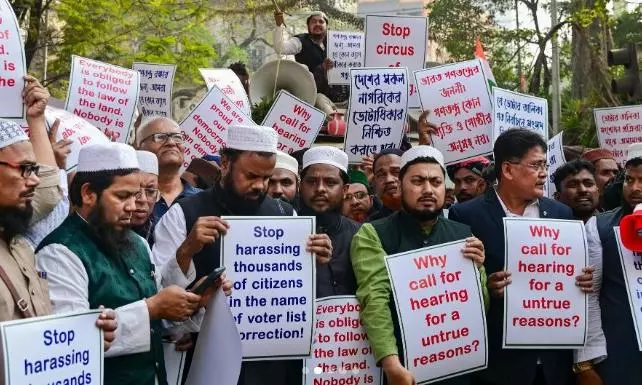
Members of the Muslim community participate in a recent protest march against the ongoing special intensive revision (SIR) of electoral rolls in West Bengal, in Kolkata: For the TMC the central challenge in the upcoming 2026 state assembly elections, is no longer mobilisation of minority votes, but its retention
Muslim voters in flux ahead of 2026 Bengal polls as SIR fuels fear
Uncertainty over voter roll revision, political fragmentation, rising polarisation may reshape minority voting behaviour possibly altering Bengal's electoral math

The Muslim electorate, which accounts for nearly 30 per cent of West Bengal’s population, is in an unprecedented state of flux.
Concerns over procedural ambiguity and fears of disenfranchisement arising from the SIR of voter rolls, coupled with growing political fragmentation and rising communal polarisation are emerging as key factors that may influence the Muslim community’s voting behaviour in the upcoming crucial West Bengal assembly elections.
BJP shuns Muslim support
The Bharatiya Janata Party (BJP), the principal challenger to the ruling Trinamool Congress (TMC), appears to have largely written off Muslim support in the state.
Instead, it has focussed its campaign on issues of identity, migration and voter list integrity, a strategy that political observers suggest is aimed at consolidate support among Hindu voters, who constitute nearly 70 per cent of the electorate.
Further, the BJP leaders argue that the SIR exercise is essential to identify and remove Bangladeshi Muslims and Rohingya illegal migrants, whom they allege have flooded the electoral rolls, though no official data substantiates these claims.
Also read: Amartya Sen flags SIR issues: Undue haste, possible ‘class bias’, ‘faulty arrangement’
Moreover, senior West Bengal BJP leader Suvendu Adhikari recently remarked that “Sabka Saath, Sabka Vikas wasn’t necessary in Bengal, as Muslims generally do not vote for the BJP.”
To further underscore the purpose of the exercise, he employed a vivid metaphor, saying, “Carbolic acid has been poured in the pits to drive out the snakes who will be caught and deported. The EC has applied the right medicine through the SIR”, referring to the EC’s stated role to flush out alleged illegal infiltrators.
Adhikari, along with several other BJP leaders, has repeatedly claimed that the ongoing SIR exercise would remove over one crore illegal Muslim migrants from the voters’ list.
SIR-induced factors
Such statements and rhetoric have intensified fears of disenfranchisement among minority communities, a concern reflected in violent protests against the SIR in some Muslim-majority areas, including Farakka in Murshidabad district and Chakulia in North Dinajpur.
Highlighting these concerns, Congress leader Ranajit Mukherjee observed that the fear surrounding the SIR exercise could further drive Muslim voters closer to the TMC. The Congress and the CPI(M) have often alleged that the developments surrounding the SIR are intended to reinforce the TMC-BJP binary.
The consolidation of minority votes triggered by SIR could simplify what might otherwise be a more complex challenge for the TMC to secure overwhelming support from the community this time.
Also read: Bengal SIR on the boil as EC seeks criminal case against TMC MLA over vandalism
Since coming to power in 2011, the party has secured an overwhelming share of Muslim votes, often exceeding 90 per cent in minority-dominated constituencies. That dominance, analysts say, can no longer be assumed.
Disquiet over the changes to the state’s OBC classification following court directives, and a broader sense of political fatigue have created space for alternative claimants to minority support.
Alternative options for minorities
One such figure is Humayun Kabir, a former Trinamool leader who has emerged as a prominent voice seeking to represent Muslim political aspirations through his Janata Unayan Party.
Kabir, a Bengali-speaking Muslim with influence in parts of Murshidabad, has sought to capitalise on local grievances against the TMC’s leadership. His rise, however, is tempered by allegations of past proximity to the BJP, an association that critics argue could undermine his credibility among Muslim electorates.
Other parties are also seeking to regain or expand minority footholds.
The Indian Secular Front (ISF) has stepped up its outreach in pockets of South Bengal, while the Congress, long marginalised in the state, has shown renewed activity in Malda and adjoining districts.
Efforts by Congress, AIMIM
The Congress’s effort has been energised by the recent return of Mausam Noor, niece of former Union minister Gani Khan Choudhury, who resigned as a TMC Rajya Sabha MP and rejoined the Congress.
Her move has revived organisational momentum in a region where the Congress still retains pockets of influence tied to Gani Khan’s legacy. Mausam Noor claimed that she rejoined the grand old party “to work along” the secular ideology of her uncle, emphasising that she would “work as a member of the Congress family to strengthen the party while upholding my uncle’s legacy”.
Also read: SC directs EC to display SIR discrepancy lists at West Bengal panchayat offices
Muslim-centric parties, on the other hand, are attempting to benefit from the deepening polarisation.
The All India Majlis-e-Ittehadul Muslimeen (AIMIM), led by Hyderabad MP Asaduddin Owaisi, has expanded its organisational footprint in districts such as Murshidabad and North 24 Parganas.
From the six seats it contested in the 2021 assembly elections, the AIMIM is now planning to field candidates in around 100 constituencies for the 2026 polls.
While AIMIM has succeeded in mobilising sections of the electorate, particularly Urdu-speaking Muslims and younger voters, its limited penetration among rural Bengali-speaking Muslims has limited its broader appeal.
Rising Muslim assertion
This political churn has unfolded against a backdrop of rising Muslim assertion, partly fuelled by communal tensions.
Murshidabad has witnessed sporadic violence in areas such as Shamsherganj, linked to protests over the Waqf (Amendment) Bill, while Beldanga saw unrest following demonstrations over the death of a migrant worker in Jharkhand.
State authorities have described these incidents as localised, but Opposition leaders and civil society groups say they reflect an increasingly polarised environment influenced by political narratives.
A 17-member fact-finding team comprising Feminists in Resistance (FIR), Association for Protection of Democratic Rights (APDR), Nari Chetna, Committee for the Release of Political Prisoners (CRPP), and Gono Songram Moncho observed that the Shamsherganj violence was “politically motivated” rather than a mere communal clash.
Analysts say that the implications for the 2026 election remain unclear. Heightened polarisation could push Muslim voters to consolidate tactically behind the strongest anti-BJP candidate in each constituency, which in most cases continue to be the TMC.
At the same time, the proliferation of minority-focussed parties and independent leaders raises the prospect of vote fragmentation in closely contested seats, a dynamic that could benefit the BJP even without significant Muslim support.
As Kolkata-based political analyst Nirmalya Banerjee pointed out, “The BJP does not need Muslim votes to improve its seat tally if the minority vote fragments. For the TMC, the central challenge is no longer mobilisation, but retention.”