








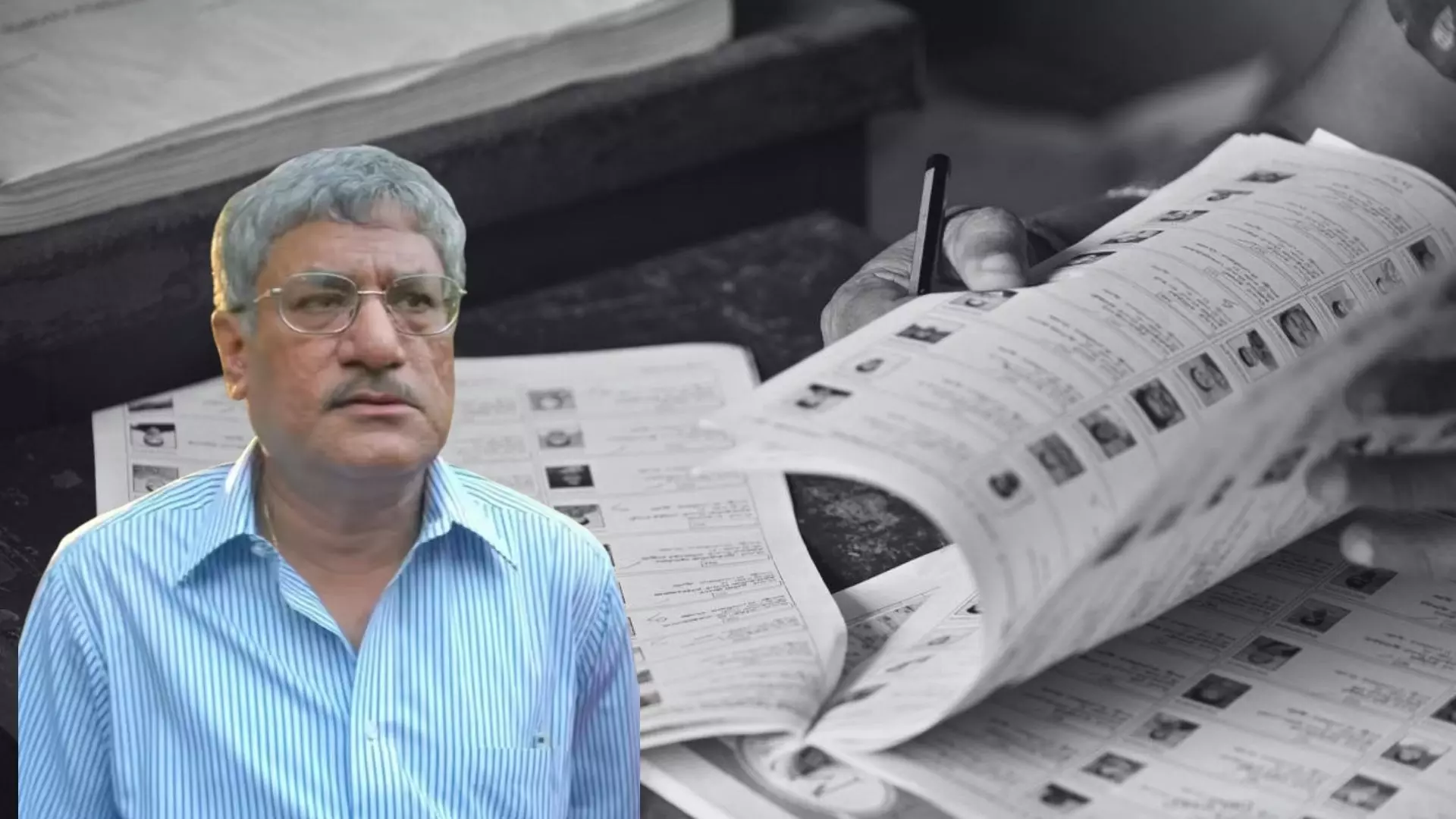
Bengal SIR: How did a former IPS officer's name vanish from voter list? | Interview
Prasun Mukherjee, former Kolkata Police Commissioner and retired IPS officer, receives an SIR notice. What does it reveal about voter verification in West Bengal?

The Federal spoke to Prasun Mukherjee, former Kolkata Police Commissioner and retired IPS officer, after he received a notice under the Special Intensive Revision (SIR) of electoral rolls in West Bengal.
Also read: Is SIR undermining voter rights in Bengal? | Jawahar Sircar interview
Despite decades of voting and public service, Mukherjee discovered his name was missing from the 2002 electoral roll. He explains what he found, why it surprised him, and what the process could mean for ordinary voters.
When did you receive the SIR notice questioning your voter status, and what was your immediate reaction?
I received the notice about two weeks ago. A booth-level officer came to my house with the form. What surprised me initially was that my wife’s name was still there, even though she has passed away. The names of my elder son and his wife, who are settled in Vancouver and have taken Canadian citizenship, were also present.
At present, only two of us live here — myself and my younger son, Ranjit Mukherjee. I pointed this out to the officer, and she said the list would be corrected after verification and republication. When the revised list came out, and we checked online, we found that our entire family’s names were gone.
What was more startling was that houses on both sides were listed, but our house — DL 183 — was completely missing, along with all voters registered here. That was genuinely surprising.
Also read: UP SIR row: Akhilesh Yadav accuses EC of deleting PDA votes, favouring Centre
Your name was missing from both the Bodyguard Lines and Salt Lake voter lists in 2002. How could this happen to a serving senior IPS officer?
That is exactly the question. In 2002, I was Inspector General of Police, South Bengal Zone. That included North 24 Parganas, Howrah, Nadia, Murshidabad, and other districts. We had shifted here around 2001.
I have voted in every election since I joined service. Before that, we lived at the Bodyguard Lines, where we voted at St. Thomas’ School. When we checked there as well, our names were missing. So, the names were missing at both locations.
This is difficult to understand. The house was never vacant. People were always around. Someone would have been present during enumeration. How could the entire household disappear from the rolls in one year?
You have voted in every election since then, and your son even contested a parliamentary election. How do you explain this contradiction?
I do not have to explain anything. It is for the enumerators to explain. Someone made a mistake.
We have always been around. Election notices came, and we voted. I have voted in every election since 1976. Every time, my name was on the rolls. After one election, someone else would be enumerated next time. That is how the process works.
So how the names went missing and then came back is not something I can explain. That responsibility lies with those conducting the enumeration.
Your son Ranajit Mukherjee contested the 2019 Parliamentary elections after full verification. What does this say about the verification process now?
I am a former government officer, so I will not comment on the credibility of a national institution. I can only state facts.
My son contested the Parliamentary election from Barrackpore. Anyone familiar with elections knows how rigorous the scrutiny process is. Every detail — spelling, documents, finances, affidavits — is checked repeatedly. Even senior leaders file multiple nomination papers because one small mistake can lead to rejection.
He went through that entire process successfully. I am also familiar with elections from the policing side and know how closely the administration works with election officials. Given all that, this notice was more surprising to him than to me.
Does the current verification process place an unfair burden on ordinary citizens?
Yes, absolutely. For ordinary people, it is far more difficult.
Even for us, documents can go missing temporarily. But think of people in villages. During floods or emergencies, people flee with cash or livestock. Nobody thinks about preserving documents. Papers get damaged or lost.
For me, the verification centre is barely 200 metres away. I can go by car. I have my passport and documents. It is manageable. But a rural resident living miles away, or an elderly person, faces enormous difficulty.
You have seen reports of very old people falling ill during this process. Some are mentally distressed. For them, this process is 100 times more difficult.
Do you see this as isolated errors or a deeper systemic problem?
I will not accuse any institution. But this appears to be a systemic issue. These mistakes should not happen at all.
If errors were made earlier, they should have been corrected by the system itself. Instead, citizens are being asked to prove themselves. That is troubling.
(The content above has been transcribed from video using a fine-tuned AI model. To ensure accuracy, quality, and editorial integrity, we employ a Human-In-The-Loop (HITL) process. While AI assists in creating the initial draft, our experienced editorial team carefully reviews, edits, and refines the content before publication. At The Federal, we combine the efficiency of AI with the expertise of human editors to deliver reliable and insightful journalism.)


