BJP’s illegal migrant claim in Bengal falters as SIR finds few dubious entries
ECI's SIR identifies 10.95 lakh untraceable voters, far below 1 crore illegal deletions claimed by state BJP leaders

The BJP’s SIR narrative in West Bengal seems to be faltering, much like its NRC campaign in Assam, as the voter-screening exercise has so far failed to identify the large number of Muslim “illegal migrants” the party had expected in the state’s electoral rolls.
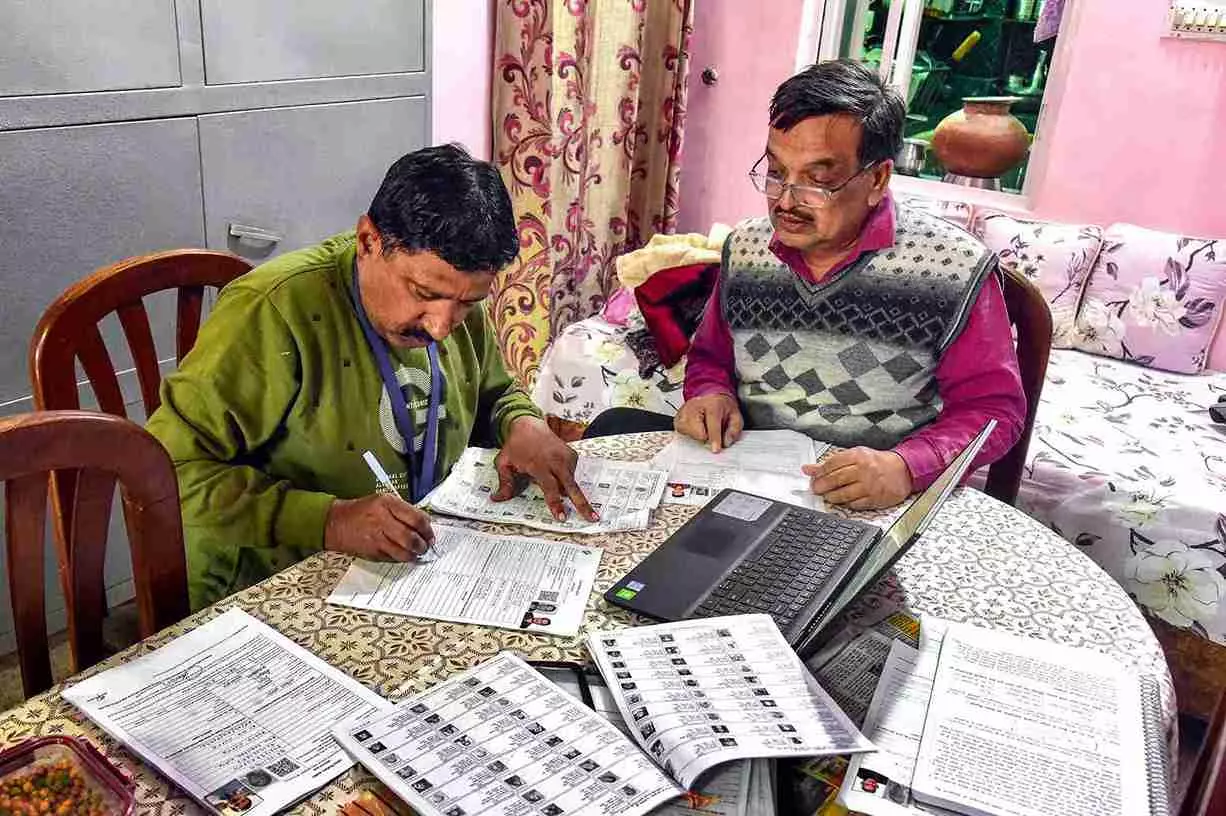
The Election Commission of India (ECI), through the ongoing Special Intensive Revision (SIR) of electoral rolls in the state, has marked over 56.37 lakh voters as “uncollectible” as of the evening of December 8. These uncollectible voters will not make it to the draft electoral roll.
'Untraceable voters'
According to the estimate of the office of the state’s Chief Electoral Officer (CEO), approximately 23.98 lakh of these voters are deceased, 19.65 lakh have shifted addresses, 1.32 lakh are duplicate entries, and 10.95 lakh are untraceable.
Also Read: 'SIR debate' packs no surprises as govt deflects Oppn fire with platitudes
It is evident from the data that the majority of names slated for deletion stem from routine demographic adjustments rather than issues related to citizenship.
Even the category of untraceable voters, numbering just under 11 lakh, represents less than two per cent of the roughly 7.66 crore electors in the state.
No sign of 'purge'
Thus, the proportion of entries that could be considered potentially dubious is small and far below the scale suggested by BJP leaders in public statements. Bengal BJP leaders, in rallies and even in general public discourse, have claimed that more than one crore voters would be deleted, and a significant chunk of these would be illegal Bangladeshi migrants and Rohingyas.
“There are at least one crore illegal Bangladeshi Muslims and Rohingya voters in Bengal, draining our resources. They should be removed from the voter lists,” Leader of the Opposition in the Bengal assembly Suvendu Adhikari claimed recently.
Also Read: EC will announce poll dates right after final voter list to prevent legal challenge: Mamata
Union minister and BJP MP Shantanu Thakur had claimed that the process would purge approximately 1.2 crore “illegal voters.”
Other BJP leaders, such as the current state president Samik Bhattacharya and his predecessor Sukanta Majumdar, have also made similar claims in different fora.
However, the figures available so far suggest that the proportion of entries potentially considered dubious is small and far below the scale indicated by BJP leaders in their public statements.
Critically, only the untraceable or missing voters could potentially be considered as dubious entries, since their identities could not be verified during the door-to-door checks.
Can Bengal mirror Bihar?
Furthermore, ground reports from the SIR process in minority-dominated areas indicated that only a small proportion of these missing voters are likely to be Muslims. Preliminary data suggested that the number of “uncollectible” forms is comparatively lower in districts like Murshidabad, Malda, and North Dinajpur, which have sizeable Muslim populations.
Kolkata recorded the highest number of “uncollectible” forms among all districts, sources said. Within Kolkata, the highest concentration of such voters is in Jorasanko, followed by Chowringhee. Both constituencies have considerable Hindi-speaking voters, a segment where the BJP has greater influence.
Also Read: Biggest anti-national act you can do is vote chori: Rahul in Lok Sabha
To put the development in perspective, over 65 lakh names were left out of the draft roll prepared after the SIR in Bihar, a state with a roughly similar electorate size. BJP leaders had claimed that the number would be much higher in Bengal, as the state shares a long border with Bangladesh.
Although the numbers are still being updated, the final figure in the draft list, to be announced after the enumeration concludes on December 11, is unlikely to exceed Bihar’s by a significant margin. The BJP leaders have already started crying foul, according to political observers, having realised that the exercise is not meeting its expectations.
Modi warns BJP leaders
A BJP delegation led by Adhikari earlier this month submitted a memorandum to the commission, demanding scrutiny of around 1.25 crore voter-list entries reportedly enrolled between November 26 and 28, alleging that an unusually high number of entries were made in a short span. Going a step further, the BJP’s state president Samik Bhattacharya even went to the extent of alleging that the exercise was heavily manipulated.
Also Read: What nation wants to know as govt, Opposition debate electoral reforms
During a recent meeting with Bengal BJP MPs, Prime Minister Narendra Modi reportedly advised them not to communalise the SIR exercise. BJP’s Ranaghat MP Jagannath Sarkar told reporters that the PM had made it clear that discussions on the SIR should not focus on excluding individuals based on their religion.
The BJP had placed considerable political stakes on the SIR, portraying it almost as its own flagship project aimed at identifying illegal foreigners. Many state leaders now privately acknowledge that the strategy may have been flawed and could backfire, much like the widely publicised NRC exercise in Assam.
Dissatisfied
The final NRC draft punched a hole in the BJP’s narrative that illegal Bangladeshi migrants had inundated the state. The number of people unable to prove their citizenship after the rigorous NRC scrutiny was far lower than the party had claimed, and notably, the majority of them were Hindus.
Even the EC is allegedly dissatisfied with the SIR’s outcome so far and has stepped up supervision of the exercise. Around 30 to 40 lakh people who submitted enumeration forms may be required to appear for hearings following the publication of the draft roll, sources said.
Also Read: ECI extends SIR schedule in Kerala by one week due to local body polls
After initial hesitation, the poll panel on December 8 appointed five IAS officers of joint secretary rank as Special Roll Observers to strengthen the monitoring process in all stages until the final list is published.
The move is intended to enhance oversight and safeguard the integrity of the voter rolls, sources added.