SIR hearings trigger Rajbongshi voter anxiety, put BJP on the spot
Loss of official papers due to flooding, migration to other states pose problems during document checks in north Bengal, leaving BJP to address local anger

In north Bengal’s flood-prone plains and border villages, the latest phase of the Special Intensive Revision (SIR) of electoral rolls is posing a new challenge for the BJP, already facing Matua-community unease over the exercise.
Many Rajbongshi families across districts such as Cooch Behar, Jalpaiguri, Alipurduar and parts of Uttar Dinajpur are grappling with SIR-related anxieties as they struggle to navigate bureaucratic demands to prove their eligibility to vote in India.
Also Read: UP SIR exercise: Electoral roll draft on January 6, final list March 6
“I have been under tremendous stress ever since I received the hearing notice. I never thought it would be so important to collect and preserve documents. Now I am running from pillar to post to get the necessary identity papers to prove my domicile here,” said Nila Barman, an elderly Rajbongshi voter from the Natabari assembly constituency in Cooch Behar district.
Long waits for elderly voters
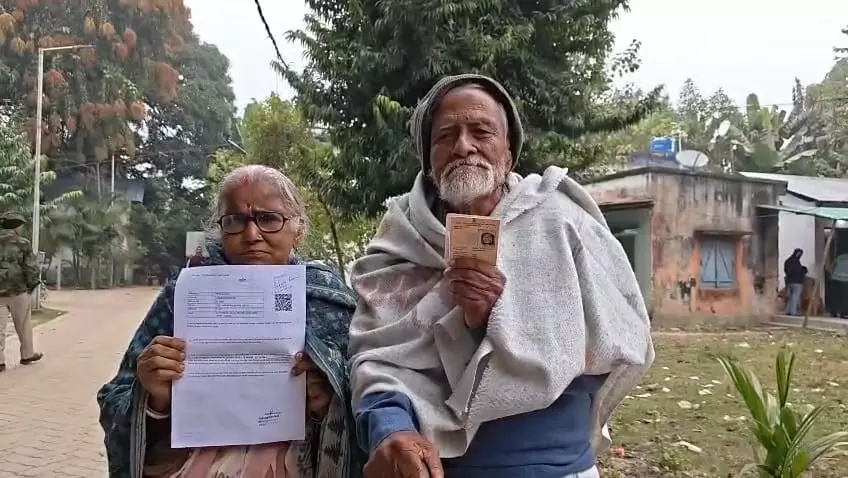
At SIR hearing centres, even elderly voters were seen waiting for hours in queues for their turn, often without seating or shade, only to be told that their documents are incomplete or insufficient.
In several cases, families travelled long distances from remote villages to block offices for the hearing.
“I am here with my 96-year-old husband, Nikhil Chandra Sarkar, who received the hearing notice because his name was unmapped. Despite his ailments, I have had to bring him nearly 8 km from our home to the Dinhata Block I BDO office for this hearing, as he is now expected at this age to prove his credentials as a voter,” said Ava Sarkar, who accompanied her husband to the centre.
The nonagenarian had already survived two strokes and could barely walk.
Scope of current SIR exercise
The latest phase of the SIR, conducted across the state ahead of the 2026 Assembly elections, requires multiple groups of voters to attend hearings, not just those whose names are “unmapped.”
Around 30 lakh voters have been categorised as unmapped, meaning their details could not be linked with the 2002 electoral roll and they are called for verification hearings.
Also Read: EC halts hearings for ‘unmapped’ voters amid SIR exercise in West Bengal
In addition, roughly 1.36 crore entries have been flagged for “logical discrepancies”, such as mismatches in age or family details. They are also summoned to clarify or correct their records.
A recurring problem faced by many during the hearing process is the lack of documents or the loss of documents due to flooding, a familiar reality in north Bengal.
Missing papers
Bisadi Barman, 75, a resident of Purba Chamta in Cooch Behar’s Dinhata subdivision, has found herself in difficulty due to missing official papers.
“I had filed the application linking my name to my brother’s as a relative to establish a connection with the 2002 voter list, but it made no difference. I was still summoned for a hearing at the Sitai BDO office, where I presented whatever papers I had,” she said, adding that she had lost most of her documents, highlighting the strain on voters without proper documentation.
Also Read: Training of 4,600 micro-observers for SIR begins in Bengal
Seasonal floods and river erosion have destroyed homes repeatedly over the years, washing away voter cards, land records and ration cards.
For poorer Rajbongshi households, replacing these papers is neither quick nor easy, and officials’ insistence on documentary proof dating back decades has added to the distress.
“Many voters are struggling because they lack the necessary documents, which means a significant number of names could be left out of the final SIR list,” BJP’s Rajya Sabha MP and prominent Rajbongshi leader Ananta Maharaj said, acknowledging concerns about documentation gaps in the hearing process.
Migration adds to fears
Migration has further complicated matters. Rajbongshi families have long social and marital ties across the Assam-Bengal border, and marriage-related relocation of women, as well as seasonal migration for work, is common.
Several households said male members working outside the state were unable to attend hearings within the limited timeframe, raising fears that their names could be deleted in their absence.
Also Read: Chowdhury meets PM Modi over 'attacks' on Bengali-speaking migrants, Matua concerns
These anxieties have been sharpened by developments in Assam, where members of the Koch-Rajbongshi community have, in recent years, faced scrutiny by foreigners’ tribunals despite long residence.
Maharaj’s remarks spark political storm
It is against this backdrop that Ananta Maharaj criticised the SIR exercise.
In a recent speech delivered in Cooch Behar district, he questioned why long-standing residents should be made to repeatedly prove their origins. His remarks, including controversial references to detention camps, triggered a political storm, forcing the BJP’s state leadership to distance itself from his claims, even as it acknowledged that concerns raised by voters would need to be addressed.
Other BJP leaders from North Bengal also voiced similar concerns over the SIR process, amplifying worries within the party’s state leadership about its implementation and impact.
“During the SIR hearings, legitimate voters’ names are being left out of the list. Furthermore, there is confusion over document requirements, hearing dates and procedures. All these issues have been raised with the electoral officials,” alleged BJP’s Siliguri legislator Shankar Ghosh.
Electoral stakes for BJP
The SIR anxiety among the Rajbongshi community and the outburst by Maharaj are matters of political concern for the BJP.
Mahara’s elevation to the Rajya Sabha was widely seen as part of the BJP’s strategy to deepen its footprint among Rajbongshis, the largest Scheduled Caste group in West Bengal, numbering nearly 40 lakh according to census estimates.
Concentrated heavily in North Bengal, Rajbongshis play a decisive role in multiple assembly constituencies.
Also Read: Mamata Banerjee rejects Amit Shah’s border fencing claim, slams BJP over SIR
Their support, along with that of the Matuas, is considered a key factor in the BJP’s emergence as the principal challenger to the TMC in state politics since the 2019 Lok Sabha elections.
Over the years, the BJP has made calculated efforts to court the community. Ananta Maharaj himself emerged as a crucial intermediary.
That he has now voiced dissatisfaction with the conduct of the SIR process has therefore underscored the party’s dilemma as to how to defend the exercise it supports nationally while managing local fallout among two politically vital constituencies — the Rajbongshis and the Matuas.