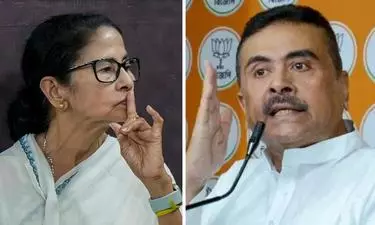
Suvendu revives 1993 police firing report to undermine Mamata’s Martyrs’ Day legacy
The tabling of the 1993 police firing commission report ahead of July 21 has reignited the political battle over the incident that shaped Mamata’s rise in Bengal politics

A day before the Trinamool Congress’s annual Martyrs' Day rally, West Bengal Chief Minister Suvendu Adhikari sought to discredit the political legacy Mamata Banerjee has built around the 1993 police firing.
By tabling in the Assembly the long-pending Justice Sushanta Chattopadhyay Commission report on the 1993 police firing, Adhikari sought to portray Banerjee not as the custodian of the martyrs’ legacy but as a leader who built a political career on their sacrifice while failing to deliver justice to their families after coming to power.
More than a commemoration
The police firing that left 13 Youth Congress workers dead became the defining moment in Banerjee’s political journey, with the anniversary evolving into the TMC's biggest annual political mobilisation event.
Also read | Suvendu's deportation claims: Dhaka ties sink even as numbers don't add up
It is the platform from which Banerjee has reinforced her image as a street fighter who took on the Left Front government.
For her party, the day is more than a commemorative event. It is a reminder of the struggle that eventually brought the party to power in 2011.
Adhikari’s Assembly speech was designed to challenge that narrative without disputing the central fact that the firing was unjustified.
Turning legacy against Mamata
Quoting extensively from the commission’s findings, he accepted its conclusion that the police action was "unnecessary, unprovoked and unjustified."
His argument instead was that Banerjee had failed to honour the very cause that became the foundation of her politics.
Referring to Banerjee, Adhikari said some leaders had used “the emotions of July 21 and the blood of the martyrs” to gain political office, wealth and privilege while leaving the victims’ families without justice.
It was perhaps his sharpest political attack since taking office, aimed at eroding the moral capital Banerjee has drawn from the incident for decades.
The inquiry was constituted by the TMC government after it assumed power in 2011, but its report remained unpublished for years.
Reviving a dormant report
Adhikari repeatedly questioned why a government that had promised justice never placed the report before the Assembly.
By tabling the report now, his government sought to project itself as the one finally bringing the findings into the public domain.
The chief minister also highlighted what he described as a glaring omission in the inquiry. Although the commission examined former bureaucrats, police officers and political leaders, Banerjee herself, who had led the 1993 march, was never called to depose.
Adhikari used this to suggest that important questions surrounding the events of that day had remained unanswered. He promised to implement the commission’s recommendation of Rs 25 lakh compensation for the families of those killed and Rs 5 lakh for the injured, saying the previous government had paid only a fraction of the recommended amounts.
He also said affected families would be free to lodge fresh FIRs with legal assistance from the state, reinforcing the BJP government's broader effort to revisit politically sensitive episodes from the TMC era.
Battle for political legacy
Adhikari announced that reports relating to alleged irregularities in Amphan relief distribution and COVID-19 procurement would also be tabled in the Assembly, signalling that his government intends to keep the previous regime on the defensive.
Also read | ‘Religion is personal, national security first’: Suvendu backs airport mosque curb
The political significance of this year’s anniversary is greater than usual as the legacy has become the subject of a political tug of war.
While the Banerjee-led TMC continues to project the day as the defining moment in her political journey, rival factions that broke away from the party have also announced separate observances, each claiming to represent the original spirit of the movement.
The Congress, where Banerjee was a Youth Congress leader when the 1993 police firing took place, has also planned an expanded commemoration, arguing that the legacy of the martyrs predates the formation of the TMC and was later appropriated after Banerjee split from the party in 1998.