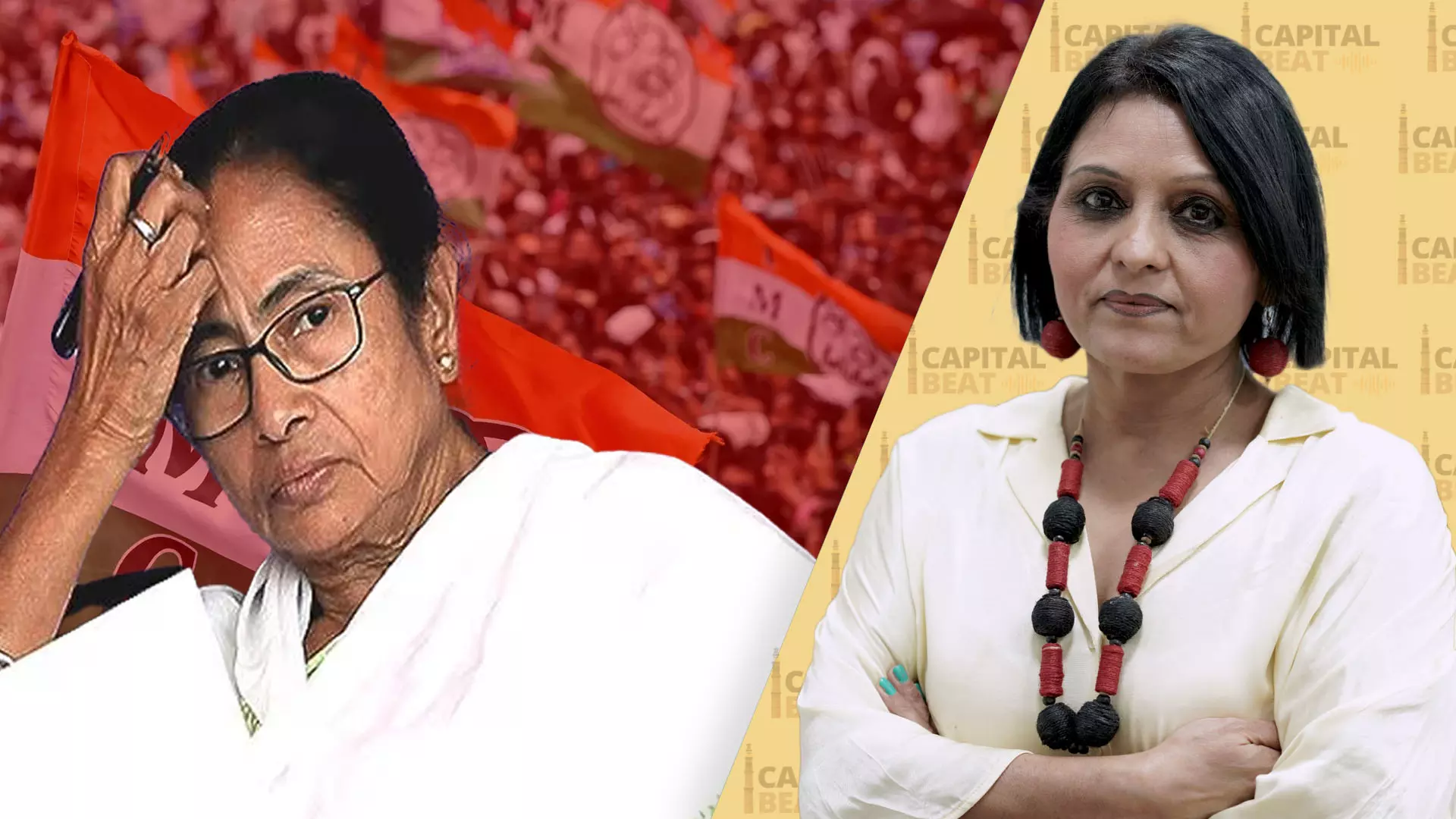
Capital Beat | TMC rebels merge with NCPI: What is the plot and script?
NCPI, a little-known Tripura-based party that once campaigned against turncoats, is now home to 20 rebel TMC MPs; what's the bigger game plan?

In a sharp indictment of the political manoeuvring surrounding the rebel Trinamool Congress MPs, Congress leader and economist Prasenjit Bose called their merger with the Nationalist Citizens Party of India (NCPI) "a complete cynical manipulation of the democratic system", demanding that all dissenting MPs resign from their seats before switching political affiliations.
The development has drawn widespread criticism for what analysts describe as a deliberate misuse of anti-defection provisions and parliamentary rules. In a Capital Beat panel discussion, The Federal brought together Prasenjit Bose, economist and head of the SIR Committee of the West Bengal Congress, TK Rajalakshmi, Associate Editor with Frontline; and Samir K Purkayastha, senior journalist with The Federal to decode the legal, political, and ethical dimensions of this unprecedented merger.
The NCPI, till recently a registered but almost entirely unknown political party based in Tripura, was thrust into national focus when 20 rebel TMC Lok Sabha MPs chose to merge with it rather than directly join the BJP. Purkayastha noted that the party had contested a few seats in Tripura in 2023 and is registered in Howrah, West Bengal, but has no significant political footprint.
He pointed out that even within the NCPI, the merger triggered internal discord — founding general secretary Santanu Dey reportedly told the media that he had not been consulted and would have opposed the move, while party president Shiuli Kundu welcomed it and stated that Dey was no longer part of the organisation.
Also read: TMC pushed to the brink in LS as veteran MP Sudip Bandyopadhyay joins rebels
Purkayastha explained the logic behind the rebels' choice: Directly joining the BJP would have been politically damaging for the saffron party, given that many of the rebel MPs carry court cases, corruption allegations, and accusations of violence against BJP workers after the 2021 Bengal assembly elections.
"For the BJP, it would have been a very bad move to welcome them and take them into the party fold," he said. He further noted that the operation appears to be happening along three tracks — Rajya Sabha members resigning and likely joining the BJP directly, Lok Sabha members parking themselves in the NCPI, and assembly-level rebels claiming to be the real Trinamool Congress.
A script written in Delhi
Bose laid out the sequence of events methodically, tracing the rebellion back to the aftermath of the West Bengal assembly election loss. He said former chief minister Mamata Banerjee had refused to engage with internal accountability demands after the defeat, instead alleging EVM tampering and rigged results. This, he said, triggered the first break — over two-thirds of TMC MLAs parted ways with the parent party, formed a separate group in the assembly, and elected a leader of the opposition different from the one proposed by Mamata and party General Secretary Abhishek Banerjee.
Bose stated that the entire operation was masterminded from Delhi, pointing to the fact that the newly recognised leader of the opposition in the Bengal assembly had met Chief Minister Suvendu Adhikari in Delhi before the split unfolded publicly.
Also read: TMC calls rebels' NCPI merger 'ridiculous', BJP says exodus reflects party's ideological vacuum
"The script was being written in Delhi and it was enacted in the West Bengal assembly," he said. He drew a direct parallel with the Maharashtra model, where a dissenting group backed by the ruling party captured the parent organisation while the original leader was sidelined.
A parking lot, not a party
Bose described the NCPI as a "parking lot" — a temporary vehicle for rebels who ultimately want to align with the NDA but cannot enter the BJP directly for political and organisational reasons. He said the rebels have converted a non-entity into a holding space, allowing them to vote with the NDA in parliament without giving the Opposition legal grounds to challenge the defection.
TK Rajalakshmi agreed with this assessment, noting that rebel MP Kakoli Dastidar had publicly stated the group was looking forward to working with the NDA, making their ultimate destination clear. However, she cautioned that absorbing these MPs into the BJP structure would not be straightforward.
"The BJP fought essentially against the TMC on grounds of corruption, on grounds of violence and various other things. To accommodate them as a collective is not going to be easy," she said. She also flagged the risk of internal BJP resistance, describing the rebels as political competitors in the eyes of BJP candidates who had contested against them.
Ethical breach and anti-defection gaps
The sharpest critique of the merger came from Bose, who argued that the rebels' conduct amounts to a brazen betrayal of their electoral mandate. He pointed to the profile of many rebel MPs — film personalities, sports figures, and individuals with little grassroots political background — who he said treated their TMC candidacy as a career option rather than a democratic responsibility.
Also read: TMC rebel MPs join NCPI to back NDA while also skirting legal hurdles
"Till the results came, they thought Trinamool was a good brand and they were like employees of that brand. Now that brand has crashed overnight and they are looking for alternative employment," he said.
He invoked the example of former TMC MP Sukhendu Shekhar Roy, who resigned from parliament upon deciding to distance himself from the party, as the ethical benchmark the rebels have failed to meet.
Rajalakshmi described the move as "clear brazen political immorality", adding that the rebels had ethically "completely lost it" by continuing to hold parliamentary privileges won under Mamata Banerjee's name and symbol while simultaneously walking away from her.
Demand for reform
Both Bose and Rajalakshmi called for structural reforms to prevent such manoeuvres from recurring. Bose demanded that the anti-defection law be revisited and that a right to recall be introduced into Indian electoral law, allowing constituents to withdraw support from an MP who defects from the party on whose symbol they were elected.
"This is a complete betrayal of their mandate. There should be a demand from all quarters that these people should resign," he said, adding that the Congress was formally demanding the resignation of all rebel MPs.
Also read: Congress: Amit Shah engineered 'illegal' TMC split to build NDA's majority
Rajalakshmi questioned how the rebels would justify the move to the very constituents they represent. Citing rebel MP Saayoni Ghosh's response to reporters in Delhi — that she would answer not to the press but to the people of her constituency — Rajalakshmi said the challenge of accountability remained entirely unresolved.
Purkayastha added that legal experts have flagged the possibility of TMC approaching the courts to challenge the MPs' decision to merge with the NCPI, and that legal complications were, in fact, the primary reason the rebels had abandoned their original plan of floating an independent parliamentary block or claiming the original TMC name and symbol.
(The content above has been transcribed from video using a fine-tuned AI model. To ensure accuracy, quality, and editorial integrity, we employ a Human-In-The-Loop (HITL) process. While AI assists in creating the initial draft, our experienced editorial team carefully reviews, edits, and refines the content before publication. At The Federal, we combine the efficiency of AI with the expertise of human editors to deliver reliable and insightful journalism.)