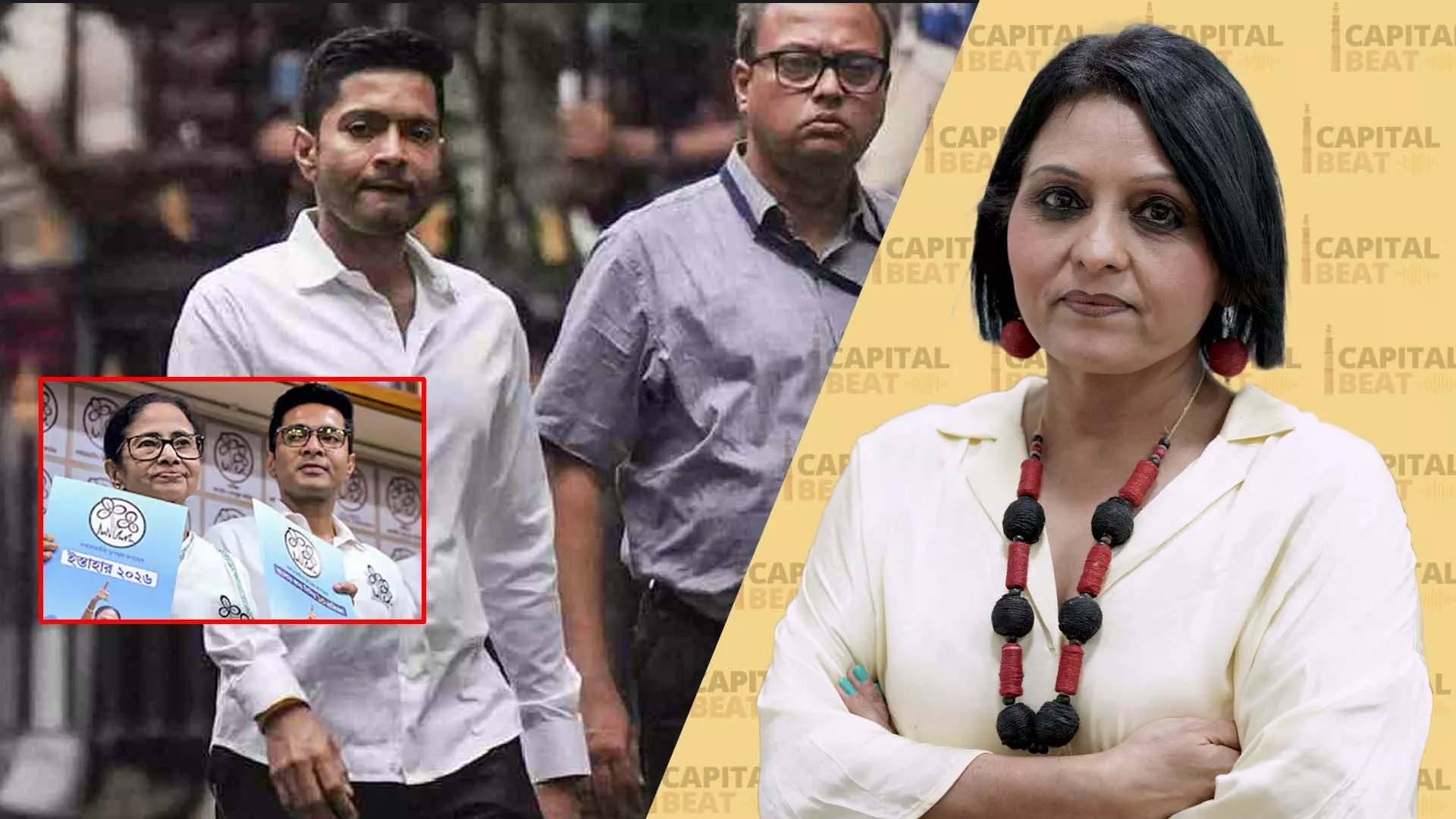
TMC turmoil deepens: Will Abhishek Banerjee face arrest? | Capital Beat
Police searches at Abhishek Banerjee’s residence, rebel faction claims, and growing defections dominate the discussion as TMC faces its biggest crisis

In Saturday's (June 13) Capital Beat discussion on the ongoing crisis within the Trinamool Congress (TMC), party spokesperson Manojit Mondal, political analyst Debashish Chakraborty, The Federal's Samir K. Purkayastha, and West Bengal Congress's spokesperson Chandan Ghosh Choudhury debated the implications of the police search at TMC general secretary Abhishek Banerjee’s residence, the growing rebellion within the party, and the political challenges confronting party supremo Mamata Banerjee.
The discussion centred on claims by TMC's rebel leaders that the number of legislators willing to split from the party has risen significantly, alongside reports that a police team accompanied by central security personnel conducted a search operation at the residence of Abhishek.
Also read: As TMC crumbles, what's next for Mamata and the state forces she fought over the years?
The panel also discussed reports that several MPs and MLAs were exploring the possibility of forming a separate faction while extending support to the ruling BJP at the Centre.
Questions over police search
The discussion began with questions surrounding the early-morning police operation at Abhishek’s residence in Kolkata.
Mondal described the search as part of a pattern of investigations involving TMC leaders.
“This is quite normal as far as BJP coming to power is concerned,” he said.
Mondal referred to previous investigations involving Abhishek and other TMC leaders, noting that several cases had remained unresolved for years despite repeated questioning by central agencies.
Debate over arrest possibility
The possibility of Abhishek facing arrest emerged as a major topic during the discussion.
Also read: TMC’s double coup and Mamata’s silence: Martyrs’ Day will be her last test
Mondal argued that arrests of political leaders do not necessarily translate into convictions and cited examples of TMC leaders who were jailed but later returned to active politics.
“Nothing new in politics in India. People get arrested for all kinds of reasons. They come out and they win elections,” he said.
He maintained that the present controversy should not be viewed in isolation and linked it to broader political developments unfolding in West Bengal.
Rebel camp and shifting loyalties
Attention then shifted to reports that senior TMC figures were meeting BJP leaders amid speculation of further defections.
Purkayastha described the political situation as highly fluid.
“This scenario for the TMC is very fluid now. And who is with whom is very difficult to guess now,” he said.
Also read: ‘Abhishek is like my son’: Kalyan Banerjee strikes conciliatory note
Purkayastha noted that speculation surrounding possible defections had intensified in recent days and suggested that additional MPs and MLAs could potentially leave the party.
He also observed that investigations involving political leaders had become a recurring feature of the political landscape.
Internal criticism within TMC
Mondal criticised decisions taken by the party leadership regarding candidate selection and organisational management.
“I repeat, that is a mistake that the party has made,” he said while discussing the induction and promotion of leaders who later distanced themselves from the party.
He argued that many individuals currently associated with the rebel camp were not longstanding party loyalists.
“Most of these turncoats are deprived self-serving opportunists,” Mondal said.
He also maintained that responsibility for the party’s present difficulties should not be placed solely on Abhishek Banerjee.
Debate over party strategy
The discussion expanded into a broader examination of TMC’s organisational structure and political strategy after its electoral setback.
Mondal acknowledged that the party needed to undertake internal reforms and reconnect with district-level workers.
“The party needs to be reformed,” he said.
He argued that both Mamata and Abhishek should engage more directly with party workers across districts and address concerns among long-time supporters.
The panel also discussed whether organisational weaknesses and leadership decisions had contributed to the current unrest.
Corruption perception and investigations
Purkayastha pointed to the existence of a public perception surrounding corruption allegations against several TMC leaders.
“In public perception, it is there that Abhishek Banerjee and lots of TMC leaders are corrupt,” he said.
At the same time, he questioned the effectiveness of prolonged investigations that do not culminate in convictions.
“If they have solid evidence against him, they should arrest him and then try to get a conviction,” Purkayastha said.
He argued that investigations should produce concrete outcomes rather than continue indefinitely without resolution.
Congress's perspective on TMC’s decline
Choudhury focused on the broader political decline of the TMC following its electoral defeat.
He described the situation as a significant political development and questioned how a party that had previously enjoyed a strong mandate had encountered such rapid organisational challenges.
Choudhury also argued that the TMC’s present crisis reflected deeper organisational weaknesses that had developed over time.
Future of Abhishek
The possibility of Abhishek facing legal action remained a recurring theme throughout the discussion.
Choudhury stated that imprisonment alone would not determine a politician’s future.
“Abhishek Banerjee is facing arrest. He might be going to jail. He might come out again,” he said.
He stressed that the larger issue was the political and organisational condition of the TMC rather than the legal challenges confronting a single individual.
The panel also debated whether the current investigations were related primarily to recent allegations or to older corruption-related controversies.
Ideology versus power
Chakraborty examined the crisis from an ideological perspective. “Because Mamata has lost power,” he said while explaining why many leaders appeared willing to leave the party.
He argued that the developments highlighted the absence of a strong ideological foundation within the organisation.
“It means that TMC as a party was never built on an ideological platform,” he said.
According to him, the movement of legislators and MPs reflected political calculations rather than ideological commitments.
Mamata’s challenge
Chakraborty maintained that Mamata remained the central figure within the party despite the rebellion.
“Mamata should retain her street fighter image,” he said.
He suggested that the TMC chief should focus on rebuilding the organisation and reconnecting with supporters.
Purkayastha echoed concerns about organisational uncertainty, noting that even identifying loyal leaders had become difficult amid ongoing defections.
“The problem with her is now the dilemma she is facing, rather than who is with her? She doesn't know,” he said.
The discussion concluded with attention turning to the expected meeting between rebel MPs and the Lok Sabha Speaker Om Birla, a development that panellists described as potentially significant for the future direction of West Bengal politics.
(The content above has been transcribed from video using a fine-tuned AI model. To ensure accuracy, quality, and editorial integrity, we employ a Human-In-The-Loop (HITL) process. While AI assists in creating the initial draft, our experienced editorial team carefully reviews, edits, and refines the content before publication. At The Federal, we combine the efficiency of AI with the expertise of human editors to deliver reliable and insightful journalism.)