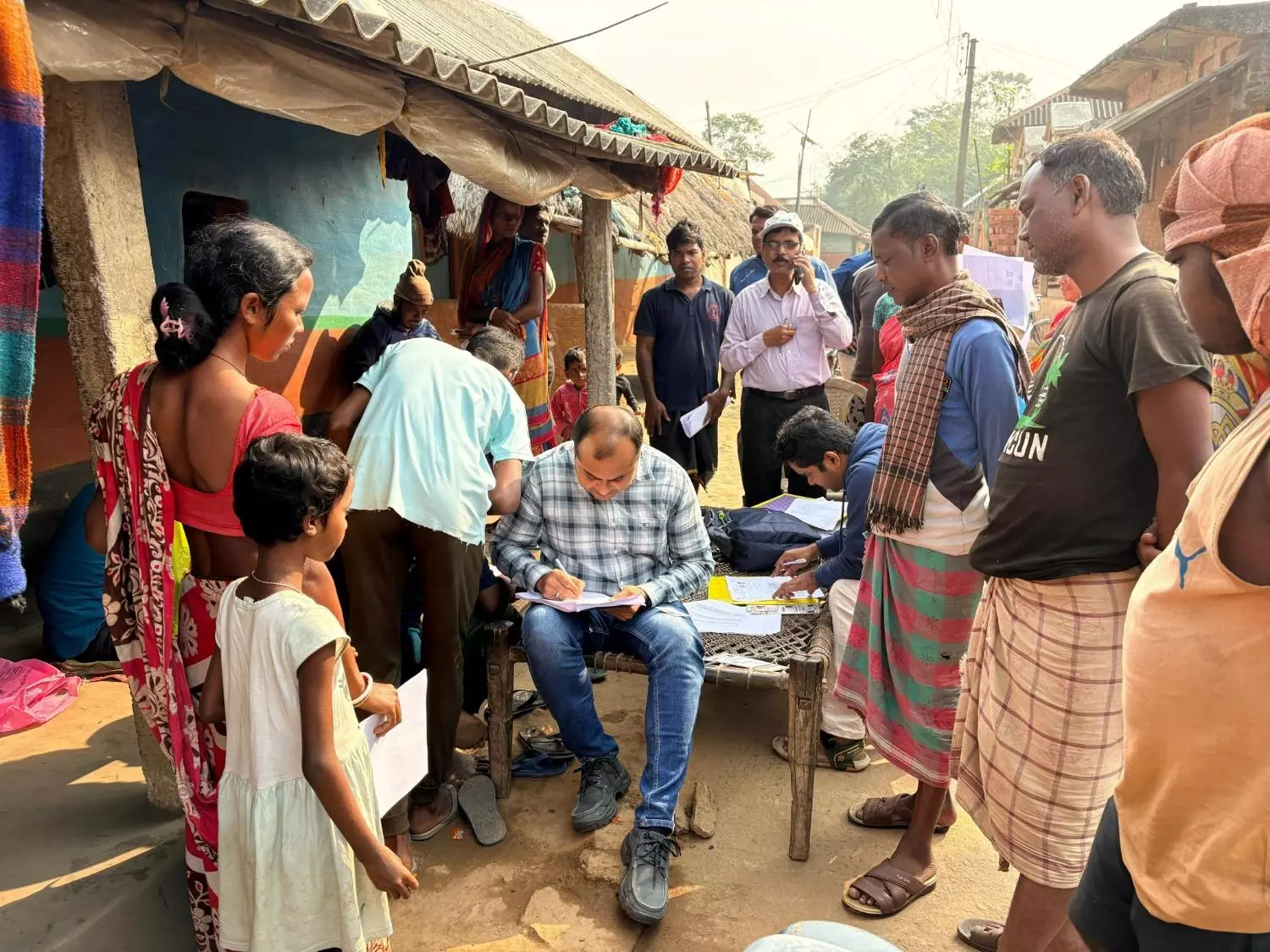
Bengal SIR at tribal village areas of Purulia district: To conduct the verification process, the EC has decided to hear at least 100 voters from each assembly constituency every day, doubling the earlier target of 50. File photo
Bengal SIR under Maoist shadow in Jangalmahal as tribals reject EC exercise
Their argument centres on the belief that they are the “original inhabitants” of West Bengal and therefore do not require separate documentation to establish citizenship or voter eligibility

With the Special Intensive Revision (SIR) of the electoral roll entering its final stage in West Bengal, resistance from several Adivasi-majority villages in the Jangalmahal region has raised concerns of a Maoist shadow over the process.
A large number of residents in parts of Bankura and Purulia have refused to fill their voter enumeration forms, asserting that they are the original inhabitants of the land and need not prove their identity to the state, according to Election Commission (EC) sources.
Claim of ‘original inhabitants’
Their argument centres on the belief that they are the “original inhabitants” of West Bengal and therefore do not require separate documentation to establish citizenship or voter eligibility.
Also read: Bengal SIR: BJP does volte-face, alleges irregularities, seeks probe
The office of West Bengal’s chief electoral officer and the state administration have not officially released any figures on how many residents have so far refused to fill out the enumeration forms to assert their tribal identity.
However, officials privately indicated that the number could run into hundreds, with the strongest pushback reported from Bankura district’s Bheduasole and Muchikata, as well as across Purulia’s Bandwan Assembly constituency, including the villages of Krudabar, Pukurkata, Chirudi, Jorasal and Kaera.
In these pockets, villagers have told Booth Level Officers (BLOs) and local officials that they will not participate in the SIR process under any circumstances.
Also read: Suspended Bengal TMC MLA to hold Quran recital after mega Gita event in Kolkata
The administration’s extensive outreach has so far failed to persuade them to change their mind, EC sources said.
Police teams that visited affected villages last week also encountered firm refusal.
Documents issued by ‘Samajwad Antarastriya Majhi Sarkar’
The refusal has triggered political as well as security alarms, especially given Jangalmahal’s history. During the Left Front regime, Maoists had expanded their influence in these same districts by tapping into deep-seated grievances and alienation of a section of the villagers.
Police are particularly alarmed because many of these villagers have obtained identity documents issued by the ‘Samajwad Antarastriya Majhi Sarkar’, a self-proclaimed authority that describes itself as a traditional tribal government and issues its own identification cards, which they claim are sufficient proof of tribal identity.
The organisation was founded by freedom fighter Kangla Manjhi to protect the rights of impoverished tribal communities and to act as an unarmed ‘sainik’ force for justice, representing an alternative form of self-governance against exploitation.
The organisation is also active in certain tribal pockets of Odisha and Chhattisgarh, according to police sources.
“We are aware of this anti-SIR campaign, and it is only confusing people. We will certainly protest if Adivasi rights under the Constitution are ignored, but this campaign doesn’t seem grounded in facts,” Ratanlal Hansda, a leader of the apex tribal body, the Bharat Jakat Majhi Pargana Mahal, told The Federal.
What TMC leaders said
Leaders of the ruling Trinamool Congress (TMC) say the current resistance resembles past Maoist mobilisations.
“This is not organic. It has a clear pattern,” said Gangaram Murmu, Trinamool’s ST cell president in Bankura. “People have been systematically influenced to reject constitutional processes. The signs are worrying.”
Police officials say they are investigating possible involvement of extremist groups and are examining the circulation of Majhi Sarkar identity cards, along with potential connections to networks in Odisha and Chhattisgarh.
“Someone is certainly orchestrating this. The scale of coordinated refusal cannot be ignored,” said an official.
“Decades of deprivation have deepened the villagers’ distrust of electoral processes,” said Bipinbihari Besra, a functionary of the ‘Majhi Sarkar’ in Bandwan.
The Federal had reported in July that Maoist groups were on the lookout for bases in West Bengal’s Jangalmahal region following a series of setbacks they suffered in Chhattisgarh.