In Arunachal Pradesh, a law that had remained dormant for nearly five decades has become the centre of an emotionally charged debate, fuelling anxiety, political calculations and growing mistrust between communities that have largely coexisted peacefully for generations.
The Arunachal Pradesh Freedom of Religion Act (APFRA), passed in 1978 but never implemented due to the absence of rules, is now back in focus after the state government moved to frame guidelines for its enforcement after a Gauhati High Court directive.
At the heart of the controversy lies a deeply sensitive question: where does the line between protecting indigenous traditions and safeguarding religious freedom truly stand?
Politically delicate
The law prohibits religious conversions carried out by force, inducement or fraudulent means and prescribes punishment, including imprisonment of up to two years and a fine. But despite being enacted by the first Arunachal Pradesh Assembly under the then Janata Party Chief Minister Prem Khandu Thungon, successive governments avoided enforcing it.
At the time the law was passed, Christianity had only a small presence in the state, accounting for less than 5 per cent of the population. Over the decades, however, the religious landscape changed dramatically. Census figures show the Christian population crossed 30 per cent by 2011, while several local estimates now place it above 40 per cent in some areas.
That demographic shift turned the law into a politically delicate issue. For years, Congress governments and later BJP-PPA coalition administrations chose not to touch the Act, fearing social unrest and alienation of the growing Christian population, which today forms a significant social and political bloc across Arunachal Pradesh.
PIL seeks implementation
But the issue resurfaced after a public interest litigation (PIL) filed in the Gauhati High Court sought implementation of the law. In September 2024, the court directed the Arunachal Pradesh government to frame rules within six months.
Around the same period, Union Home Minister Amit Shah reportedly assured the delegations of the Indigenous Faith and Cultural Society of Arunachal Pradesh (IFCSAP) that the Centre supported steps to operationalise the law.
Since then, the BJP-led government under Khandu has found itself walking a political and social tightrope. The Chief Minister has repeatedly maintained that the law is not aimed at any religion.
“We want people not to misinterpret this. This is not against any religion. It is meant to protect the traditions and culture of our indigenous communities,” he said recently. The state government has also formed committees and held consultations while trying to calm tensions surrounding the issue.
Yet, apprehension continues to grow, particularly among sections of the Christian community.
Christians up in arms
Many Christians fear the law could eventually be used selectively or become a tool to create pressure on religious minorities.
“This is not just about a law. For us, it feels like our faith is being questioned,” said Tarh Miri, president, Arunachal Christian Forum (ACF). “People are worried about what may happen once it is enforced,” he said.
The ACF has emerged as the strongest voice opposing the law’s implementation. Tarh Miri has openly demanded that the Act be repealed. “We have said it clearly — this Act must go,” Miri said. “It is discriminatory, and it targets our community. It interferes with our right to practise and propagate religion,” he said.
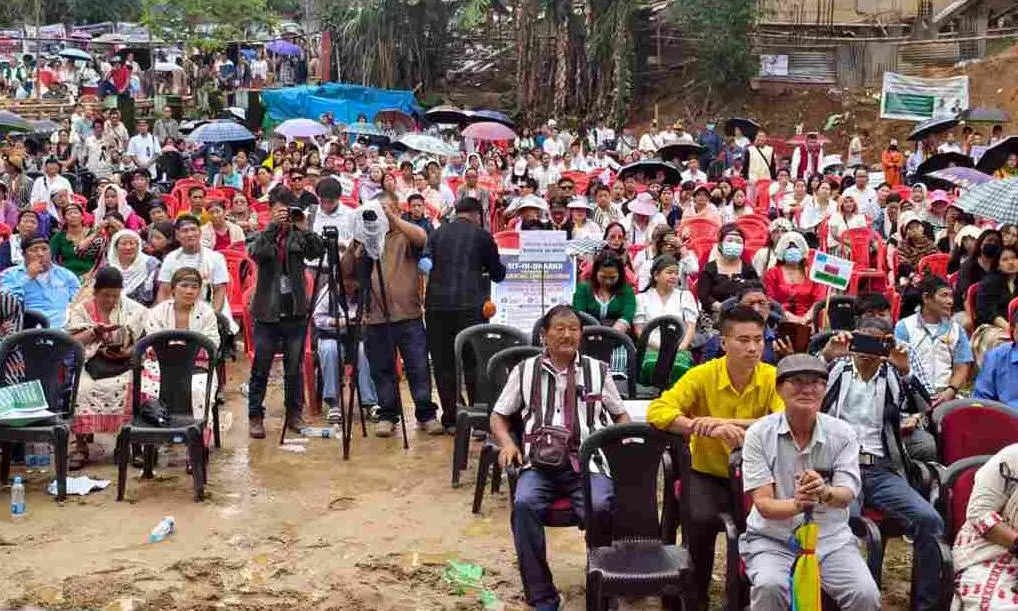
The ACF has already organised protests across the state, including a major rally earlier this year. It also called for a statewide protest on April 30 and May 5, refusing to participate in a High Power Committee (HPC) constituted to discuss the rules.
“We cannot be part of a process where our primary concern is ignored,” Miri said. “We asked for repeal or major changes, but the government is proceeding without addressing those concerns,” Miri also said.
Long-overdue safeguard
On the other side of the debate, indigenous faith organisations insist the law has been misunderstood and unfairly projected as anti-Christian. For groups representing Donyi-Polo practitioners and followers of other indigenous tribal faiths, the law is seen as a long-overdue safeguard for cultural survival.
Emi Rumi, president of the Indigenous Faith and Cultural Society of Arunachal Pradesh (IFCSAP), has strongly backed the implementation of the Act. “For us, this is about survival,” he said. “APFRA is the only legal protection available for indigenous faiths, traditions and culture. Every delay weakens that protection,” Rumi said.
Rumi rejected allegations that the law targets Christians. “This is not against Christianity or any religion. It is only against forced or induced conversions. That is clearly mentioned in the Act,” he said.
He argued that fears surrounding the law were exaggerated and politically amplified. “The Act already exists. It has not been struck down by any court. Even without rules, people can approach authorities. Proper rules will only make the process clearer,” he added.
Gods and myths
Behind the legal and political debate lies a much deeper concern among indigenous communities — the fear of losing traditional identities rooted in tribal customs, oral traditions and nature-based belief systems.“Our gods are not myths,” Rumi said. “If we do not act now, we may slowly lose our traditions and identity.”
He also questioned why opponents were resisting implementation politically instead of legally challenging the Act. “If someone believes the law is unconstitutional, they should challenge it before the courts. Why oppose it only through protests?” he questioned.
The issue has become even more politically sensitive because religion and electoral arithmetic increasingly overlap in Arunachal Pradesh.
BJP's balancing act
The BJP currently enjoys a commanding majority in the 60-member Assembly, winning 46 seats in the 2024 elections. But the party’s support base cuts across tribal identities, including indigenous faith followers, Buddhists in western Arunachal and a sizeable number of Christian tribals.
Several of the state's 17 incumbent Christian MLAs, including those from the BJP, have either opposed or expressed discomfort over the implementation of the Act. However, with its strong majority and support from indigenous faith groups, the BJP leadership appears confident about moving ahead while attempting to balance outreach to Christian communities through assurances and development politics.
Political observers believe the BJP’s approach reflects a larger ideological position seen elsewhere in the country — emphasising protection of indigenous and traditional identities while taking a tougher stand against alleged forced conversions.
At the same time, the saffron party is aware that alienating Christian tribals entirely could carry electoral risks in the future.
In 2018, there were discussions within the state government about repealing the Act, reportedly to avoid upsetting Christian voters. But the proposal never moved forward, and the party later shifted towards implementing the law amid pressure from indigenous organisations and ideological affiliates.
The renewed assertion of indigenous faith identity in Arunachal Pradesh has also played a major role in reviving the debate.
Reviving traditions
Over the past decade, there has been a visible push to revive and institutionalise traditions such as Donyi-Polo (centres on the reverence of the Sun (Ane Donyi) and Moon (Abu Polo) as deities) with prayer centres, cultural campaigns and community mobilisation gaining momentum in several districts.
For many indigenous groups, this is viewed as a cultural renaissance aimed at preserving disappearing traditions. Critics, however, fear such movements could deepen social divisions if linked too strongly with political narratives.
Despite the sharp rhetoric on both sides, protests so far have remained peaceful. Yet, many residents worry about the long-term social impact if mistrust continues to grow. “We have always lived together peacefully,” said Boney Tirkey, a school teacher from Namchai. “Now there is a feeling of suspicion creeping in. That is what worries people.”
Fragile social balance
Lina Gambho from Pasighat echoed similar concerns. “This is a sensitive state with many tribes and communities. If any decision is seen as favouring one side over another, it can create tension later,” she said. For the Arunachal Pradesh government, the challenge now is not merely legal implementation of an old law, but managing a fragile social balance in one of India’s most diverse frontier states.
It is not clear whether the government will comply with the Gauhati High Court’s directive to frame the rules or repeal the act, responding to pressure from Christian groups.
For now, the rules under the APFRA are finalised but they are yet to be formally notified. But even before implementation, the debate has already transformed public conversations across Arunachal Pradesh — raising difficult questions about identity, faith, political power and the future of coexistence in a rapidly changing society.