Shocking accounts of alleged sexual abuse, violence and bonded labour in a brick kiln in Saharsa in Bihar have emerged after 47 workers from Assam’s Dhubri district were rescued by the Bihar Police.
Survivors have come forward to recount disturbing allegations of systemic sexual abuse, physical violence, and bonded labour, arousing suspicions of organised exploitation.
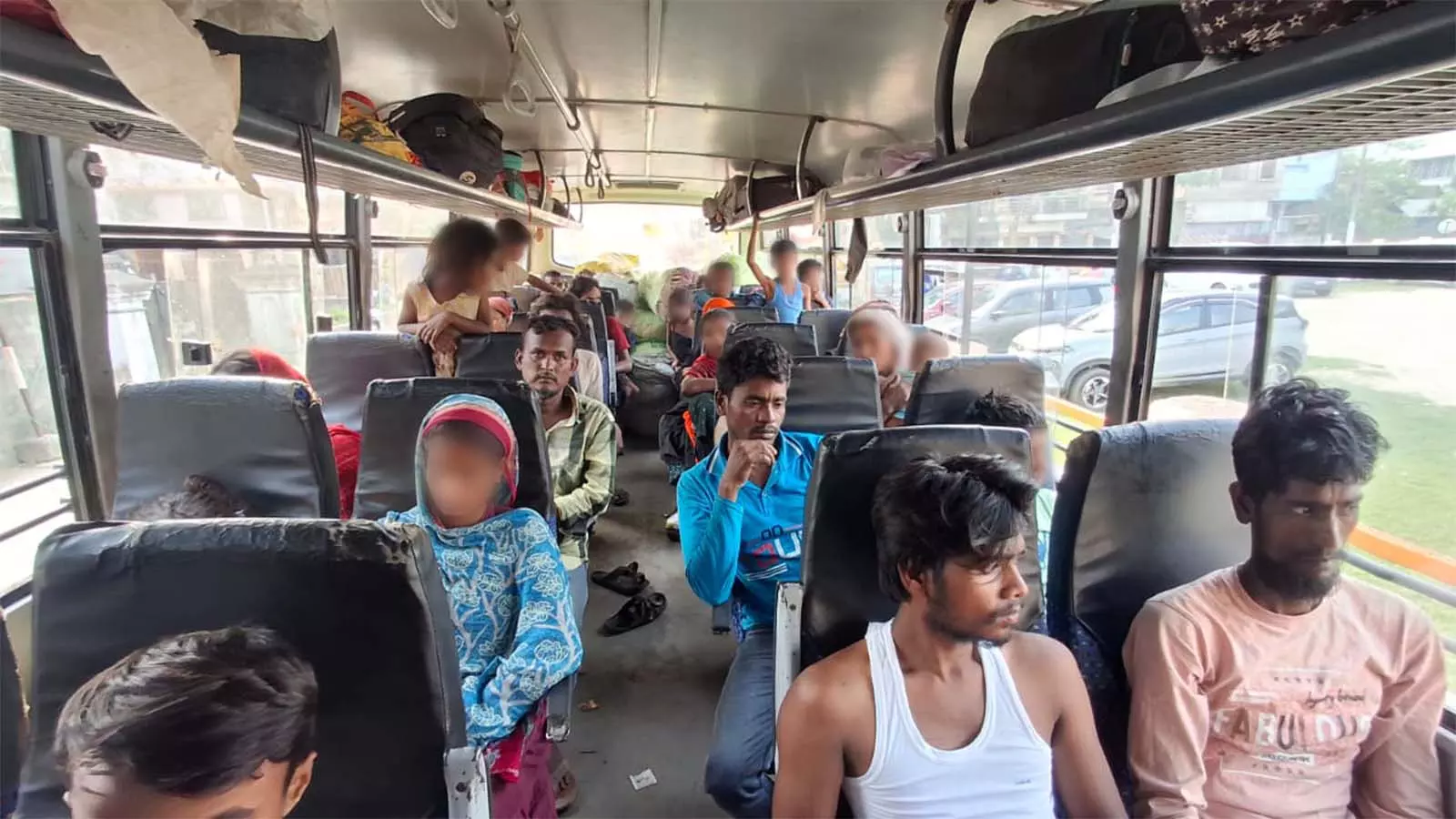
The labourers — including women and children — were brought back to Assam on Monday (April 13), after Saharsa police conducted a rescue operation in Star Marka brick kiln in Dhamsaini village under Kahara block. The workers from Assam were then transported in buses to Dhubri and handed over to the authorities.
Bullet injury
The case came to light only after a woman sustained a bullet injury inside the kiln, triggering police action.
Deputy Superintendent of Police Om Prakash said, “I received information that a woman had been shot inside the brick kiln. We rushed to the spot and rescued her. She was shifted to a private hospital, and a case was registered based on her husband’s complaint.”
Police subsequently arrested kiln owner Md Owais Qarni, also known as Chunna Mukhia, along with his associate Amit Kumar. Both have been sent to judicial custody, and further investigation is underway, with more charges likely to be added.
Horrific stories of abuse
What has emerged from the testimonies of the rescued workers points to a deeply disturbing pattern of abuse.
Refaz Ali, a labourer from Airanjongla village in Dhubri, said, “We went there to earn money, but we were trapped. We were not paid anything and were treated worse than animals.”
Describing the conditions, he added, “We were forced to wake up at 2 am and work till late. If we refused, they threatened to kill us using excavators. My uncle was tied to an excavator machine and given electric shocks. He somehow managed to escape.”
Several survivors alleged that women and minor girls were systematically targeted. “They would come drunk and take away minor girls. If anyone protested, they were beaten brutally. We were living in constant fear,” Refaz said.
He also recounted the incident that led to the exposure of the kiln. “Last night, at 2 am, they called me and asked for my wife and daughter. When they refused to follow their orders, they shot my wife in the leg. I do not even know where they took her,” he said.
Another labourer, Ali Sk, echoed the allegations. “They used to take girls by force. We could not stop them. If we tried, we were tortured,” he said.
No dignity, no freedom
Another worker, Kasemuddin, said, “We were beaten every day and forced to work without rest. There was no dignity, no freedom.”
Chandra Banu added, “We did not get proper food or shelter. We were just surviving somehow.”
One of the most disturbing claims was that a young girl was burned with a cigarette for refusing to dance, pointing to the extent of cruelty in the camp.
Officials said seven minor girls rescued from the kiln are currently lodged in a government children’s home in Saharsa, where they are being provided with care and protection. Their statements are expected to be crucial in the investigation, especially in relation to allegations of sexual abuse.
Labourers brought back safely
Labour officer Ravindra Kumar Sarma confirmed the repatriation and ongoing support. “All 47 labourers, along with their children, have been brought back safely. The accused have been arrested, and rehabilitation under bonded labour schemes has been initiated,” he said.
The rescued group, comprising around 14 families, migrated from Dhubri nearly five to six months ago in search of work. Instead, they were allegedly trapped in a cycle of bonded labour, with no wages, restricted movement and constant threats.
The scale and nature of the allegations — involving confinement, exploitation of minors and organised abuse — have drawn comparisons among observers to high-profile cases of systemic sexual exploitation.
Vulnerable migrant labourers
While investigators are yet to establish the full extent of the crimes, officials said multiple sections of law, including those related to bonded labour, trafficking and possibly child protection laws, may be invoked as the probe progresses.
The incident has once again exposed the vulnerability of migrant labourers from economically weaker regions like Dhubri, who often fall prey to traffickers and exploitative employers in informal sectors such as brick kilns.
For the survivors, the trauma remains deep. “We just want justice. What happened to us should not happen to anyone else,” one of them said.