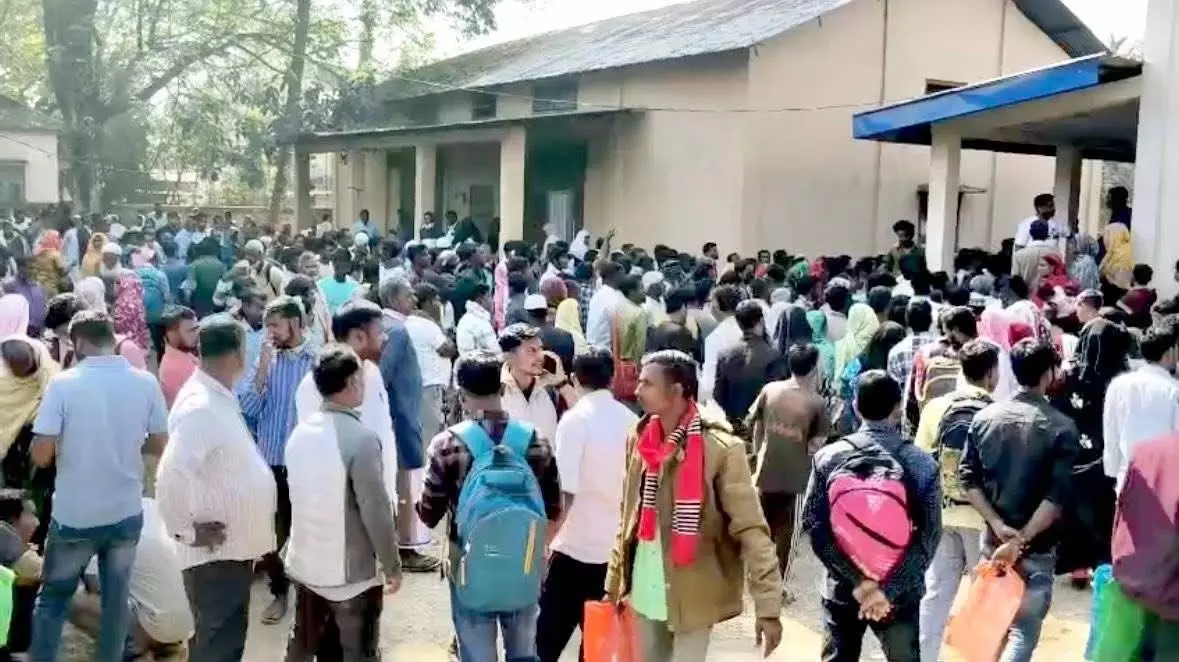
People gather for electoral roll-revision hearings in Majbat in Udalguri district of Assam.
Assam voter roll revision triggers panic among Muslims; freedom fighters' kin not spared
Thousands face hearings after 'fake' complaints seek to delete names from the electoral list, as CM Himanta Sarma says it is his job to make 'Miyas' suffer

At 58, Abdul Rafique had never imagined he would have to spend an entire day at a government office just to prove that he is a genuine voter.
A resident of Deva Pukhuri village under the Majbat Assembly constituency of Assam, Rafique was summoned to appear before the electoral registration officer (ERO), Majbat, in the state’s Udalguri district on Tuesday (January 27).
Waiting entire day to prove his existence
As per the notice that he received, a complaint had been filed seeking the deletion of his name from the voter list. Thereafter, Rafique waited at the circle office from morning to evening, clutching documents that proved his citizenship, hoping to submit them to the official concerned.
Also read: Assam CM defends notices to Bengali-speaking Muslims, says it's a 'pressure tactic'
What made the situation farcical is that the complainant, one Khatu Panika, is unknown to Rafique’s family, and he did not even turn up at the hearing.
Rafique’s ordeal is not an isolated case. Across Assam, particularly in minority-dominated areas, thousands of Muslim families are receiving similar notices under the ongoing special revision (SR) of electoral rolls. Many allege that complaints have been filed either by unknown individuals or by local Bharatiya Janata Party (BJP) workers, triggering widespread anxiety and fear.
In Deva Pukhuri alone, 49 families have been served such notices, according to Ashadul Hoque Choudhury, a local resident. In the nearby village of Bishkuti in Sonitpur district, the number rises to 125 families.
“In most cases, the complainants are either BJP workers or people nobody in the village recognises,” Choudhury told The Federal.
Hearings for thousands
The scale of the exercise is staggering. On January 27, hearings were held for over 2,200 people. The following day (January 28), more than 4,000 citizens crowded circle offices across districts. The hearings are scheduled to continue until February. For many, the uncertainty is unbearable.
Also read: Why Priyanka Gandhi’s Assam role matters for Congress ahead of Assembly elections
“Nobody knows whether their names will remain on the voter list or not,” said one affected resident.
Freedom fighters' families not spared
Even families of freedom fighters have not been spared. In Goalpara district, located on the southern banks of the Brahmaputra River, notices were served to three families of freedom fighters. Among them is Jakiya Bewa, the widow of freedom fighter Aftab Uddin Ahmed, who receives a government pension in recognition of her husband’s role in India’s freedom struggle. The notices were issued not only to her, but also to her sons, daughters and grandchildren — spanning three generations.
On Wednesday (January 29, residents staged a protest outside the district commissioner’s office in Goalpara. Organised by the district committee of the Communist Party of India (Marxist), the protest demanded an end to what they described as the arbitrary deletion of genuine voters’ names.
Ayesha Tabashum, a member of Aftab Uddin’s family, voiced anguish and anger. “We are from a freedom fighter’s family. If even families like ours receive such notices, the government must investigate who is filing these objections and under whose direction,” she said.
“In Goalpara, almost all Assamese Muslim families have received notices. The complainants themselves don’t even know about the complaints.”
Also read: 2026 Assembly polls: BJP’s long march meets its first major test
The controversy has erupted amid the SR of electoral rolls, ordered by the Election Commission (EC) on November 17, 2025. Unlike the Special Intensive Revision (SIR) being conducted in 12 other states and Union Territories, Assam’s SR involved door-to-door verification between November 22 and December 20 — without checking documentary proof. Critics argue this omission has made the objection phase vulnerable to misuse.
Districts such as Udalguri, Darrang, Sribhumi, Barpeta, Goalpara, Sivasagar, Nagaon and Lakhimpur have reported a surge in 'Form 7' objections — meant only for limited corrections such as death or permanent relocation — being used to seek bulk deletions of voters.
'No factual basis'
“There is no factual basis, no individual verification. It’s a blanket exercise,” said Akbar Ansari, a voter from Tangla in Udalgiri district. Others claim the objections were filed en masse, without supporting documents.
Those named have been summoned to appear before the circle offices acting as EROs. While officials insist due process is being followed, observers question whether fair hearings are possible, given the February 2 deadline to dispose of all claims.
Also read: I am a victim of rift between Rahul and Priyanka: Assam CM Himanta
Procedural lapses have also surfaced. In Sribhumi district in southern Assam bordering Bangladesh, booth-level officer Sumona Rahman Choudhury revealed that she was handed objection forms against 133 voters from her booth — every one of them Muslim. All objections were filed by a single person, alleging that the voters had either shifted their permanent residence or were enrolled twice.
“I personally verified them during house-to-house enumeration,” Choudhury told the media. “They are genuine voters. Some are parents of my students. One is my school’s headmaster.”
More disturbingly, the complainant, whose name appeared on the notice, said he did not make such a move. “When I called him, he denied filing any objections,” she added.
There are also instances where the complainant is known to those who are receiving the notices but when asked, they say that they would never bring such complaints against their own.
Civil society groups, minority organisations and opposition parties say the SR has become a tool of intimidation. They allege selective targeting of Bengali-speaking Muslims, though indigenous Assamese-speaking and Hindi-speaking Muslim families have also been affected.
My job to make them suffer: CM Sarma
Tensions escalated further after Assam Chief Minister Himanta Biswa Sarma, on January 27, claimed that four to five lakh voters identified as “Miya” would be removed from the rolls and declared it was his “job to make them suffer”.
Also read: Assam polls: Congress plans grassroots mobilisation to strengthen support
The remarks drew sharp criticism from rights groups and the Opposition, who questioned their impact on electoral fairness and minority rights.
Advocate Shajid Khan of the Gauhati High Court warned that filing false objections under 'Form 7 is' a punishable offence under the Representation of the People Act, 1950.
“But prosecution can only begin if EROs act. Citizens must file complaints,” he said, adding that the controversy has raised serious questions about the credibility of the EC ahead of the Assam Assembly elections due in a few months.
'Grave threat to democracy'
Minority student leader Taison Hussain, president of the All BTC Minority Students Union, called the situation “a grave threat to democracy”.
“This is a conspiracy to erase Muslim voters from the electoral rolls. Authorities must reject these fake objections and take action against those filing them,” he said.
For Abdul Rafique and thousands like him, the fight is deeply personal. It is no longer just about a name on a voter list — it is about dignity, belonging, and the right to be recognised as citizens in the land their families have called home for generations.