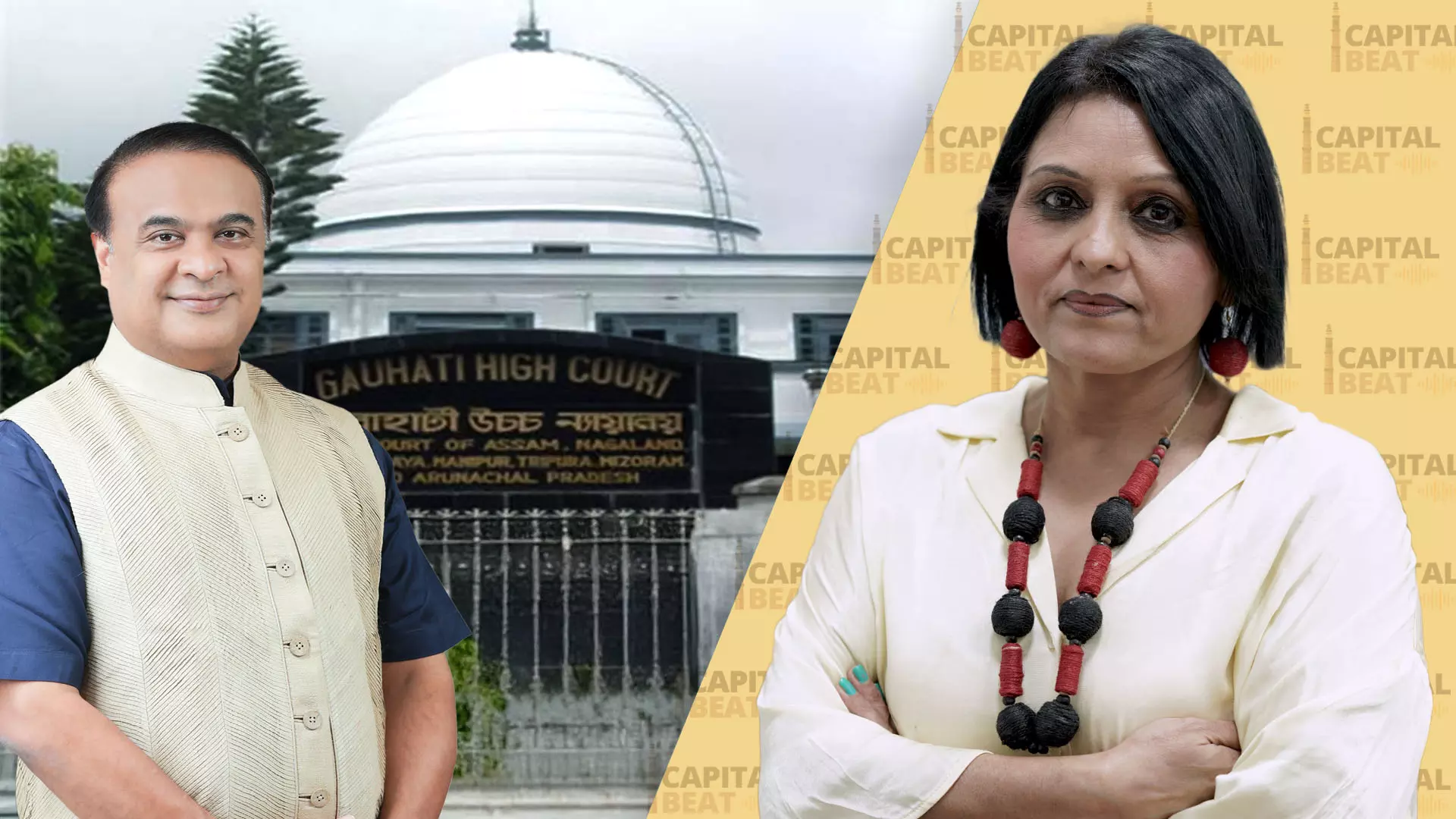
Did Assam CM cross Constitutional limits by openly targeting ‘Miya Muslims’ amid SR?
Bulk objections without individual verification appear to be a structural risk to electoral integrity rather than isolated administrative lapse, say panellists

This Capital Beat episode brought together Supreme Court lawyer Sanjay Hegde, The Federal’s Senior Editor Samir K Purkayastha, and senior advocate of Gauhati High Court, Hafiz Rashid Ahmed Choudhury, to examine controversial public remarks made by Assam Chief Minister Himanta Biswa Sarma and their implications for constitutional governance and electoral processes in the state.
The discussion focused on statements attributed to the chief minister encouraging BJP workers to file bulk Form 7 objections during the Special Revision (SR) of electoral rolls, alongside remarks explicitly targeting “Miya Muslims,” a term commonly used to describe Bengali-speaking Muslims in Assam.
Panellists assessed whether these remarks, placed on record by a sitting chief minister, crossed Constitutional limits, undermined electoral neutrality, and legitimised the use of administrative machinery to pressure a particular community during an election cycle.
Remarks on record and electoral process concerns
Form 7 is a statutory mechanism used to object to the inclusion of names in electoral rolls. The SR process is currently underway in Assam. During the discussion, references were made to allegations that Form 7 objections were being filed in bulk without adequate justification, a matter already before the Gauhati High Court through a public interest litigation.
Sanjay Hegde stated that the remarks attributed to the chief minister go beyond routine political rhetoric and raise concerns about institutional failure. “If your constitutional authorities, your Election Commission do not work or are seen as being ineffective, this is what will obviously happen,” he said.
He added that the statements draw distinctions between communities and undermine constitutional obligations. “What he has done is to spread hatred between communities. He has tried to undermine the election structure itself,” Hegde said.
Constitutional duties and institutional accountability
Referring to constitutional guarantees, Hegde cited Articles 14, 15, and 21 as relevant safeguards that prohibit discrimination and protect individual dignity. He noted that constitutional office-holders are bound by oath to uphold these principles.
“Sometimes it is courts which have to step up to the plate and do their constitutional duty,” Hegde said, while also stating that judicial intervention depends on institutional willingness to act.
He expressed concern about precedents being set through the normalisation of bulk objections. “Today there is one government in office and one set of election commissioners. Tomorrow there may be another set… Who can play at that game?” he said.
Form 7 objections and procedural safeguards
Hegde emphasised the need for clear procedural safeguards in the use of Form 7. “You should not be able to delete any name unless the person whose name is sought to be deleted you have proof that the person has been served a notice,” he said.
He also argued for emergency remedies. “If any name gets deleted there must be an emergency procedure to reinstate the name in case the person turns up even on voting day,” he said.
The discussion framed bulk objections without individual verification as a structural risk to electoral integrity rather than an isolated administrative lapse.
Community targeting and constitutional protections
Hegde characterised the implications of the chief minister’s remarks as severe. “What you are essentially doing is checking him out of the benefits of being a citizen of India,” he said, linking electoral deletion to broader civic exclusion.
He pointed to the Constitutional right to free movement and residence. “Every person has the right to move freely within the territory of India and to settle anywhere that he wants. This is totally unconstitutional,” Hegde said.
He also cautioned government officials against compliance with unlawful directions. “Any officers who obey or act on these illegal or extra-constitutional orders better get those orders in writing,” he said.
Civil society response and legal pathways
Hafiz Rashid Ahmed Choudhury, senior advocate of the Gauhati High Court, described the remarks as part of a pattern of communal division. “He is referring only to Muslims,” Choudhury said, rejecting distinctions between Assamese-speaking and Bengali-speaking Muslims.
He cited Supreme Court directions on hate speech enforcement. “The Supreme Court recently stated… if somebody is making hate speech then immediate action should be taken and FIRs should be registered,” he said.
Choudhury raised concerns about administrative conduct during the revision process. “People are asked to come at a fixed time. No officer comes. No receipt is given. This is simply harassment,” he said.
Electoral law and enforcement limits
Choudhury outlined constraints under the Representation of the People Act, 1950. “If somebody files a false complaint or declaration, proceedings can be initiated,” he said, while noting that action against officials requires directions from the Election Commission.
He alleged that objections were being processed without verifiable complainants. “X’s name is used. X does not exist. Still action is taken,” he said.
Referring to citizenship determinations, he said, “Indian Muslims are also being evicted in the name of illegal migrants. That is the reality on the ground.”
Political context and governance record
Samir K Purkayastha located the controversy within Assam’s broader political landscape. “Earlier also we had BJP governments in Assam, but it was not so polarised,” he said, referring to the tenure of former Chief Minister Sarbananda Sonowal.
He pointed to governance indicators raised during the discussion. “Look at the unemployment rate, look at the debt to GDP ratio,” Purkayastha said, stating that development failures have sharpened political polarisation.
He also referred to internal party dynamics. “Senior BJP leader and former state president Rajen Gohain left the party,” he said, citing discontent within the ruling party.
Electoral mobilisation and polarisation
Purkayastha argued that polarisation has become a unifying mechanism within the ruling party. “When it is Hindu-Muslim, then all BJP leaders, irrespective of their political differences, fall in line,” he said.
He addressed perceptions surrounding the term “Miya”. “These people are not even migrants. They are indigenous inhabitants of those areas,” he said, referencing historical administrative boundaries.
On political resistance, he said, “Unless courts intervene, I don’t see any kind of relief coming to the voters affected by Form 7 objections.”
Judicial intervention and institutional trust
Choudhury stated that faith in institutions has narrowed. “We have faith only in the judiciary at this stage,” he said, adding that public unrest is a risk if grievances remain unaddressed.
Purkayastha noted that Assam’s Leader of the Opposition, Debabrata Saikia, has written to the Chief Justice of India seeking suo-motu cognisance of alleged irregularities.
The discussion concluded without a resolution, centring attention on pending judicial scrutiny in the Gauhati High Court and the possibility of a Supreme Court intervention.
(The content above has been transcribed from video using a fine-tuned AI model. To ensure accuracy, quality, and editorial integrity, we employ a Human-In-The-Loop (HITL) process. While AI assists in creating the initial draft, our experienced editorial team carefully reviews, edits, and refines the content before publication. At The Federal, we combine the efficiency of AI with the expertise of human editors to deliver reliable and insightful journalism.)